


Ag Impact Still Huge in Fayette
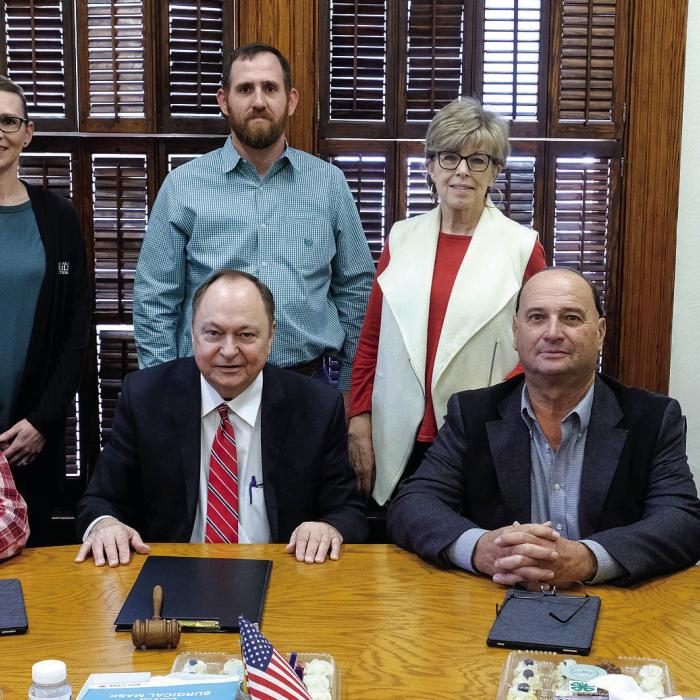
Fayette County AgriLife Extension Office gave an annual update to the Fayette County Commissioners Court on Thursday, Jan. 26. Agents Sally Garrett, Kayla Kaspar and Scott Willey gave reports on their activities throughout the year.
Willey reported on the state of the agriculture economy in Fayette County. In 2021, Willey said, gross receipts for ag producers in Fayette County totaled $98.5 million. Willey provided figures fromAgriLife economics specialist Dan Hanselka which estimated a total economic output of more than $146 million annually. That number includes gross ag receipts along with indirect effects of the ag economy such as wages paid to employees that then circulate in the local economy.
“It shows that agriculture is still an important heartbeat of this community,” Willey said. “That’s equivalent to about 3,100 full- and part-time jobs.”
Beef cattle production remains the largest component of Fayette County’s agriculture economy, with gross receipts of $57.2 million annually and economic output of $83.6 million. Willey said the National Agricultural Statistic Service counted approximately 54,500 head of beef cows in Fayette County. He said that number is up 2,500 head from the previous two years but still down from a decade ago. As recently as 2007-2008, Fayette County ranked 3rd in the State with 75,000 head of beef cows.
The nursery sector is the second-largest component of the ag economy in Fayette County, with $15 million in gross receipts and an estimated economic output of a little over $22 million. Hay production came in third, with nearly $9.9 million in gross receipts and economic output of $16.5 million.
Other major components of the local ag economy include egg production with $8.5 million in gross receipts and feed corn with $3.6 million in gross receipts.
Other crops besides corn and hay, such as cotton, grain sorghum and pecans, brought in just $266,500.
Kaspar leads the Extension Office’s youth programs including Fayette County 4-H. Kaspar said there are 342 4-H members across the County.
“How does that compare to, say, 19 years ago?” asked County Judge Dan Mueller. “Are we getting more or less?”
“For a while it was real steady,” Kaspar said. “But since COVID we’re getting 10 or 20 new members every year since. I think parents are seeing the importance of getting kids involved in anything. And with 4-H, it’s not just about showing animals.”
Kaspar said that since 2008, Fayette County 4-H members have received $428,000 from Texas 4-H Opportunity Scholarships.
In addition, Kaspar said most fifth grade students in the County, with the exception of those from Flatonia ISD, participated in Ag Safety Day at the Fairgrounds in May. Kaspar said she had spoken with officials from Flatonia ISD and was hopeful they would participate this year.
“We teach kids safety on and off the farm, how to handle guns, what happens if you’re in a situation where you need to give first aid, and alcohol awareness people also come in,” Kaspar said.
Also at the meeting, Garrett reported that the annual child seat safety checks that the Extension Office used to help organize have been put on hold. Texas A&M AgriLife used to send a team of child seat safety experts to La Grange each year for an annual safety check event, usually held in the Walmart parking lot. Families could drive through for a free safety check. If the inspectors deemed any child seat unsafe, AgriLife would replace it with a free new seat on the spot.
“I’ve been told that we’re not a County in need,” Garrett said.
“I think that was a good service,” said Pct. 1 Commissioner Jason McBroom.
“We’re still a distribution center for distributing seats,” Garrett said. “Jennifer (Boening) and I still do individual educational programs and we’re distributing seats. We’re not going to lose that at this point.”
Garrett said she plans to contact other agencies about bringing back the child seat safety check day.