


1925—Fayette County Happenings One Hundred Years Ago, Part 3
This is Part III of a series looking back into happenings a century ago in Fayette County and centered predominately on the severe drought that struck the state of Texas in 1925. Drought seems to be a subject that the citizens of our county know very well. Now, let us examine how our ancestors dealt with this situation.
The dry spell, according to reports in the La Grange Journal
from that time period, actually started in the summer of 1924. The year of 1924 ended with a severe cold weather event. The La Grange Journal reporter in the Winchester area described the night of December 19 in this manner. “Friday morning and Friday night the mighty gale continued and upon arising Saturday the people…were very much surprised…to find the ground covered with sleet.” This weather incident left the agriculture based families of the county with a difficult start to the new year. Weather records kept concerning this storm tell of thousands of head of cattle killed on the coastal prairies by the extreme sudden drop in the temperature and the fact that they were left without any type of windbreak.
In the February 26 issue of the Journal, the Ellinger reporter stated “the [weather] has passed the joke stage, the family vegetable gardens are demanding moisture as well as the farm lands. We have been suffering for moisture.”
In April, the Journal editor commented that the “drought condition prevailing at this time may have a tendency to create the feeling of unrest, that seems to be shown so much here of late. When the farmer fails to make a good crop and get returns for what he has grown, the business man…will feel that loss.”
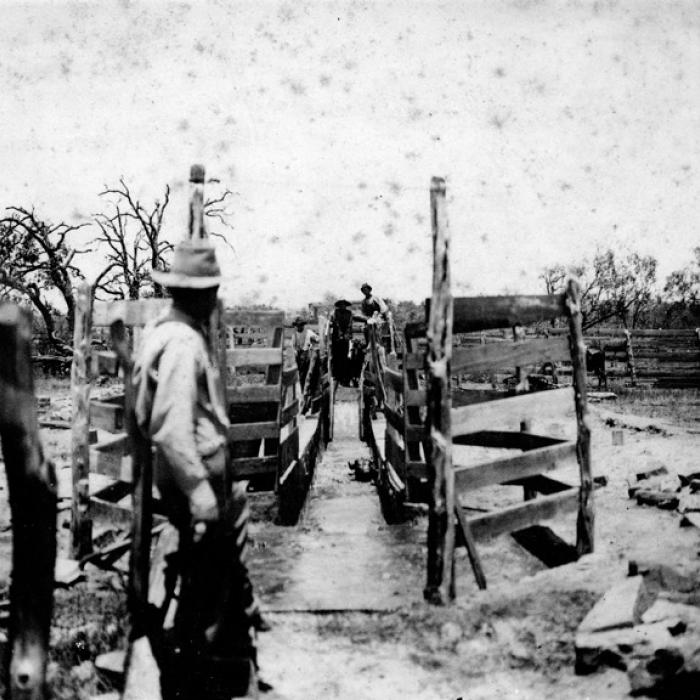
By April 30, the Journal shared the news that the Livestock Sanitary Commission in Austin had to suspend the tick eradication program in Texas due to the poor condition of the cattle and the strain on them. Since 1922, the cattle in Fayette County were required to be frequently dipped in one of the county concrete dipping vats to eradicate ticks which effected the health of the cattle. To put this in perspective, during this time period the cattle were not trucked to the dipping vats, but had to walk the distance to these facilities. In many cases, this could be several miles. And once there, they had to be forced into the dipping vat, then swim themselves out of the vat, and after that ordeal, they were forced to walk back to their home pastures.
Furthermore, the same issue of the La Grange Journal was informing the public that hay was being shipped to La Grange via the railroad. The farm families were being forced to bring their wagons into town to receive the hay for their horses and cattle.
By August, the citizens in the Schulenburg area reported that “we need water very badly…lots of people are getting short of water, some have to haul water and everything is suffering.” It must be remembered that at this time in the county, most of the water wells were shallow hand-dug wells, as the deep water wells and the electric water pumps (as well as home electricity) had not as yet arrived for the general public. Also, it was reported that the Fayette County Farm Bureau had ordered four railroad cars of Oklahoma prairie hay, and one car of Missouri ear corn for the public.
Many years ago, the writer of this article personally heard many stories concerning this unprecedented drought, told by those who had lived through it. Stories of water wells going dry, corn and various other crops ruined, and cattle being walked each day for miles to get water from the Colorado River or from the remnants of spring fed waterholes in the creeks of the county. The suffering affected the livestock, the crops, as well as the public in counties all over the state of Texas.
One elderly citizen told of how the drought finally came to an end. She stated that “in the fall of the year, the rains finally came back.” The October 22 issue of the Journal reported that near Schulenburg “all the creeks were out of their banks…[and] several bridges were washed away.” The Winchester reporter stated that “the rainfall of Monday, Tuesday, and Thursday amounted to sixteen and a half inches.” More details included the fact that there was a bad electrical storm, the Southern Pacific Railroad tracks were washed out, and that “all the creeks were overflowed, … badly washing the land, and carrying many miles of wire fencing in its mad rush.”
With this, the severe drought of 1925 came to an end. The resilience and determination of the people of Fayette County as well as the state of Texas were on full display. There have been many catastrophic events that took place before this and many since then, be it drought, flooding, fire, etc., but the tenacity and toughness of the people seems to always come out in times of trials and tribulation.
Footprints Of Fayette
Fayette County is one of the most historic counties in Texas. In this weekly feature from the County Historical Commission, a rotating group of writers looks back at local history.