

Soil Microbes: Capitalists of Dirt

Exciting news, folks: we’re working on a “2022 Year in the Garden” calendar that we plan to publish later this month. It isn’t any old plain calendar, though. Each month will feature one of my columns from the past year along with tips for the garden for that month.
It will also include an article about soil microbiology featuring Mike Serant, president and owner of San Jacinto Environmental Supplies, the company that manufactures Microlife organic products. Not many people in Texas know more about soil microbes than Serant.
I interviewed Serant this Tuesday. You’ll have to wait until the calendar comes out to see the final story. I’d like to share a sneak peak with you, though.
“How would you like to have a workforce that always shows up, never is absent or calls in sick, never asks for a pay raise and does a tremendous amount of work for you 24/7?” Serant asked. “You’ve got that. It’s the soil microbes.”
Soil microbes include bacteria, fungi, protozoa, nematodes and a variety of other microscopic critters that live in a symbiotic relationship with plants.
“Planetary life started 3.7 billion years ago, and with that you have the relationship between the microbes and plants, and the relationship between plants and humans beginning a few million years ago,” Serant said. “Whether you’re a creationist or evolutionist, you see that all these things have been working together for eons, and the systems work fantastically well. So why don’t we try to emulate those systems instead of trying to tell those systems what to do?”
Plants release anywhere from 50 to 80 percent of the nutrition they make from photosynthesis into the soil as root exudates – carbon, sugars, carbohydrates. These root exudates get deposited in the tiny space between the root hairs and soil particles. The exudates attract beneficial microbes.
Serant compared the microbe-plant relationship to a market economy:
“There is no free ride,” Serant said. “The plant says, ‘I will feed you guys and I want you next to me. In return, you have to do things for me.’ Microbes build bigger root systems, defend against plant disease, secure minerals the plant needs, give it protein. This is natural law.”
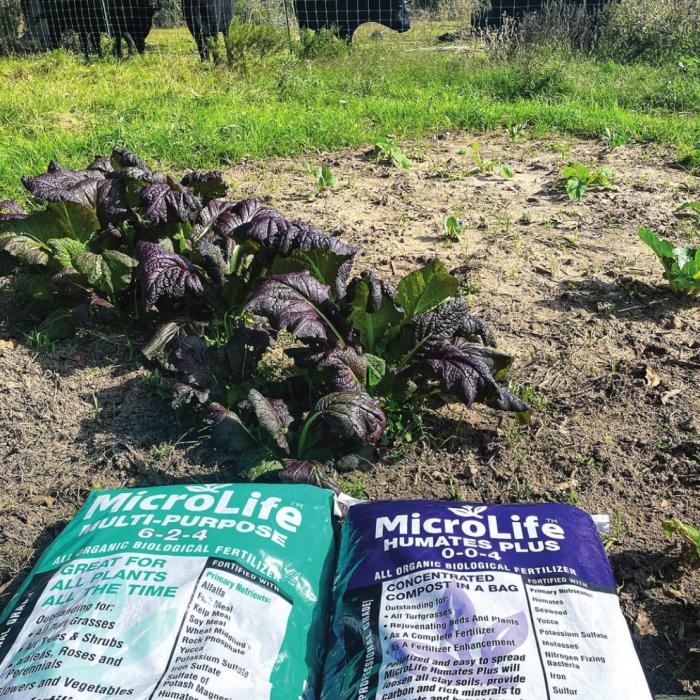
After work that day, I picked up a couple of Serant’s products at Sutherlands in La Grange: Microlife Humates Plus and Microlife 6-2-4 Multipurpose Fertilizer.
Serant describes the Humates Plus product as “concentrated compost in a bag.”
“I’m very familiar with the soils in Fayette County, and all soils can use good organic matter,” he said. “Let’s say you want to apply compost to your 4,000 sq. ft. lawn. You probably want to put out a ¼ inch of compost. You’ll need about four cubic yards. That’s about 6,000 lbs. Let’s say that good compost will cost you $60 a yard delivered. That’s $240, and you’re going to need a lot of manpower. Or you can go to Sutherlands and buy a 40 lb. bag of Microlife Humates Plus for about $40, and it’s a lot easier to put out.”
He recommends applying Humates Plus once a year in gardens, beds and lawns.
Plants need fertilizer. Many long-time gardeners swear by conventional triple 13 fertilizer, which contains equal parts nitrogen (N), phosphorus (P) and potassium (K). But that only provides three nutrients. Microlife 6-2-4 Multipurpose Fertilizer is a granular material and comes in green packaging. Despite the three numbers on the label, the product contains more than 100 different organic nutrients.
Earlier this year I started a new bed for my winter garden. My soil is pretty sandy, and it needs a bunch of compost. I’m excited to see what the Humates Plus product does to the bed.