

The Environment Around the Bluff
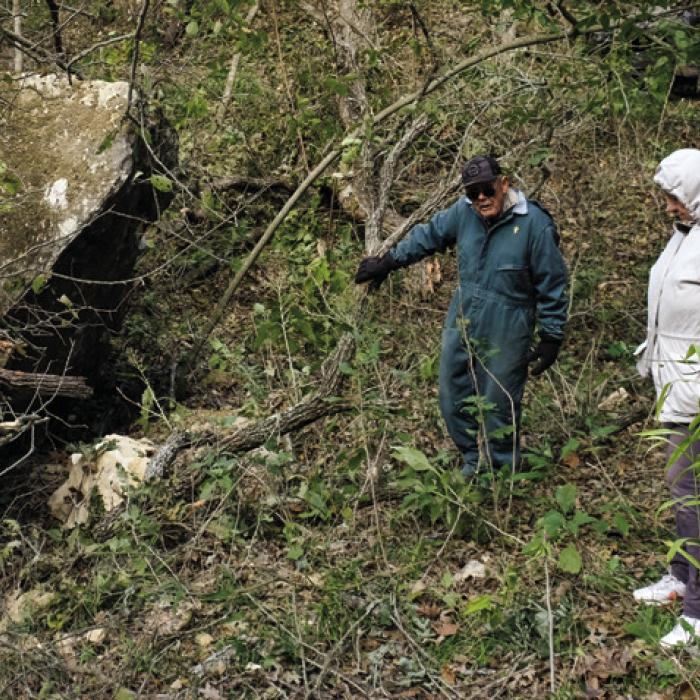

The front page of today’s paper tells the story of the massive rockfall that took place Friday morning on the limestone Bluff south of the Colorado River from La Grange. The event jogged some memories of a few other historic “rock falls” on the Bluff.
Larry Adamcik came into our office Wednesday morning and recalled the time when the State of Texas built the park that would become Monument Hill and Kreische Brewery State Historical Sites. At that time, the State wanted to plant some trees on the property, he said. But the thin soil covering the limestone on the Bluff wasn’t exactly ideal. So the landscapers used dynamite to blast holes in the rock. He said you could hear the explosions and see rock flying in the air all the way from town. I guess that’s one way to plant trees.
Perhaps the most tragic “rock fall” happened in 1882. Heinrich Kreische was a master mason and brewer who lived on the Bluff. He supplied the stone that built many of the town’s buildings, including several that still stand today. And he brewed the famous “Bluff Beer’’ that gladdened hearts of La Grange’s hardworking early settlers. Kreische died in an accident in 1882 from a fall off his wagon while transporting a load of stone from his property on the steep limestone inclines.
After I heard about the rockfall last week, I called Dr. James Tiemann. He owns the property below Monument Hill where the rocks fell. Dr. Tiemann graciously invited me to join him and his wife on a tour of their property. It was one of the highlights of my life.
Now, before I go any further, Mrs. Nita Tiemann asked me to let everyone know that their land is not open to the public. Do not go snooping around.
“We’re locked and loaded,” she told me, a point driven home by the rifle that leaned on the seat between Dr. Tiemann and myself as we rode around their valley floor Monday morning.
I’ve never seen such an ecosystem anywhere else in Fayette County. Burr oaks, pecans and cedars grow unbelievably tall down there.
“They have to, to reach the light,” Dr. Tiemann said.
The tall limestone cliff shades the valley on one side. The topsoil is quite thin, and roots can’t really anchor the trees well. Storms and strong winds frequently topple these trees. I suppose the combination of decomposing trees and weathered rock from the Bluff over the eons has created a unique type of soil. An unbelievable diversity of plant life springs from this valley floor, especially among the understory plants – ferns, honeysuckle, beautyberry, soapberry, palmetto, and wild tobacco.
What amazed me the most were all the Ohio buckeye trees. You can occasionally find the smaller native Mexican buckeye trees growing in Fayette County. But in the Tiemanns’ valley, Ohio buckeyes grow everywhere. Mrs. Tiemann said these buckeyes produce a beautiful flower earlier in the year. By now, most of these trees have shed their leaves and most of their fruits. But we found a few of the huge Ohio buckeye nuts still hanging from the branches. Dr. Tiemann said they sprout quite easily. Sometimes, he said, they’ll begin to sprout while still hanging from the tree.
How did they get here? Dr. Tiemann said he has no idea. The tip of the Ohio buckeye’s southern range lies more than a hundred miles north of here. His best guess was that an early settler may have brought some buckeye nuts from Ohio and planted them in the area. They’ve certainly naturalized on their property.
They also showed me the steep cart path that Heinrich Kreische carved into the Bluff to transport his beer and stone into town, and the spot where a ferry crossed the River. It was like walking back in time.
I’m so thankful to the Tiemanns for showing me around. I hope their family keeps this property preserved well into the future.