

Aiming for the Stars
In other areas parents can tell their kids ‘the sky’s the limit.’
That’s not aiming high enough in Fayette County.
Thanks to former La Grange High School student William A. Anders, kids here – and all of us really – have reason to shoot for the moon and beyond.
Anders, who was still flying planes at the age of 90, died June 7 in a solo private plane crash in Washington. Hopefully you saw our story then recounting his amazing legacy.
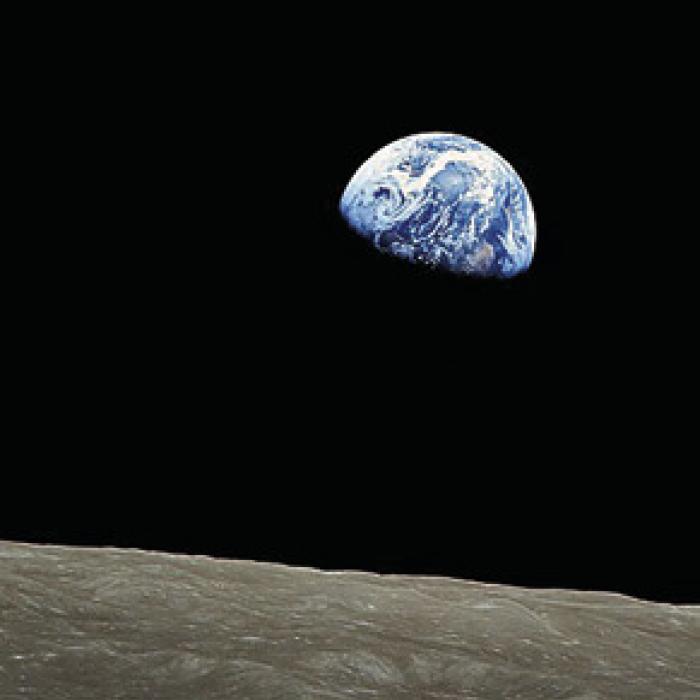
He was an Apollo 8 astronaut and took the first ever colored photo of Earth from space.
He is, in my opinion, the most important Fayette County resident ever.
And his story deserves additional retelling, not just for its amazing historical significance, but because of it’s inspirational power.
William was the son of Tex and Alison Anders, and he moved to La Grange in 1946 as an 8th grader after his father’s retirement from the military. His dad and uncle bought the Hermes Drug Store on the courthouse square and operated it as a partnership.
They stayed here for four years through William’s junior year in high school.
But those were formative years for him. According to a story by Carolyn Heinsohn about William, “he always remembered his academic training in La Grange, having written his uncle several times about how he valued his schooling here and especially singled out Superintendent Charles A. Lemmons for his counsel and guidance.”
After his family moved to California, William embarked upon a distinguished Air Force career that eventually led to his selection into the Apollo space program.
His role on the Apollo 8 mission is credited with laying the foundation for the Apollo moon landing seven months later.
But his enduring legacy was that photo of Earth, which allowed people for the first time ever to see that little blue planet hanging there in the void of space.
An Associated press story about William’s death described it this way: “The photograph, the first color image of Earth from space, is one of the most important photos in modern history for the way it changed how humans viewed the planet. The photo is credited with sparking the global environmental movement for showing how delicate and isolated Earth appeared from space.” On the 50th anniversary of William’s taking of the photo, the magazine “The Guardian” did an extensive piece on the picture called “Earthrise at 50: the photo that changed how we see ourselves.”
Here’s an excerpt: “To see the Earth as it truly is, small and blue and beautiful in that eternal silence where it floats, is to see ourselves as riders on the Earth together, brothers on that bright loveliness in the eternal cold – brothers who know now they are truly brothers.”
Suddenly Earth no longer seemed the center of the universe, poet Archibald MacLeish wrote. Logically of course many people had long known this, but Anders’ photograph had a way of confirming it. Writers and dreamers and scientists would return to that feeling of celestial displacement often over the years. In a 1983 short story Human Moments in World War III, Don DeLillo places a character in Anders’viewpoint.
“The view is endlessly fulfilling,” he wrote. “It is like the answer to a lifetime of questions and vague cravings.”
After the mission was complete the photo would go on to grace the final issue of Time Magazine of the year, with the caption: “Dawn.”
Broadcasting home, the Apollo 8 crew read from the Book of Genesis as the Earth rose before them, contrasted against the lifeless moon.
“In the beginning God created the heaven and the Earth,” Anders said.
For the astronauts, and the rest of us back on Earth, it was as if something new had been born and we could all perceive it for the first time together. We saw ourselves.”
On April 19, 1969, La Grange held a “Bill Anders Day.” Anders and his family attended the event, which included a parade, reception, barbecue and a program of film and slides on his space flight.
Often when I hear Mike Anders’voice on KVLG I think about the amazing legacy of his cousin.
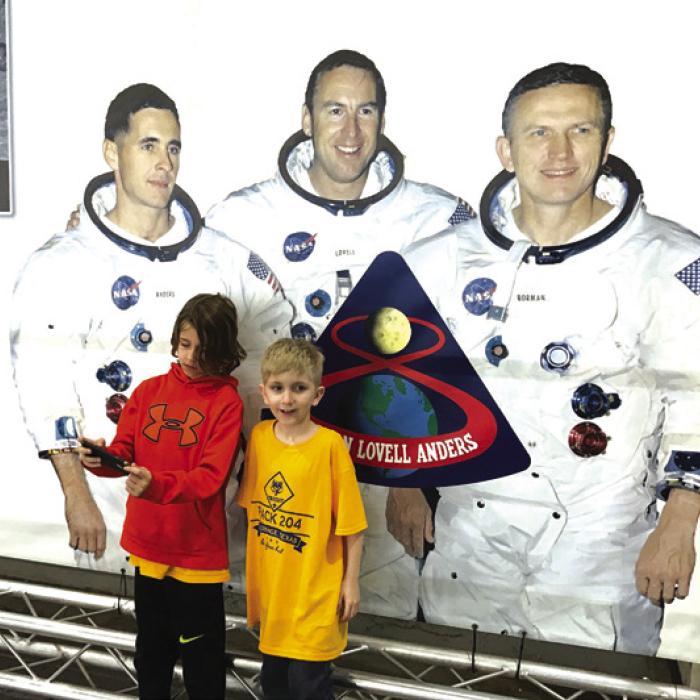
I chaperoned a Boy Scout trip with our son’s troop years ago and we got to spend the night in NASA. We were taking a tour the next day and I saw this big mural with a photo of the Apollo 8 crew on the wall. I proudly told the kids ‘that guy up there was from La Grange.’