


When Fayette Had the Most Schools in Texas
Footprints
-
 When Fayette Had the Most Schools in Texas
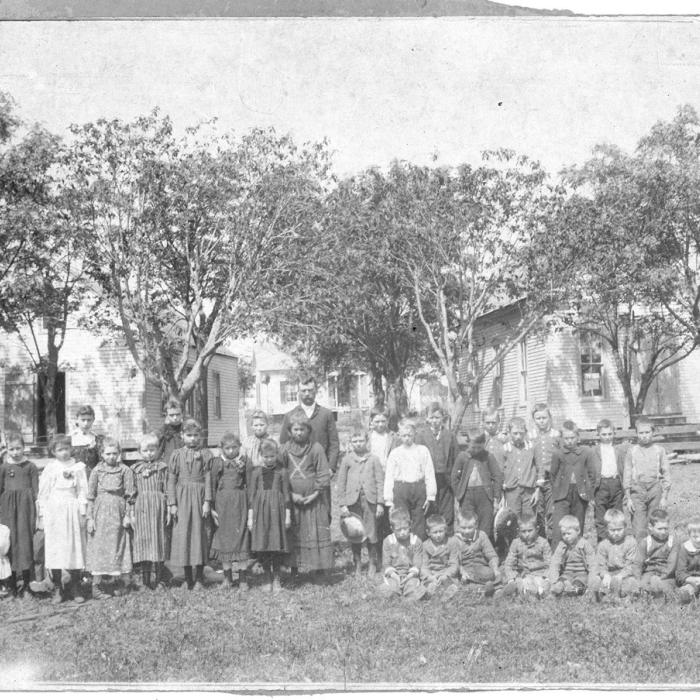
Fayette County has a long history of making education a priority for its children. Just as public schools are a political controversy today, so they were 150 years ago. But that didn’t stop Fayette County from establishing and supporting them.
As Texas emerged from the Civil War’s devastation, education was seen as a way up. The Reconstruction legislature in 1871 authorized spending state money to provide local public schools. Not surprisingly, many opposed the high state taxes required to fund the schools, opposed having state commissioners to accredit the schools, and opposed loss of parental authority resulting from compulsory school attendance. But Fayette County took full advantage of the state’s offer. In May 1872, Fayette County had 50 accredited schools – more than any other county in the state.* With 62 teachers in its public schools, Fayette was tied with Lamar County for the most teachers. In fact, Grayson and Lamar counties (along the Red River in the rich agricultural farmland of North Texas) and Fayette (attracting many immigrants to its own fertile fields) were the top three counties in Texas for public education.
Fayette County had more schools, more teachers and more students than Dallas County, Harris County or Travis County in 1872.
Of course that shouldn’t be too surprising. In 1870, Fayette had more people than Dallas County – or almost any other county in the state.
The 1870 Census found Washington County to have the biggest population in Texas, with 23,104 residents. Harris County ranked second, with 17,375. Rusk was third at 16,916 and Fayette was fourth, with 16,863. Texas at the time had only a few “big cities,” and even they were tiny by modern standards. Galveston was the biggest, at 13,818, La Grange, by comparison, was only 1,165. But all the farm families spread across the county resulted in a total population of 16,863 compared to Galveston County’s total of 15,290.
Germans first became numerous in Fayette County in the 1840s (followed by Czechs in the 1850s). These European arrivals may have valued education more highly than the frontiersmen who came mostly from the southern U.S. New Braunfels, an early German settlement, was the first town in Texas to vote in a tax to support a “free” school. That happened in 1858.** Most of Texas, however, left education to families and to churches. When the post-Civil War legislature created a tax-supported public school system, many opposed it.
“Thousands of poor children now in the State, and the children of thousands of immigrants coming every year to Texas, will depend exclusively upon free schools for their education,” an article in the 1873 Texas Almanac opined. “Nothing will tend more to encourage immigration, and in general to build up our State, than a good system of free public schools.”
Another writer, however, noted that “It should be borne in mind that private schools still exist in most neighborhoods all over the State, and especially in our towns, though in some cases they have been superceded by the recently established public schools. These public schools have, however, objectionable features, rendering them unpopular with many of our people.”
Chief among those “objectionable features” might have been the requirement that public schools accept both Black and White pupils (although they could be segregated). During Reconstruction, Republicans dominated the state legislature, enforcing post-slavery freedoms for Blacks. Democrats would regain control only a few years later, reversing many of the Reconstruction policies, including free public schools.
Despite the political controversy, public school spending meant much to cash-strapped Fayette’s economy in the early 1870s. Like all parts of the south, the Civil War left rural Texas deeply impoverished.
According to data published in the Texas Almanac for 1873, the state of Texas spent $3,568.40 a month on Fayette County schools. Only Grayson County, which had a few more students than Fayette, got more state funding.
Statewide, public schooling cost Texas $120,536 a month. That was to teach a total of 84,007 pupils, or a cost of $1.43 per pupil for a month of education. Probably not a bad deal at all.
* The Texas Almanac for 1873 and Emigrant’s Guide to Texas, pp 22-25.
** Online Handbook of Texas, “Education.”