


Think About Garden Pairings
-
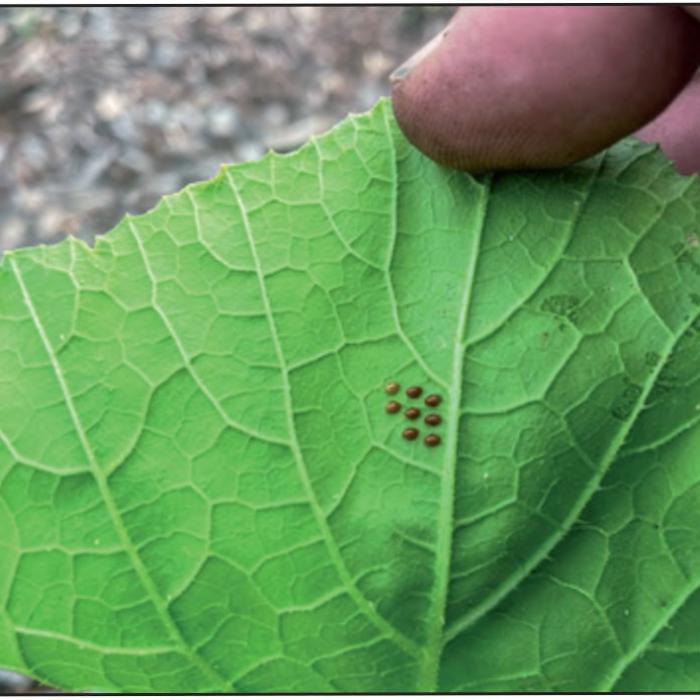 This week I noticed what appear to be squash vine borer eggs on some of my zucchini leaves. I checked all the leaves and squished all the eggs I could find.
 -
 I grew a bunch of basil from seed in the plug tray pictured above. I planted the basil between my tomato plants this week.
As I mentioned last week, I primarily grow indeterminate tomatoes. These varieties grow into long vines and produce throughout the season. Determinate varieties, on the other hand, produce most, if not all, of their fruit at one time. They grow in a more compact size and do well in pots.
Indeterminate varieties need to be pruned. I try to prevent disease as much as possible. The best way, I think, is to prune any stems or leaves that touch the soil. Many diseases and fungal problems come from soil touching the tender, new growth. As the plants grow, I trim away everything except the main stem to about 18 inches above the soil level.
I also snip away all the suckers - new stems that form at the base of each leaf cluster.
This serves several purposes.
First, it directs all of the plant’s energy into the main stem. The flower clusters that form along the main stem will fill out and produce heavier fruit. Flower clusters that grow from suckers never seem to fill out with fruit, and the fruits are smaller.
Additionally, snipping the suckers opens up the plant and improves airflow. This can cut down on disease and fungal problems. It can also help you better manage pests such as the tomato homworm, since they are hard to see in dense foliage.
Removing the suckers also allows you to train the plant into a desired shape. You can train the main stem to grow up a pole or horizontally along a trellis. Once it reaches the desired height or length, snip away the terminal bud. The plant will stop growing longer or taller. It will continue to grow flower clusters along the length of the stem until freezing weather kills the plant at the end of the season.
I always try to increase plant diversity in my garden.
Monocultures - growing only one crop in a given area - encourages pests and diseases specific to that crop. Instead, I think its a good idea to plant multiple species around each other. Certain plants can benefit their neighbors.
Basil is one of the most popular companion plants for tomatoes. For one, they pair well together in the kitchen.
Basil does not compete very much with tomatoes for space or nutrients. More importantly, their strong scent can help deter some pests.
Onions, chives and garlic also work well with tomatoes in the garden. Their strong scent deters a host of pests, especially aphids. Their flowers can also attract beneficial insects to the garden.
Marigolds are one of the most popular companion plants for tomatoes. They attract beneficial insects that prey on many garden pests. Plus, they are beautiful.
Thyme, another stronglyscented herb, also compliments basil in the garden. Its low-growing habit shades the ground and keeps weeds from sprouting.
This year I am growing borage throughout my garden and around my tomato plants as well. I love the blueish-purple flowers this herb produces. It attracts a ton of bees to the garden. Borage tastes a little like cucumbers. I like to add a few leaves to cold water or tea for a refreshing summertime drink. The herb should be consumed sparingly, though, since it contains low levels of a toxic compound.
Borage is in the same botanical family as comfrey, and they share some characteristics. Comfrey, sometimes known as “compost plant,” decomposes very quickly. You can make a nutrient-rich compost tea with it by allowing a few leaves to rot in a bucket of water. I’m going to try doing the same thing with borage. In other news from my garden, I noticed a small adult squash vine borer buzzing around my zucchini plants this week. So I checked the leaves, and sure enough, I found several colonies of what appear to be vine borer eggs. This pest can wipe out your squash crops. The adult lays eggs on the underside of squash leaves. These hatch into larvae which crawl down the leaves and bore into the hollow stems of squash plants. They eat the stems from the inside, eventually killing your plant. Since the larvae lives inside the stem, you cannot kill it with any type of spray.
The best way to deal with the vine borer is to plant varieties resistant to it, such as “Tatume,” which does not have a hollow stem.
The second best way to deal with them is to inspect the leaves and remove all eggs you can find. Squish them between your fingers to kill them. I spent much of the evening this Tuesday hunting and destroying the eggs on my squash plants.
The third best way to deal with them is to inject the stems with the organic pesticide Bacillus thuringiensis, known as Bt. Dilute the Bt with water according to the manufacture’s instructions. Then use a syringe to inject the solution into the hollow stems. Bt is a bacteria that sickens and eventually kills larvae of many garden pests, mostly catterpillars. But it also works on the vine borer, so long as you get it inside the hollow stem.