


The Story of Dawson Massacre Survivor Edward Manton
-
 The Story of Dawson Massacre Survivor Edward Manton
Edward Manton was born Sept. 20, 1820 in Rhode Island to Henry and Ann Manton. His mother died when he was five and his father remarried.
In the early 1830’s, the Manton family came to Texas and settled on the west side of the Colorado River at the La Bahia crossing. Henry Manton helped develop the site of Colorado City with John W. Dancy.
In the summer of 1836, Indian attacks and cattle thefts were troubling the settlers along the Colorado River. In July 1836, at the age of fifteen, Edward Manton joined the Texas Army and served in Colonel Edward Burleson’s ranging corps of mounted rifleman.
Edward’s father died in 1840 and his step-mother, brother and sister died in 1841 leaving him to manage a large plantation and estate of nearly 3,000 acres.
Despite the decisive victory at San Jacinto, Texas continued to be harassed by Mexico. On Sept. 11, 1842, General Adrian Woll invaded Texas, attacking and capturing San Antonio.
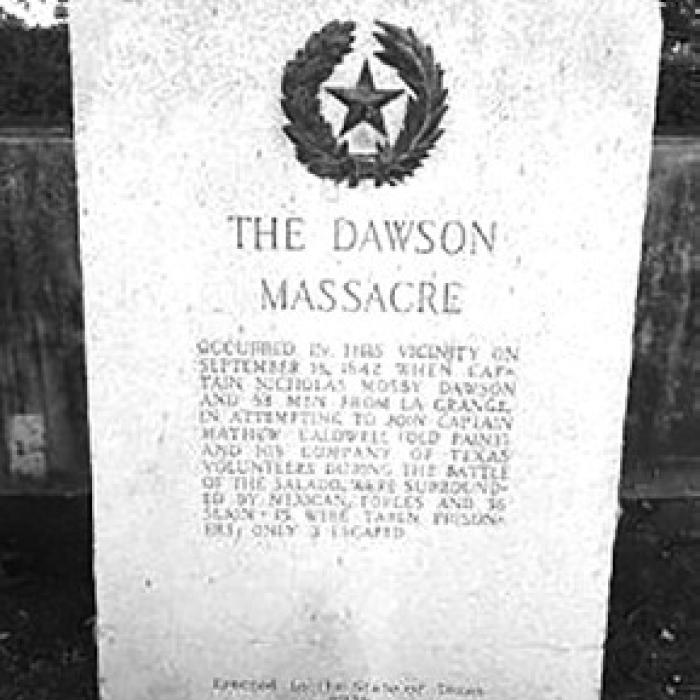
The news reached La Grange on Sept. 14 and the next day Nicholas Dawson, Edward Manton, and other volunteers willing to ride to the defense of San Antonio left home riding night and day until they reached Nash’s Creek, sixty miles from La Grange.
Colonel Matthew Caldwell and his army were encamped on Salado Creek east of San Antonio and proceeded to draw Woll’s army out of the city to engage them in battle. Late on Sept. 17, Caldwell sent out an express rider with a message that “urged on all companies” to join him. Captain Dawson and his men hurriedly broke camp, saddled their tired horses and rode all night.
On the morning of Sept. 18 Dawson’s company determined Caldwell’s position and found the battle already underway. They advanced until they could see the battlefield about two miles in the distance. They did not know that they were approaching the rear of the Mexican army until it was too late. Woll sent 400 men and one piece of artillery to crush the newly discovered Texans. By the time Dawson and his men realized that the approaching troops were Mexican “retreat was out of the question.”
The men sought cover in a sparse mesquite thicket and prepared to stand and fight.
They were quickly surrounded but were able to keep the enemy at bay with their rifles; however, once the Mexican cannon began to open fire, Dawson’s force began to be slaughtered. About sundown, the Mexicans made their final assault and the battle became one of hand to hand combat.
When the battle ended, fifteen men, including Edward Manton, had survived the carnage. They were disarmed and stripped of everything except their shirts and pants. Their hands were tied behind their backs and their pockets turned inside out in search of money.
Two days later, on Edward’s twenty-second birthday, he and the other prisoners were marched on foot out of San Antonio along with the Mexican army bound for Mexico. Three months and a thousand miles later, the men reached their destination, Perote Prison, below Mexico City.
The men were chained together and made to work. Their rations were poor and they suffered severe illnesses and several men died. Edward Manton and five other surviving men of the Dawson Company were released on March 24, 1844. They had been in prison for nineteen months.
Manton returned to his plantation near La Grange and over the years acquired extensive land holdings and was a prosperous farmer and rancher, owning a herd of thoroughbred Holstein cattle. In 1845 he married Sarah Rabb and they had at least nine children.
After her death he married Mary Scott and had three more children. He died at his home on Aug. 20, 1893 and is buried in the Manton family cemetery.
Footprints Of Fayette
Fayette County is one of the most historic counties in Texas. In this weekly feature from the County Historical Commission, a rotating group of writers looks back at local history.