


A Steinway Debut Concert at St. James
-
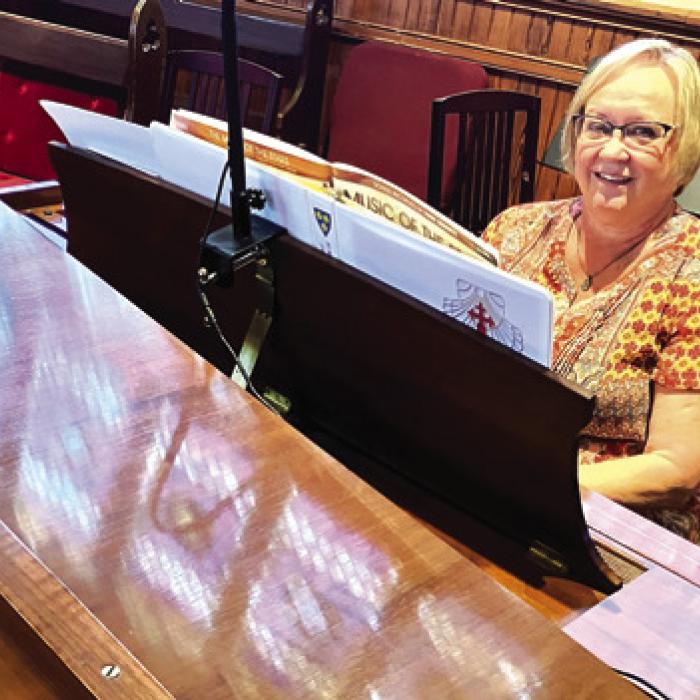 A Steinway Debut Concert at St. James
Ijust learned, from Music Director Don Kirby, St. James’ Church will be announcing a piano concert featuring the church’s recently acquired Steinway and the excellent pianist Mary Ann Hatfield (who began with the piano at three years old and was a church organist by 13!) The occasion? Introducing our community to our amazing Steinway Model S.
I got to wondering, I know the Steinway brand has a stellar reputation, but what is the big deal? Really! So, I dug into the story a bit.
It starts in 1815 with an eighteen-year-old bugle boy with the Prussian coalition in the Battle of Waterloo––during the last of the Napoleonic Wars. While in the army, the bugler learned woodworking and carpentry. He would later work for a German pianoforte builder, and, in 1825, would build a pianoforte in his kitchen for his wife. His name: Heinrich Engelhard Steinweg.
He sailed to New York in 1850, found work with a piano factory, and, in 1860 built his own piano factory. He was meticulous. Super meticulous. He inspected every board, every rafter, every beam during the factory’s construction. If any piece of material had a flaw of any kind––a scratch, a burr, or, horror of horrors, a knot–– Steinweg would discard it. If that’s how he oversaw construction of a factory, imagine how he’d be with creating pianos.
Earlier, after changing the “weg” of his name to “way,” to avoid the enmity towards immigrants of the time, he opened Steinway & Sons in 1853 in a Manhattan loft in Varick Street and proclaimed he would build the world’s pianos of perfection. The Steinway “Sons” would be with the company continuously until the last one, Henry Z., Great, Great Grandson of the founder, died at 93 in 2008.
Did it work? It certainly would seem so. There are 135 All-Steinway Schools worldwide; 1,600 professional pianists play only Steinways (800 in the USA). One of those is James Dick; another is Ramsey Lewis, whom I escorted to the stage in 1998––a stage with, uh oh, a Yamaha piano waiting for him. The task of telling his fans he was unable to perform as advertised fell to me.
Random facts about Steinway pianos: 1. Each one is 80% handmade and contains 12,116 separate parts; the action for each key comprises 57 parts.
2. It takes dozens of skilled artisans 12 months to produce one grand instrument.
3. In 1903 Steinway & Sons gave President Teddy Roosevelt the 100,000th grand piano for the White House; in 1938 it was replaced by the 300,000th one and presented to Teddy’s fifth cousin, FDR.
4. In early 1940s S&S parachuted 3,000 “Victory Verticals”– also known as “G.I. Pianos”––(lightweight uprights) to US troops and ships in WWII.
5. During WWII both the Hamburg and New York factories were converted to aircraft assembly sites; Hitler used the wood from the Hamburg factory for rifle stock. The New York factory made wooden gliders to take American soldiers behind enemy lines.
6. Henrich Steinweg’s chief competitor was Albert Weber’s Chickering Piano Company; St. James’s new 540-pound Steinway replaced a serviceable Chickering baby grand a few days ago.
7. In 2011, 97% of concert soloists played a Steinway.
8. The most expensive one sold for 1.2 million euros.
9. In 1958 Van Cliburn (Kilgore, Texas) won the Tchaikovsky Piano Competition on a Steinway.
10. S&S went public in 1996, its share price, $19; its Wall Street abbreviation, LVB (as in Ludwig Van Beethoven).
Many of the luminaries of the founding era of our region were members of St. James’ Episcopal Church. It is perhaps right and fitting that the Queen Anne Revival structure across from H-E-B be the home of an instrument of a revered name. It is a historically important fine instrument in a historically significant location. The concert will showcase the range of musical possibilities a Steinway permits: Classical (Debussy), Jazz, Ragtime, and even Showtunes. Expect an entertaining hour or so of a rainbow of musical colors. Details: Sunday afternoon, August 27, 3 p.m. Dress: jeans are fine. No charge, a freewill donation will be welcomed.
See you there.