


Spotlight on the Historic Faison Home
-
 Spotlight on the Historic Faison Home
This is the second of a series of articles covering the stories of the historic Faison House, located at 822 South Jefferson Street (Hwy. 77) across from the Fayette Public Library in La Grange, Texas. Major efforts are underway to secure the future of this privatelyowned landmark, now on the National Register of Historic Places at the state level of recognition for its social history.
This account describes the personal history of Louisiana Brown Faison, a prominent black citizen of La Grange. She worked and lived in the Faison house during the last five years of Nathanael (Nat) Faison’s life and owned the house for two years after his death.
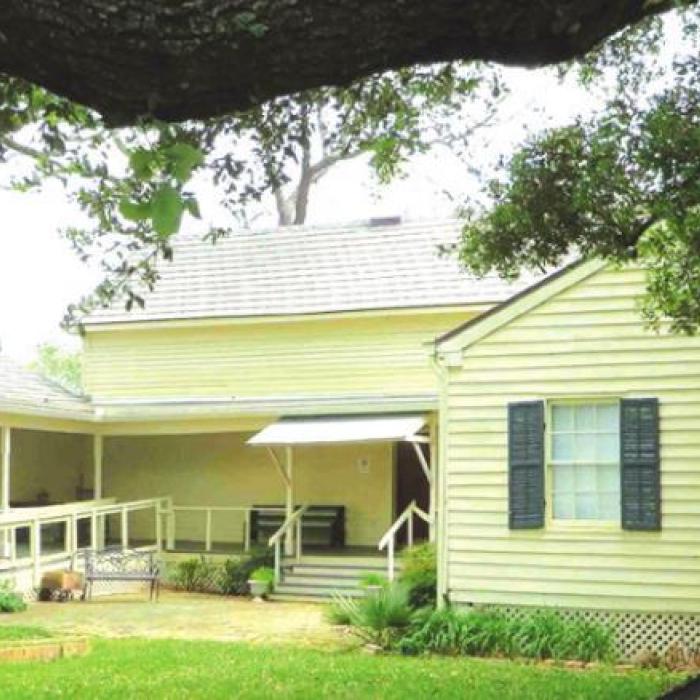
The photograph is a current rear view of the house. During the time when Louisiana lived there, the high front wing had not been built.
The north wing, on the left in the photo, contains the kitchen and the present-day dining room. In earlier days this room was probably used as a bedroom for the servants. The current bathroom was a much later addition to the end of the porch. The south wing, on the right, had a front door facing toward the Colorado River.
It contained a parlor, a master bedroom, and an attic that was most likely used as living quarters by servants.
Louisiana Brown Faison
One of the very notable things about Nathanael Faison is his friendly relationships with African American residents of Fayette County. The 1870 U.S. census recorded three other residents of the Faison House. They were Lou Brown, mulatto, age 42, housekeeper; Lizzie Blair, black, age 19, cook; and William Blair, mulatto, age 16, servant. These people most likely began living in the house soon after Faison bought it in 1866.
The census taker arrived at the Faison house on June 29, 1870. The mood must have been somber. As he took an accounting of the residents of the house, the owner, Nathaniel, lay dying. The census taker was perhaps skeptical when he recorded that the freedwoman, Brown, owned real estate worth $4,000 and had a personal estate valued at another $4,000. Nat died the very next day. His will, written on April 3 of that year, left his vast estate to his brothers and sisters as he had no children. What must have astonished the residents of La Grange was that he bequeathed $3,000 in gold coin to Lou. Most likely his brother, Peter, who had recently arrived from Tennessee, had been upset by this gift because, on June 14, 1870, a codicil to the will was written which gave $1,000 in gold coin to Peter and left Lou with only $2,000. Peter must have been outraged to discover that two months before, on April 2, 1870, Nat had sold the house with “all the improvements, household, and kitchen furniture, one buggy, one horse, one pony, and all other stock and personal property of any and every kind now on said premises” to Lou for five dollars. The property, at that time, comprised all eight lots on the block rather than the two on which the house sits. Who was this mulatto freedwoman, named Louisiana Brown, formerly the property of merchant James Eccles? Where did she come from? What did she do for Nat that moved him to grant her such a fabulous gift?
The only clue we have to her past is an obelisk in the La Grange cemetery which raises more questions than answers. The obelisk is placed only inches from a small, rough stone marker with the name of Caroline Price (May 16, 1846, to Sept. 29, 1867) who died during the yellow fever epidemic. One side of the marker contains Caroline’s name while the other side is inscribed “Lou Faison, Born in St. Louis, Aug. 4, 1819.” No date of death appears. It is possible that Lou came to Texas with the Samuel P. Brown family. Brown was a resident of Potosi, Missouri, only 70 miles from St. Louis. The family obtained a land grant from the Mexican government in 1835 and moved to Texas.
What is known is that Lou used the Faison name for the rest of her life. She is found by that name on the 1880 census living with Lizzie Blair as well as in city tax records. Lou sold the house to Peter in November 1872 for $3,000 in gold. This must have been a handsome price since Nat paid $1,800 for it in 1866. No doubt Lou had Nat’s powerful friends to thank as they witnessed her “x” on the bill of sale.
The day before the transaction, however, Lou purchased three town lots and the homestead of a white man, W. W. Little, for $1,860 which stood just off the square. Mr. Little had witnessed Nat’s will and helped appraise his estate.
When Lou sold the property in 1890 for $2,000, the newspaper advertisement indicated the residence and grounds consisted of three lots with a five-room dwelling plus a smokehouse, storeroom, etc. All were in good repair and enclosed by a good fence.
She lived here until 1890 when she bought a less expensive property for $600, at the corner of Pearl and Jackson streets. In 1895, she gave part of the land to Lizzie Blair Moore who had either lived with Lou or next to her since Nat died. The bill of sale indicated it was given to her for Lou’s love and affection and to provide her with a home which was her separate property and not to be considered her husband’s.
On Dec. 1, 1905, she gave the remainder of her property to Delany and Eva Sanford in return that they “support, maintain and take care of me for and during the remainder of my natural life.”
Lou Faison passed away on Nov. 24, 1909. The La Grange Journal noted that “Aunt Lou” Faison, “ ... of antebellum days who had many friends among the white people, died yesterday, aged about 90 years.”
Because the Faison House was owned by Lou, one of the first African American women to own property in Texas, it was accepted for its social history at the state level of recognition by the National Register of Historic Places
The Faison House Now
The impressive front wing was added in 1880. The La Grange Garden Club bought the house from the Faison family in 1961 and carried out heroic efforts to preserve it. The house is open most Saturdays from 12 to 4. Tours are free. Group tours can be arranged by appointment by emailing marie.watts@ faisonhouse.org. If you wish to join the Faison Preservation Society in its continuing efforts to preserve the house, please let Marie Watts know.
The House is now managed by the Faison Preservation Society, a non-profit 501(c)3 corporation. They are raising an endowment fund to provide permanent funds for the operation of the house. They have also received numerous grants which have been spent on restoration. The two back wings and the roof have been completely restored. The front part of the house, built in 1880, remains to be renovated inside. Concerned public spirited citizens wishing to make donations in support of this cause can send contributions to Faison Preservation Society, P. O. Box 681, La Grange, TX 78945, or can easily do so on-line at www. faisonhouse.org. At this website, select DONATE NOW and then Donate under ENDOWMENT FUND. Enter the requested details and select Credit Card or PayPal. Thank you notes with tax deduction receipts will be promptly send to all donors. We hope you will join us in this effort. We are all very grateful for your donations.
Look for the next article in this series next month.