


Solar Eclipse Expert Peter Farrow to be Featured Sunday in Fayetteville Center’s Speaker Series
-
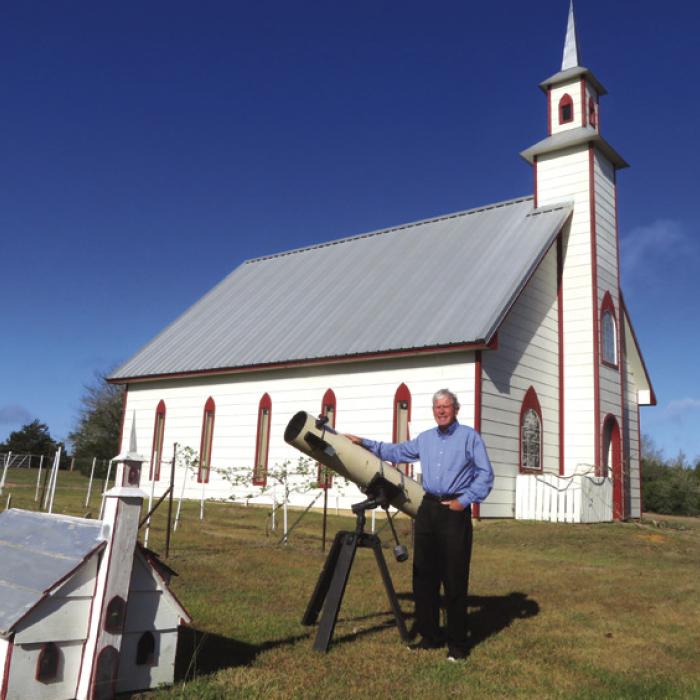 Peter Farrow, an electrical engineer by profession, was born in Ipswich, a town northeast of London England. In 1998 he and his wife started construction of their home outside of Fayetteville. His barn is what the English would call a “folly” as it looks like a church but is not. It is a reminder of a 16th century folly called Tattingstone Wonder that was close to Peter’s home in England.
Peter Farrow, who has traveled widely and often to view solar eclipses, will be the third speaker in the Fayetteville Community Center’s Speaker Series. He will present a talk covering 45 years of travel to the right location to be in the moon’s shadow for a Total Solar Eclipse. The presentation, free and open to the public, will be held at the Fayetteville Community Center on Sunday, March 29 at 3 p.m. Beverages will be served.
2026 launches a rare era of celestial events – a double eclipse cascade – and the beginning of a “golden age” of eclipses. Peter’s talk, which he has given on cruise ships around the world, will discuss many of the unusual locations where he has witnessed eclipses with interesting “tit-bits” about those experiences.
In this presentation Peter covers the geometry of Total Solar Eclipses and the challenges in being in the right place at the right time to view and photograph them. During the past 46 years Peter and his wife, Mavis, have had many interesting experiences “chasing” fifteen Total and two Annular Solar Eclipses which have taken them to remote locations around the world.
Solar Eclipses can occur twice a year when the moon passes in front of the sun causing a reduction in sunlight. During a Total Solar Eclipse (Totality) the moon completely blocks the sun’s rays for up to 7 minutes. To experience Totality one usually has to travel to remote locations, often at sea, because water covers around 70 percent of the Earth’s surface. Without travel one would have to live around 400 years to experience Totality twice at any one place.
The question most umbraphiles (one who loves eclipses, often travelling to see them) ask after their first experience of Totality is “when is the next one?” He uses “experience” rather than “see” as Totality is more than just a visual event. All goes quiet as birds believe that night has come, the temperature drops and winds appear, producing a totally eerie experience. Small crescents of light may appear on the ground.
Early peoples were very much aware of the sun, moon and stars. The Maya were able to predict solar eclipses as early as 900 BC. Astronomers in China started predicting solar eclipses around 400 BC. Eclipses can be learning experiences as well. The 1919 solar eclipse is quite famous because it provided a pivotal opportunity to test Einstein’s theory that light could be bent by gravity. When the sun’s light was obscured, astronomers could observe stars normally hidden in the sun’s brightness. The results confirmed Einstein’s prediction that light from distant stars was bent as it passed near the sun. This provided crucial evidence for Einstein’s theory of general relativity and established Einstein as one of the most influential scientists of our time.
Our speaker likes to point out he was not born in Texas but got here as soon as he could. Peter, an electrical engineer by profession, was born in Ipswich, a town northeast of London England. In 1998 he and his wife started construction of their home outside of Fayetteville. His barn is what the English would call a “folly” as it looks like a church but is not. It is a reminder of a 16th century folly called Tattingstone Wonder that was close to Peter’s home in England.
Fayetteville Community Center’s Speaker Series: Sunday, March 29, 3 p.m. Fayetteville Community Center, 107 West Fayette Street.