


Pushback Was Swift When Someone Tried to Speak Out Against the Chicken Ranch
-
 Pushback Was Swift When Someone Tried to Speak Out Against the Chicken Ranch
50 Years after it closed, The Record is running a series of articles this summer looking back at the key figures surrounding the Chicken Ranch and the complicated legacy it has left behind.
Some folks today find it hard to imagine a criminal enterprise like the Chicken Ranch operating in the open for decades here in Fayette County.
After all, this is the home of the Painted Churches, where social etiquette requires a wave at every passing car, and the biggest controversy lately was the lack of a carnival at the Schulenburg Festival.
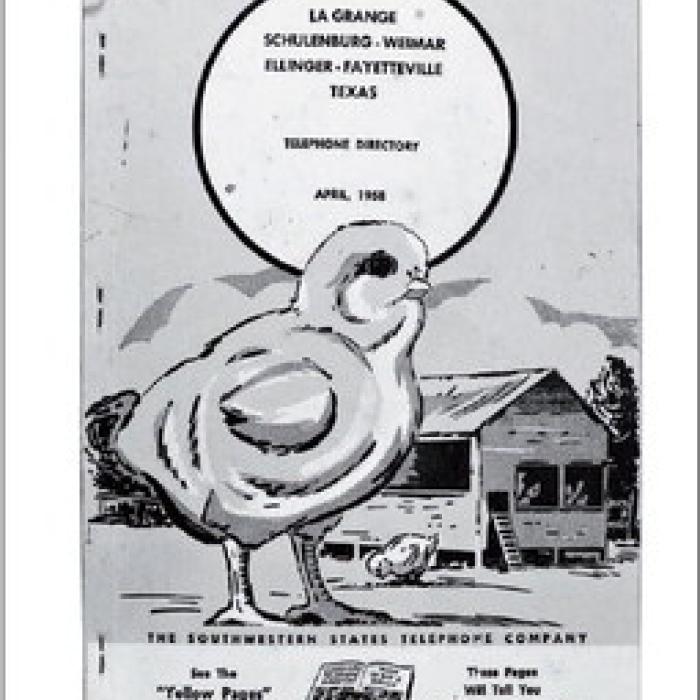
The Chicken Ranch was so well known that the April 1958 Southwestern Bell phone book for the La Grange area featured a cartoon of a baby chick and a chicken house on the front cover – a subtle nod to the area’s notoriety. Everyone from the church pastors to the County Sheriff knew about the Chicken Ranch, and almost no one spoke out against it. One of the few exceptions was a peanut salesman and his wife, presumably during the 1950s.
A few state officials wanted to shut down Miss Edna’s Fashionable Boarding House long before it finally closed with Marvin Zindler’s TV expose in 1973. Some years ago, local historian Gene Freudenberg came across a letter from the Texas State Archives that mentions the peanut man story and the State’s efforts (or lack thereof) to shutter the brothel.
The letter was dated Nov. 9, 1961. The writer identifies himself only as “Fletcher,” and it was addressed to the late Frank Maloney, a former state appeals judge who at that time served as an assistant attorney general. “Fletcher” may have been the former Texas Ranger and DPS assistant director Joe Fletcher, who died in 1966, but there is no way of confirming that from the content of the letter.
In the letter, Fletcher recounts a conversation about the Chicken Ranch that he had with Wallace Barber, who was the district attorney for this area at the time.
“As I recall, I called Wallace Barber on the telephone at his office sometime in the summer of 1959. During the preliminary exchange of greetings over the phone, he told me that Assistant Attorney General George Reid was sitting across the desk from him at that time.
“I then told Barber that we had an investigator who had made visits to the Chicken Ranch near La Grange, in his judicial district; that we had affidavits prepared and signed by the investigator; and sample forms of pleadings to be filed. Then I asked him if he wanted the affidavits and sample forms. He said, ‘No, sir.’ I said, ‘You don’t want them?’ Barber said, ‘No, sir. Officially, I don’t know that it exists. It is an established institution over there. The local people don’t want to do anything about it.’” Fletcher goes on to write Barber’s account of the peanut man.
“Barber said that a Tom’s Toasted Peanuts salesman moved to Fayette County, with the county as his district,” Fletcher recalled. “He had placed his peanuts and toasted crackers in jars in service stations, cafes and drug stores. The salesman’s wife learned about the Chicken Ranch, and was horrified to learn that such a place would be tolerated.
“She prepared a petition calling on local authorities to close it up, and took it around town for signatures,” Fletcher continued. “Barber then asked me, ‘Do you know how many signatures she got?’ I said ‘No.’ He said, ‘Not one.’ Thereafter all the merchants pulled the peanuts and crackers off their shelves, and turned in their jars. The salesman was unable to make a living in La Grange, and he and his family had to move.”
Fletcher went on to say that after Reid returned to Austin, he asked the state attorney whether he heard the conversation in Barber’s office. Reid said he had heard it, but he didn’t understand what it was about.
“I don’t believe that Barber told Reid that he had just talked with me after he hung up the phone,” Fletcher told Maloney in the letter.
Fletcher ends the letter to Maloney by saying, “It has been over two years since this occurred, and you can understand that I can’t vouch for every word of the conversation above being exactly like I quoted it. But in substance, this is the way I remember it.”