


To Prune or Not to Prune? That is the Question
-
 To Prune or Not to Prune? That is the Question
 -
 To Prune or Not to Prune? That is the Question
 -
 To Prune or Not to Prune? That is the Question
Sometimes I get into a routine in the garden. I find myself doing certain things the same way year after year. But maybe I should re-think these habits.
Some years ago, I started pruning all of my indeterminate tomatoes. According to one theory, indeterminate tomatoes produce bigger fruit from healthier vines if you routinely prune all of the suckers and train the plant to grow from a single vine. Suckers, or “side shoots,” are the growth that appears at the spot where a stem meets the branch of a tomato plant. This growth supposedly “sucks” energy from the rest of the plant. If you do not prune them, the plants grow wildly and can quickly get out of control. Pruning the plants improves airflow, which helps leaves dry faster after a rain, and may help to prevent diseases. Pruning supposedly speeds up fruit ripening as well.
I’ve gotten in a habit of pruning every single sucker that appears, at least until the plants grows to a mature size. How big? I usually allow the plants to grow to the top of their tomato cages or trellis. Once they reach that point, I snip the top from the terminal shoot, which stops vertical growth. I then allow the suckers to grow. This results in a plant that’s pretty top-heavy, and they require sturdy support.
This system has worked for me. But I have a friend in Schulenburg who never prunes his tomatoes. And I’m really jealous of his tomato crop this year. So does it even matter? Am I wasting my time?
Let’s back up a little bit. If you’re going to prune tomatoes, you should only prune indeterminate varieties. These are the “vining-type” tomatoes. Their vines will continue to grow until drought or a frost kills them. Determinate tomatoes, on the other hand, grow more like a bush. They grow to a “determined” size and typically produce all their tomatoes at once and then stop producing. Determinate tomatoes do not require any pruning, other than to remove dead or diseased leaves.
When you buy tomato plants from a nursery, the tag will usually say whether it is a determinate or indeterminate variety. Sometimes you may see “semi-determinate” varieties. As the name implies, they grow in a pattern somewhat in-between determinate and indeterminate tomatoes.
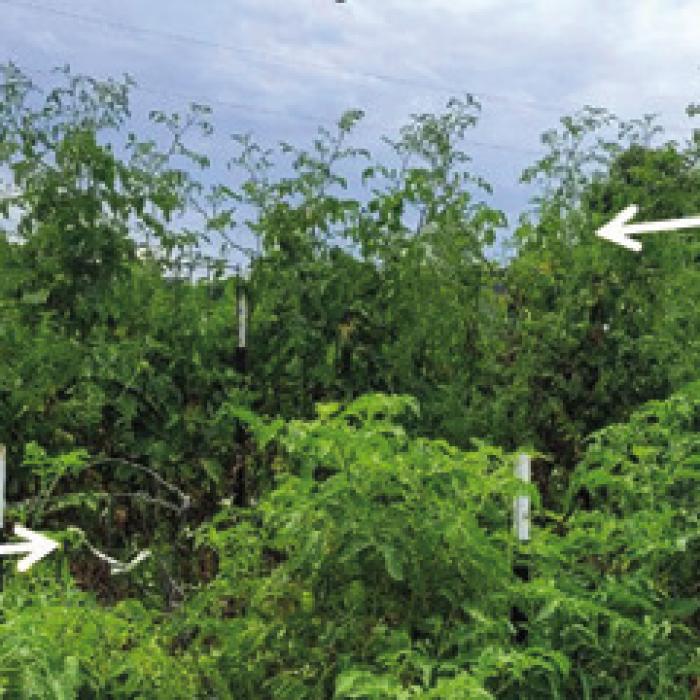
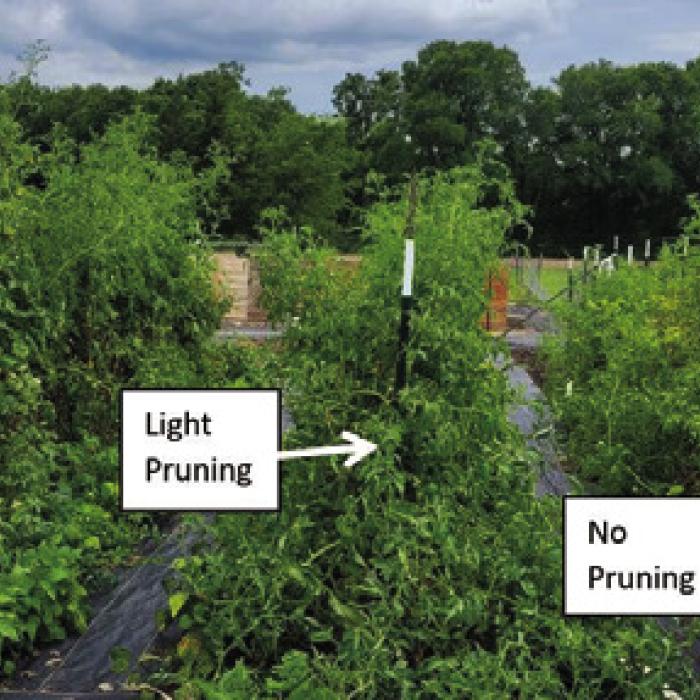
Brianne Bernsen of Plum is one of the most successful gardeners I know in Fayette County. She recently told me about an experiment she conducted this year regarding tomato pruning.
“Some years I prune indeterminate tomatoes, some years I don’t,” she said. “This year I did both to see if it really had an effect. It appears to have had a great effect.”
Bernsen reported picking 120 lbs of tomatoes this week alone. She grows a mix of determinate and indeterminate tomatoes. She provided the following advice for supporting both types of plants.
“For indeterminates, I love a single 16 foot cattle panel that is cut in half and placed so it is eight feet tall and staked with t-posts,” she said. “And for determinates, I like the regular round tomato trellises, although I prefer to make extra beefy ones by using four foot tall field wire, I bend mine into triangles instead of circles so I can stack them at the end of the season.”
So should you prune or not? I think it’s better to prune varieties that grow large, heavy tomatoes. That way, they’re easier to support. For varieties that grow smaller fruit, such as cherry and grape tomatoes, I leave the plants to grow as they wish.
Bernsen also shared a tip about planting marigolds around squash to deter pests.
“It’s been reported that planting marigolds amongst your squash will help deter pests,” she said. “I put marigolds in every bed that had squash and all have succumbed to squash bugs. This butternut squash was the last to survive, but it too will probably be done within the week due to squash bug damage. I did notice that it was the actual squash bug and not the squash vine borer that was doing all the damage. I saw very few squash vine borers throughout my garden this year. So maybe the marigolds helped with them.”
I’m growing some marigolds in my garden as well this year, but I planted them around my tomatoes, several yards away from the squash patch. I have not seen a single squash vine borer at my place so far this year. I’m not sure if the marigolds have anything to do with it. I have started to see a few squash bugs, especially leaf-footed bugs. I’ve gotten in the habit of carrying a pair of scissors with me every time I walk through the garden. When I see a squash bug, I sneak up to it and try to snip it in half before it flies away. Once mature, these insects are pretty hard to kill with any kind of pesticide, and the pesticides that do kill them also kill beneficial insects like ladybugs.