


Planting Carrots is Worth the Trouble
-
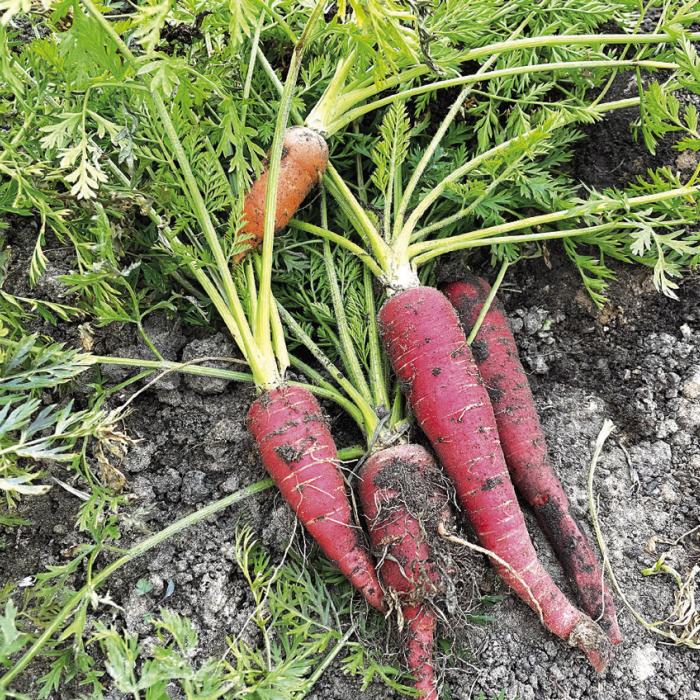 Some “Kyoto Red” carrots harvested from our garden earlier this year. Photo by Andy Behlen
 -
 By ANDY BEHLEN The Fayette County Record
A lot of folks don’t plant carrots in their vegetable garden. I understand why. They don’t like heat. They’re picky about water. They’re a little troublesome to plant and get established. And even organic carrots are pretty cheap to buy at the store. So why bother?
I’ll give you two reasons. For one, because carrots picked fresh from the garden taste so amazing. Secondly, you can grow many more varieties of colorful carrots than the plain old orange ones you’re used to seeing in stores.
Fresh carrots possess a sweetness you’ll never taste in a store-bought carrot. You can grow orange carrots, of course, but there are also red carrots, yellow carrots, purple carrots and even black carrots. Some varieties can grow roots two feet long in loose soil, such as the famed “Manpukuji” from Japan. Others were bred to grow short, stocky roots suitable for cultivation in clay or rocky soils, such as the heirloom “Oxheart” carrots from France.
Carrots prefer growing when high temperatures stay below 75 degrees during the day. Mid- to late-September and early spring are often cited as the ideal times to plant carrot seed in Central Texas. But we were in the middle of a heat wave in September.
Then we didn’t get any rain for a month.
I think now might be a good time to plant some carrots.
Most varieties of carrots prefer deep, loose soil free of rocks. When carrot roots grow downward and encounters rocks, the roots will split or curve. In clay soils, carrots struggle to grow a meaty root. You’ll end up a small, strange-looking carrots. As I mentioned earlier, there are some varieties that can be grown in rocky soils. “Oxheart” is the best variety for these situations, in my experience. Other varieties purported to grow well in hard soils include “Parisian” and “Thumbelina.”
If you have rocky or hard clay soil, you might consider growing carrots in a raised bed filled with loose soil. Carrots benefit from a bed prepared with a little compost. But carrots don’t need much fertilizer. Never add manure to a carrot bed. When carrots grow in rich soil, the roots often fork and send out side-roots. You’ll end up with lush, green carrot tops but poor quality roots.
Carrot seed is very fine, which makes it sort of challenging to plant. I recommend planting way more carrot seed than you hope to harvest. Sprinkle the seed thickly. If your garden is set up in rows, plant a wide band of carrot seed down the row instead of a single row of carrots. Many experts advise covering the seed with a quarter inch of fine soil or compost. I barely cover the seeds if at all. Instead, I use the mist setting of a sprayer to gently water the seeds into the soil. I mist the seeds nearly every day, unless it rains, until they sprout, which can be up to 14 days from planting.
Patience is key during this time. Don’t allow the soil to completely dry out. But don’t drench the soil either.
As they grow, this wide band of carrot tops will shade the ground, helping to conserve moisture and prevent weeds from sprouting. Allow the carrots to grow for a few weeks until they appear crowded in the bed. At that point, you should begin thinning the carrots.
Carrots don’t like dry soil, but they don’t like soggy soil, either. Water accordingly.
I never thin them all at one time. Instead, I perform an initial light thinning. I try to give each carrot I leave in the bed about an inch or two of growing space. A few weeks later, I perform another thinning. This time, you might end up with some small carrots to snack on or eat in a salad.
After about 60 or 70 days from germination, depending on the variety, you should have some large, mature carrots. But don’t pull them all at once, unless you plan to store them in a root cellar. They stay freshest by remaining in the soil. The carrots will continue to grow, and the roots may split if you don’t eat them fast enough. You can prevent this problem by planting a succession of carrots every three or four weeks through the fall and into the spring.
Carrot seed will not germinate in cold weather, but established plants can grow in freezing weather. In fact, many people say carrots grown in cold weather taste much sweeter.