


One of Stephen F. Austin’s Old Three Hundred: Zadock Woods

Footprints Of Fayette
Fayette County is one of the most historic counties in Texas. In this weekly feature from the County Historical Commission, a rotating group of writers looks back at local history.
Zadock Woods was born near Plymouth, Massachusetts, in 1773 and later moved with his family to Woodstock, Vermont. He married Minerva Cottle and the Woods and Cottle families migrated to Louisiana territory (Missouri) around 1800. There he built a fortified home known as Wood’s Fort. During the War of 1812 he served in Boone’s Company of mounted rifleman patrolling a two thousand square mile area between the Mississippi and Missouri Rivers. Zadock was 50 years old when he first came to Texas in 1823. He brought Minerva and his sons Norman, Montraville, Leander, and Henry Gonzalvo Woods to Texas in October 1824 and is one of Stephen F. Austin’s “Old Three Hundred” settlers. His original land grant was in present day Matagorda County but he settled his family just north of La Grange. He built another substantial log cabin known as Wood’s Fort. This fortified outpost served as a refuge against Indian attacks for settlers in the area and was later known as Wood’s Inn.
The Woods men fought in several battles leading up to the Texas Revolution.
Zadock and Leander participated in the Battle of Velasco in June 1832. The Texians won the fight, but several men were killed, one of them being Leander Woods.
Zadock and Henry Gonzalvo participated in the Battles of Gonzales and Concepcion in October 1835. During the Texas Revolution, the Woods family joined the “Runaway Scrape” when they were forced to flee their homes in advance of the Mexican army. Overnight, all roads to the east were filled with “miserable carts and wagons...”. Most left behind all of their possessions and many fled on horseback with two or three people on each animal.
Despite the decisive victory at San Jacinto, Texas continued to be harassed by Mexico. On September 11, 1842, General Adrian Woll invaded Texas, attacking and capturing San Antonio.
The news reached La Grange on September 14th and the next day Nicholas Dawson, Zadock, Norman and Henry Gonzalvo Woods, and other volunteers willing to ride to the defense of San Antonio left home riding night and day until they reached Nash’s Creek, 60 miles from La Grange.
Colonel Matthew Caldwell and his army were encamped on Salado Creek east of San Antonio and proceeded to draw Woll’s army out of the city to engage them in battle. Late on September 17th, Caldwell sent out an express rider with a message that “urged on all companies” to join him. Captain Dawson and his men, hurriedly broke camp, saddled their tired horses and rode all night.
On the morning of September 18, Dawson’s company deter-mined Caldwell’s position and found the battle already underway. They advanced until they could see the battlefield about two miles in the distance. They did not know that they were approaching the rear of the Mexican army until it was too late. Woll sent 400 men and one piece of artillery to crush the newly discovered Texans. By the time Dawson and his men realized that the approaching troops were Mexican “retreat was out of the question.”
The men sought cover in a sparse mesquite thicket and prepared to stand and fight.
They were quickly surrounded but were able to keep the enemy at bay with their rifles; however, once the Mexican cannon began to open fire, Dawson’s force began to be slaughtered. About sundown, the Mexicans made their final assault and the battle became one of hand to hand combat. After little more than one hour, the battle ended with 36 Texans killed, 15 taken prisoner and two escaped.
Zadock Woods, killed on his 69th birthday, lay near the body of Captain Nicholas Dawson. Norman Woods was wounded in the battle and taken prisoner. He died in Perote Prison in 1843. Henry Gonzalvo Woods was able to escape the battlefield after killing a Mexican soldier with his own lance and riding away on the soldier’s horse.
The bodies of Dawson and his men were stripped of their clothing and searched for valuables, mutilated and left where they had fallen. During the night a cold rain fell and cleansed the bodies of blood giving them a marble-like appearance. At sunrise Caldwell’s men located and inspected Dawson’s battleground and the men were buried on the site in shallow graves.
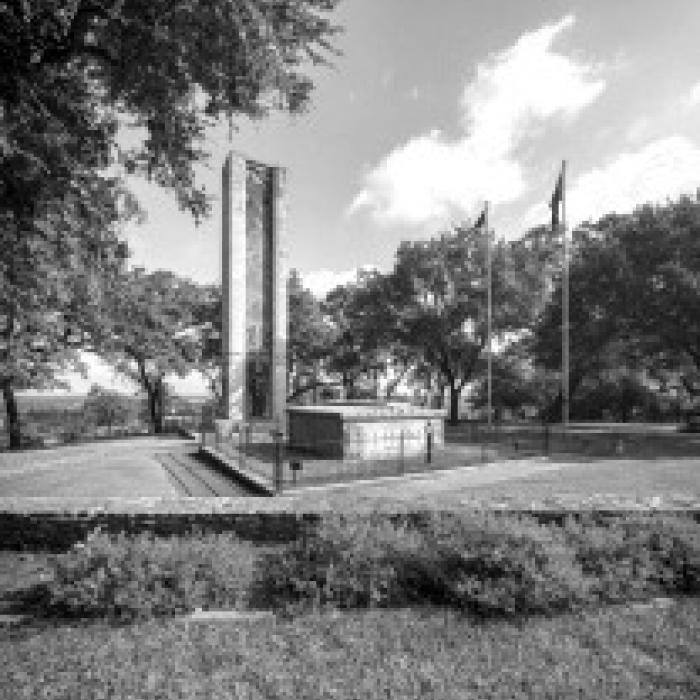
In 1848 the remains of the gallant Texans who died in the “Dawson Massacre” were exhumed and brought to La Grange. On September 18, 1848 they, with the remains of the men who were executed in the “Mier Expedition” were placed in a single stone vault on a hill overlooking the Colorado River and the city.