


MUSIC IS A WAY OF LIFE FOR LUTHERANS
-
 MUSIC IS A WAY OF LIFE FOR LUTHERANS
 -
 MUSIC IS A WAY OF LIFE FOR LUTHERANS
Since the early days of the 16th century reformation, the Lutheran church has enjoyed a reputation as a singing church. It is a heritage in which we ought to take pride and one which we ought to preserve for future generations. Leaf through our hymnal, Lutheran Service Book, and you will find a treasure trove of texts and tunes. We have hymn texts dating back as far as around 400 AD (“Of the Father’s Love Begotten,” for example) that Christians have been using for centuries. Of course we have hymns of the Reformation by Martin Luther and others. What would our Reformation celebration look like without a rousing rendition of “A Mighty Fortress?” There are settings arranged by musical genius and Lutheran cantor J.S. Bach, such as that of “Break Forth, O Beauteous Heavenly Light.” Our hymnal also includes a number of newer hymns by modern-day authors such as Pastor Stephen Starke and composers like Kevin Hildebrand. Through the ages, God’s people have been making music to the glory of the Triune God.
At Mt. Calvary Lutheran Church & Preschool, we are not merely heirs to a rich musical tradition. We have also developed and cultivated local practices of frequent musical enrichment of worship and education. This is not a privilege to be taken lightly. Mt. Calvary has more musical opportunities than many other churches of its size. Vocal choirs, which used to be prevalent in nearly every church, are becoming less common as churches struggle to find enough members to support a choir. Bell choirs are even more rare, as it requires a considerable investment to purchase all the equipment necessary. Yet the edification of Christian worship life through music cannot be overstated. Music is a stronger and more durative teacher than any other thing in the church. Pastor Kaspar often quips, “I frequently hear the people of God humming or whistling a hymn tune on the way out of church. But I’ve never heard a person humming a sermon line or Bible class gem. The hymnody of the church is a much better teacher than me.”
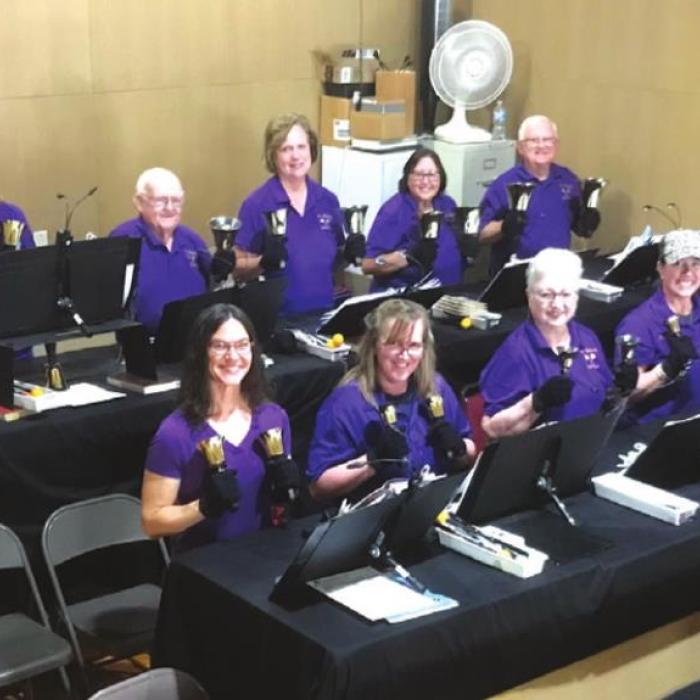
Our Bell Choir welcomes anyone with the strength to swing a bell and the ability to count to four. Reading music is not a requirement. Our members who do not read music come up with creative ways to follow along and know when to ring their bells. Director Ruth Meyer says, “The progress we have made this year is incredible. When I first started directing in September, we had a number of new members, and we were all learning or re-learning how to make music together. But our members have risen to the challenge and far exceeded my expectations. Now they are able to pull together in a couple practices what would have taken a couple months to learn in the fall. I am so honored to be part of this group.”
The bell choir currently has three octaves of bells, as well as a set of tone chimes, but Ruth would love to see that expand even more. “My dream is to have so many people interested in joining the bell choir that it forces us to consider getting another octave. Much of our music is written with the option of four or even five octaves. It would be a wonderful ‘problem’ to have too many players!” Current members include Shery Dunk, Lori Hollek, Gabby Hollek, Emma Herbrich, Wendy Kruse, Karen Pietsch, Hannah Sanchez, Lorri Sanchez, Harold Streicher, Linda Streicher, Ralph Streicher, and Judy Zuhn. “Bells are a curious musical instrument,” Pastor remarks. “They demonstrate the Bride of Christ in action. Each player is like a part of the body, diligently mastering their own work. But it’s not until they hear as one, count as one, and perceive each other’s weaknesses, that cacophony gives way to fine music. And this is fine music.”
Choral music is an entirely different sort of music making. While all other types of music make use of an instrument outside one’s self, one’s voice is the instrument for singing. It takes a certain level of courage to sing in the hearing of other people. Martin Luther regarded vocal music very highly. “And yet, compared to the human voice, all this hardly deserves the name of music, so abundant and incomprehensible is here the munificence and wisdom of our most gracious Creator,” he stated.
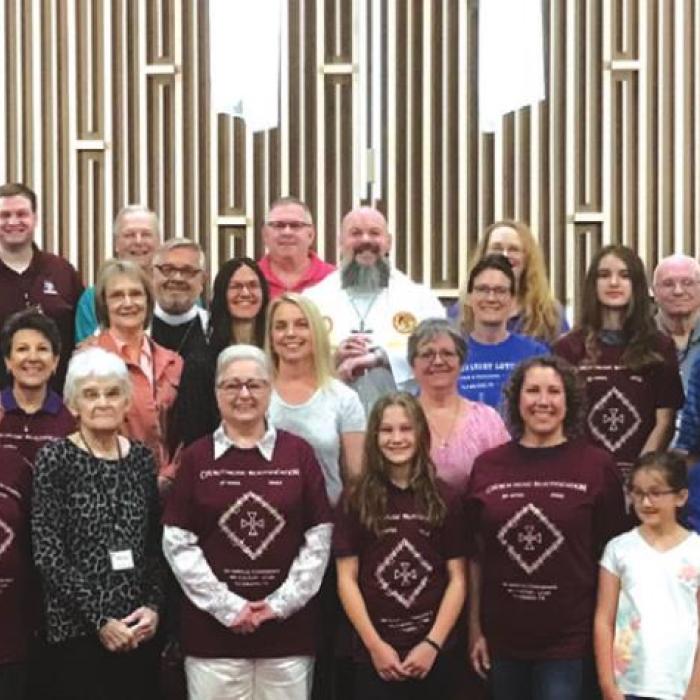
Our Chancel Choir, which is open to singers of all ages, started up again before Christmas of 2021. We currently have members ranging in age from eight to eighty years old. Pastor Kaspar has taken the reins as our director. This year we have gotten reacquainted with ourselves as singers, skipping quickly from melody and two-part singing to four-part harmony. Our choir has also re-introduced chanting the psalms and the ancient introits of the church on Sunday mornings. Our members are Brenda Fischer, Karen Fitch, Lummus Hannes, Sarah Herbrich, Shannon Herbrich, Mandy Kaspar, Brenda Rainosek (accompanist), Donald Roensch, Lorri Sanchez, Linda Streicher, Geraldine Teinert, Debbie Wilson, and Clayton Wolf. “Some of these folks have been singing together for decades, and it shows,” says Pastor. “We’ve gotten back into the swing of enjoying each other’s voices and working together. I love this group.”
For the past few years, Pastor Kaspar and our Cantor, Clayton Wolf, have traded duties chanting the graduals, tracts, and alleluia texts appointed for the Divine Service. Clayton is a long-serving member of Mt. Calvary’s choirs as a member and soloist. This year we were blessed to hear the two of them chant a unique setting of Psalm 22 during the stripping of the altar on Maundy Thursday (4/14/22). The austere, plaintive psalm tone and antiphon are an original work of Pastor Kaspar. The setting has been used by several congregations over the years and even found its way into the solemn Maundy Thursday worship service in Kramer Chapel at Concordia Theological Seminary, Fort Wayne, IN.
We are currently blessed to have two regular organists, Mrs. Kim Appel and Mrs. Ruth Meyer, who play on an alternating basis. Both are LCMS trained organists. Between the two of them, they have 58 years of experience playing organ. The Lord has seen fit to provide Mt. Calvary with suitable, faithful women who love to serve His church. Kim has been playing the organ for churches for 33 years. She studied organ at Concordia University in Austin, Texas, and has since served as organist in Austin, Kerrville, San Antonio, Lee County, and Bastrop County.
Ruth started piano lessons in first grade and was playing for evening church services by high school, but did not learn organ until her freshman year at Concordia University in Ann Arbor, MI, where she signed up for organ lessons on a whim. From her first lesson with the esteemed Dr. Jeffrey Blersch, she was hooked, and quickly settled upon church music as her major. She has served as organist or church musician for churches in Michigan, Illinois, Washington State, Indiana, and Texas, and has played a great many different organs in her day. Of the organ at Mt. Calvary, she says, “This is one of the nicer organs I’ve had the privilege to play. With three manuals [keyboards], there is a wide variety of options for different sounds. It’s a real treat to play for worship here.”
Pastor Kaspar comes to us from a family of LCMS church workers and musicians. He is a product of the elementary and secondary Lutheran music education from Winfield, KS and St. Louis, MO. He studied music education, voice performance, and voice pedagogy at Concordia University in Ann Arbor, MI (where he and Ruth overlapped in the music department for a year), as well as Colorado Mesa University. Pastor has served the church as an amateur and professional musician for 36 of his 46 years; canting, singing, directing choirs, and training singers.
Our preschool program also features music as a central component of its pedagogy. For the last three years Pastor Kaspar has led weekly chapel services for the preschoolers. During this time, he teaches the children canticles of the ancient church in addition to some hymns. This academic year he also stepped in to provide assistance to our Preschool Music Program. Our three- and four-year-olds join Pastor for music training each week. They are learning rhythmic clapping exercises, solfege (a method that teaches aural skills, pitch, and sightreading), hymns, and playful songs. Pastor strongly supports teaching children music from an early age. “Children possess superpowers,” he says. “In a limited number of exposures, they can assimilate, retain, and regurgitate massive amounts of information, skills, and music. These superpowers diminish with age. We ought to take advantage of the skill while it exists. What’s more, they’ll retain some of this until their dying days, eighty or a hundred years from now.”