


Master Fabric Artist Opening at the Red & White Gallery Oct. 1
-
 Master Fabric Artist Opening at the Red & White Gallery Oct. 1
 -
 Master Fabric Artist Opening at the Red & White Gallery Oct. 1
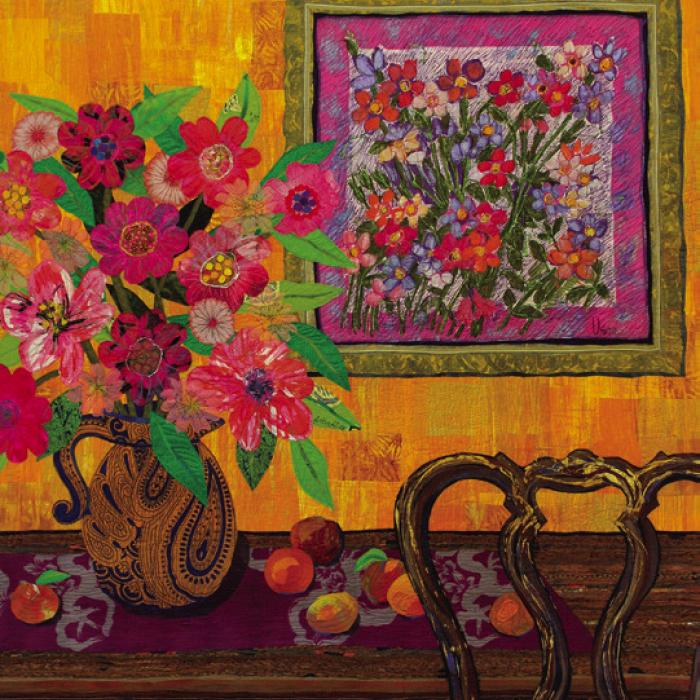
Sue Benner creates internationally collected, award-winning quilts and textile art from her Dallas studio. Her work is shown world-wide in galleries, US embassies and museums including the International Quilt Study Center and Museum, National Quilt Museum, and the Neville Public Museum as well as in many private, institutional, and corporate collections. Benner’s quilts have been juried into Quilt National eight times, recently winning the Most Innovative Use of the Medium award.
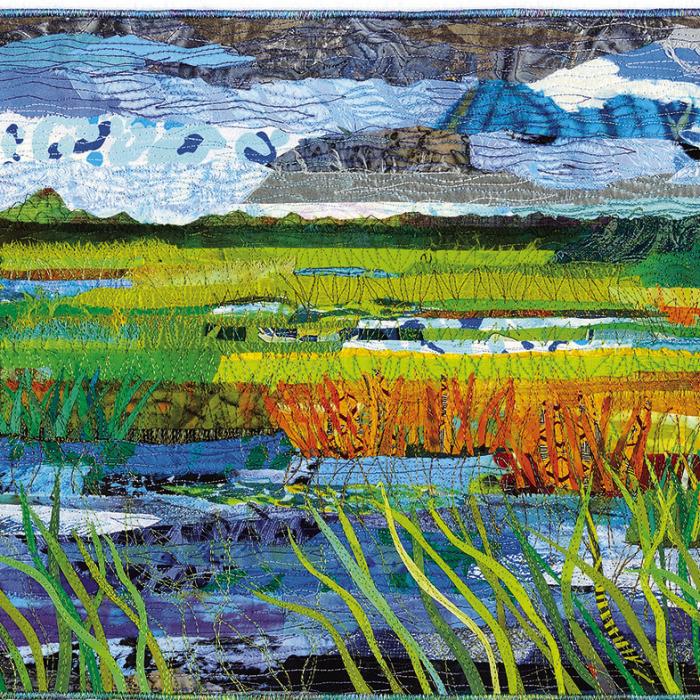
“I dye silk, cotton and other natural fibers using a variety of techniques with fiber reactive dyes,” Sue states. “These include immersion dyeing, dye-painting, block printing and monoprinting. I call this “expressive” dye-painting, giving credit to the Abstract Expressionist painters who have influenced my approach. Some works are further layered with drawing, painting and monoprinting with metallic and opaque fabric paints.” For her show at the Red & White Gallery, she has created new landscapes based on her photographs and experiences from her walks around White Rock Lake near her Dallas home and studio. Six years ago, Benner began photographing White Rock Lake as a daily devotion and artistic practice. She has been sharing her love for the quiet beauty of the lake on Instagram since then @bennersue. As her photography evolved, the idea of a book — encompassing a broader view of the lake and its many aspects — took shape. Her book, “Walking Near Water”, will also be available at the gallery. (Herring Press, $40)
Benner is returning to Fayette County, having had a solo show, “Sue Benner: Circling the Square,” at La Grange’s Texas Quilt Museum in 2015. About the three dozen quilts exhibited then, Benner stated, “The act of creating is a fascinating process of choice and discovery. The work has taught me to respect intuition, persistence, and the happy accident.” A respected educator, Benner also lectures and teaches workshops nationally and internationally in the areas of surface design, textile collage, fused quilt construction and artistic inspiration. She is well known for her communication skills and her ability to bring her knowledge of design and technique to the classroom experience. She will be attending her opening at the Red & White Gallery, and available to discuss her unique techniques (and sign books).
“I also collect vintage, retro, and recent textiles that I recycle in my work,” she says. “These are the ‘found’ fabrics referred to in my medium descriptions. I am always on the lookout for the perfect 1980s silk dress or blouse to deconstruct and reuse. These textiles have stories to tell in themselves, give a nod to quilting tradition and provide the works with a time and culture stamp. In my mind, there is almost nothing that a trip to a thrift store won’t cure!
“My love affair with fabric began with my first memories of the clothes my mother made for me. I can still recall the exact hue, fiber content and weave. In the ensuing years, my mother taught me to sew, carefully and creatively. My father always had a pencil in his hand or behind his ear, drawing on napkins in restaurants and painting on the weekends. I now recognize how creativity was imbedded in everything he did.” While in college and immersed in the subjects of calculus, organic chemistry and cellular biology, Benner was continually drawn to the visual. “I saw pattern everywhere: math problems danced in a dimensional space, organic molecules were drawn in structural diagrams, and biological cells stacked themselves in lovely arrays. When forced to satisfy a few humanities credits, I took an art history course that changed the direction of my life dramatically. Surface design, drawing, painting and more art classes followed.
“My education and early career in molecular biology and biomedical illustration still figures in my artwork with a deep sense of structure and organizing principles. With an artist’s eye, I see the world through a scientific lens.”