


Louis Melcher, Photographer and Entrepreneur
-
 Louis Melcher, Photographer and Entrepreneur
 -
 Louis Melcher, Photographer and Entrepreneur
Part II of II
Fayette County is one of the most historic counties in Texas. In this weekly feature from the County Historical Commission, a rotating group of writers looks back at local history.
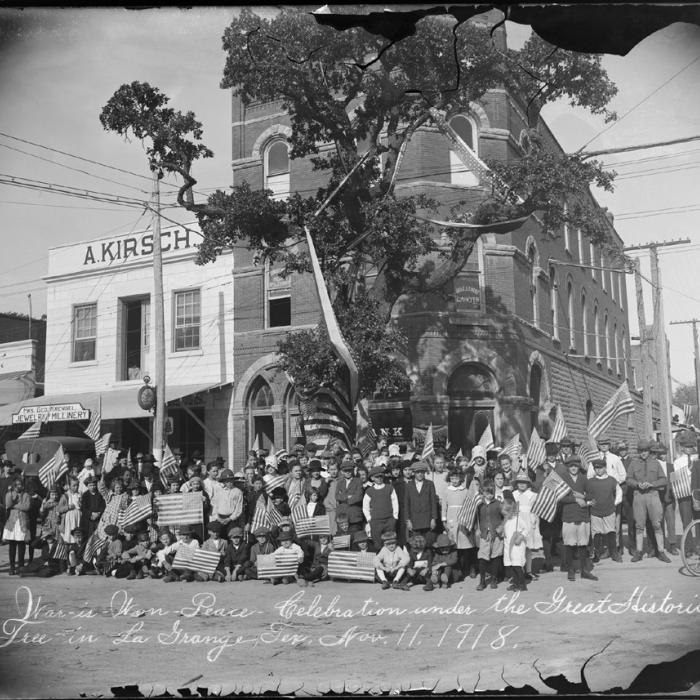
Within a couple of weeks of opening his photography studio in La Grange in March 1914, Louis Melcher announced he would open a new motion picture theater at the same address. However, this venture was apparently unsuccessful. In November 1915, there was a notice in The Shiner Gazette that Melcher was opening a studio in Shiner. However, Louis spent several months of 1916 in Houston with some sort of illness. Melcher and his wife, Ida, were back in La Grange by November 11, 1918 when Louis took his iconic photographs of La Grange’s impromptu War is Won celebration. His home and studio were next to the Lutheran Church on Travis Street. While Melcher’s attempt to set up a movie theater in La Grange failed, he seems to have had more success in the 1920s visiting small central Texas towns with a traveling picture show. Melcher converted a flat-bed truck into a tour bus that included a tent and other items needed for setting up his show and living away from home. After several months away from La Grange, he would announce the reopening of his photography studio.
The Melchers sometimes set up their motion pictures in halls, but often they hung a screen between trees and set up folding supports for long wooden planks that became benches. Ida turned a barrel organ for the silent movies, while Louis supplied the narration for those who could not read the subtitles.According to relatives, many of their movies were old and inclined to break during the running. Louis would splice the films together, sometimes substituting footage from different movies to fill in any gaps. If the film broke during a showing, it was up to Ida to entertain the audience with her organ. During the intermission, the couple sold homemade ice cream for 5 cents.
In 1924 Louis Melcher ran for La Grange city marshal, but Paul Himly defeated him with 254 versus 101 votes.At the end of that year, after a few months on the road, the couple moved back to O’Quinn. Evidently, while the traveling motion picture shows continued, Melcher had concocted an additional way to earn income when he brought his carnival concessions to the 1925 Fourth of July celebration at Winchester, where he was kept busy “amusing the children and many of the grownups.”At the Warda picnic in 1928, “Louis Melcher, the carnival man, was on the grounds with his varieties and at night gave a picture show…” According to family, during these days of Prohibition, the Melchers operated a still and were known to sell their homemade liquor at shows. Inside the kitchen of their rural home, a trap door beneath a rug led into a small secret dugout where they stored their cache of moonshine. Supposedly, tiny mirrors were positioned alongside their driveway so they could always see if someone was approaching. This early warning was needed in case the visitors consisted of law officers—like Ida’s cousin, Sheriff Will Loessin—searching for illegal stills.
The Melchers lived in the Taylor vicinity from about 1930 to 1935, before moving back to O’Quinn. Several hundred people attended when neighbors and friends gave the couple a surprise 50th Wedding Anniversary party in 1941, although it was noted that Mr. Melcher was at present a cripple and suffering with arthritis.
A life full of varied interests and activities can be seen in Louis Melcher’s August 31, 1944, La Grange Journal advertisement offering for sale “relics and antiques, Texas Horn and other old furniture, musical instruments, guns and pistols, Indian arrows, etc. Also a good surveyors transit, photo camera and accessories, moving picture machine and films, farm and implements.” He passed away at his home on September 12, 1948 after taking an “overdose of sleeping medicine to relieve pain.” He was seventy-eight. He was buried in the Black Jack Springs Cemetery. However, no marker beyond a funeral home tag marks the grave of the man who was arguably Fayette County’s most prominent photographer.
Several years ago, sixty-five of Louis Melcher’s glass negatives were donated to the Fayette Heritage Museum and Archives. A professional conservator cleaned and digitized them and those images, along with more than 150 others already in the collection, are on display in the museum’s space above the Fayette Public Library at 855 South Jefferson Street in La Grange.