


On The Hunt for Chinese Cooking Ingredients Close & Far from Home
-
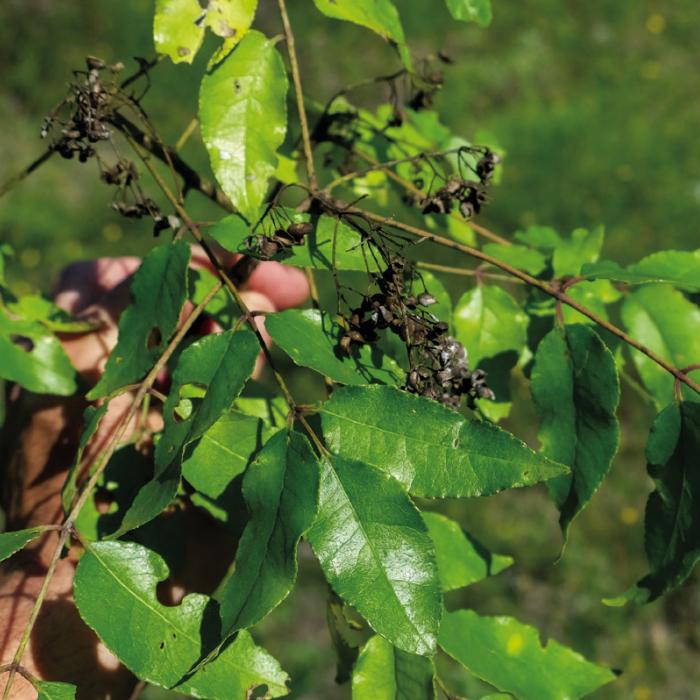 I found some seed pods attached to the branches of a prickly ash this week at my parents’ property in central Fayette County. But the pods appeared old and dark, perhaps from last year. Photos by Andy Behlen
 -
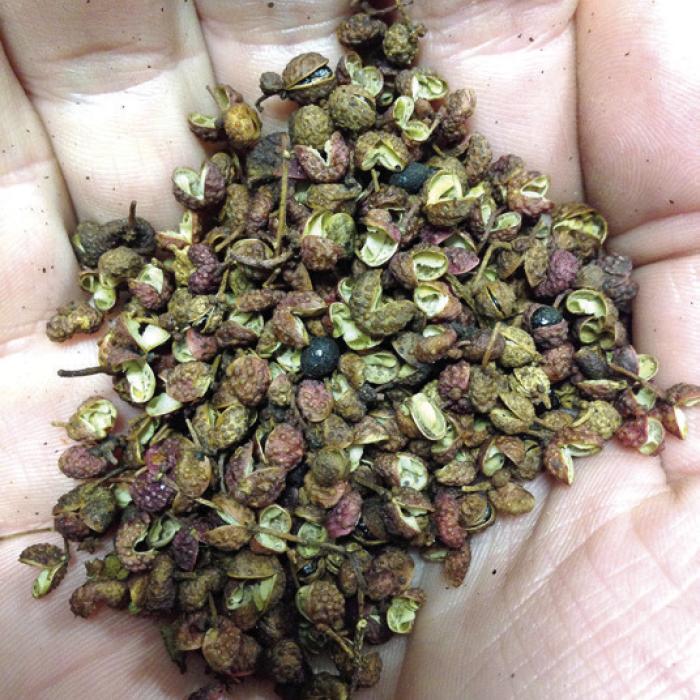 A closeup of some true Sichuan peppercorns. Photo from Wikimedia Commons
 -
 On The Hunt for Chinese Cooking Ingredients Close & Far from Home
 -
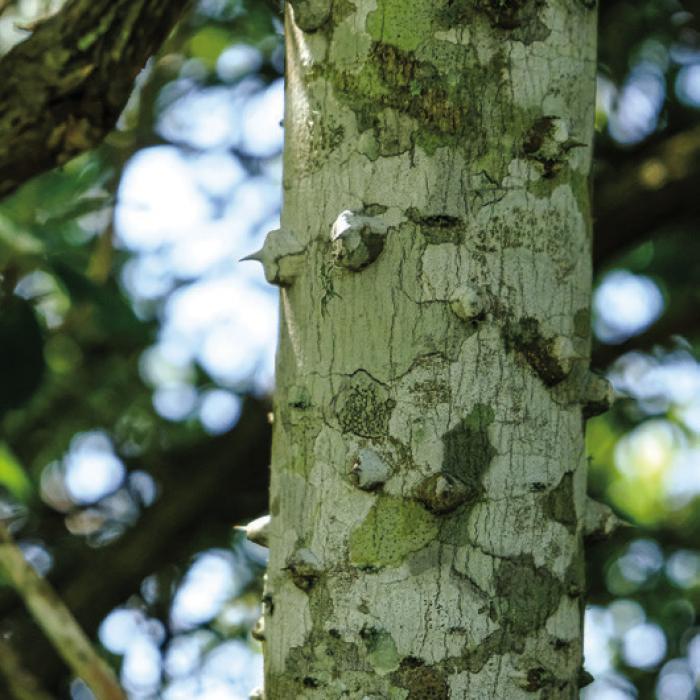 The unmistakable prickly bark of a prickly ash tree. Several species are native to Texas, and one has the scientific name Zanthoxylum clava-herculis. The species name, fittingly, means “Hercules’ Club.”
What’s a man to do when he wants to cook a pot of mapo tofu but he doesn’t have any Sichuan peppercorn in the pantry? He could go to a specialty market and buy some at a price of $10 an ounce. Or he could forage in the woods and find some himself. Sichuan peppercorn is the spice used in the Sichuan style of Chinese cuisine that causes a unique numbing sensation in the mouth. It’s made from the seed pods of several species of prickly ash (genus Zanthoxylum) native to China. Last Wednesday, my wife Janessa and I went to Texas City and Galveston to watch the Battleship Texas make its historic cruise to Galveston for repairs. Since we were driving through Houston, we stopped at the Great Wall Asian Supermarket off Loop 8 to buy a few things they don’t sell at H-E-B. Just a few basics, like dried wood ear mushrooms, lotus root, fermented chili bean paste, black vinegar, rice paper wrappers.
The place is awesome. It’s a sensory overload.You really have to know what you’re looking for, because most of the labels are written in Chinese characters. You can buy live eels there. They sell pig blood by the gallon.
But I forgot to buy some Sichuan peppercorns.
After I got home, I really wanted to make a Sichuan-style málà dish. If you ever watched Chef Chen Kenichi on the original Iron Chef TV show, you might know what I’m talking about. These dishes tend to be somewhat soupy stir-fries with a deep red oily sheen. Sichuan peppercorns are essential to this style of cooking. The taste is spicy and full of umami from fermented chili bean paste. Toasted Sichuan peppercorns impart a citrusy spiciness with a numbing sensation to these málà- style dishes. I started reading about Sichuan peppercorns to see if I could find an alternative. I learned they come from the seed pods of prickly ash native to China. That piqued my interest because I know several species of prickly ash also grow here in Texas. Anyone who has ever walked around in the country will recognize this tree by its unique trunk, which is covered in warty-looking thorns. Around here, these trees almost always get covered up with Mustang grape vines. But when they grow in the open, they can appear quite beautiful with foliage and shape that almost resembles a weeping willow. The foliage of these trees is also a preferred food of the giant swallowtail butterfly. I recalled sitting on the bank of my parent’s stock tank as a child, under the shade of a prickly ash tree, shooting at snapping turtles with a .22 rifle. “I wonder if that tree’s still there?” I thought. I drove to my parent’s farm this week and looked for it. The one I remember on the tank dam was gone. It must have died years ago. But there were several growing in a row along a fenceline nearby. They typically like to grow near water. But they’re often found along fencelines, too, because the birds like eating the fruit and then deposit the seed in their droppings.
From what I’ve read, our native prickly ash is very similar to the Asian varieties grown for Sichuan peppercorn. The seed pods supposedly possess the same citrusy-spicy-numbing quality. Native Americans and early settlers knew these plants as “toothache tree” and “tickletongue.” Chewing the foliage and bark leaves the same sensation in the mouth.
All the sources I read say that our native prickly ash bears the “fruit” or seed pod in the summer. The fruit starts out green and ripens to a red berry in the fall. During the winter, the berry splits open and releases the hard, inedible seed.
In Asia, they harvest the berries when they turn red in the fall. The hard seed is removed. The remaining red husk is what is known as Sichuan peppercorn.
I did see a few open seed pods on the trees at my parent’s farm, but they appeared to be old, perhaps from last year. I did not see any red berries on the trees. Maybe it’s too early. But I’m going to keep my eye out for them. I did try chewing the leaves. What a wonderful sensation!
I ended up buying some Sichuan peppercorns to make a málà-style chicken dish last week. But I didn’t have to drive to Houston to find them. As it turns out, Le Petite Gourmet Shoppe on the Square in La Grange carries them.