


The Freedmen’s Bureau School in La Grange, 1866-1872
-
 The Freedmen’s Bureau School in La Grange, 1866-1872
On March 3, 1865, during the closing days of the American Civil War, the Freedmen’s Bureau was established. Although a part of the United States War Department, one of the Bureau’s tasks was to establish and maintain freedmen’s schools for newly emancipated black children and adults, most of whom were illiterate.
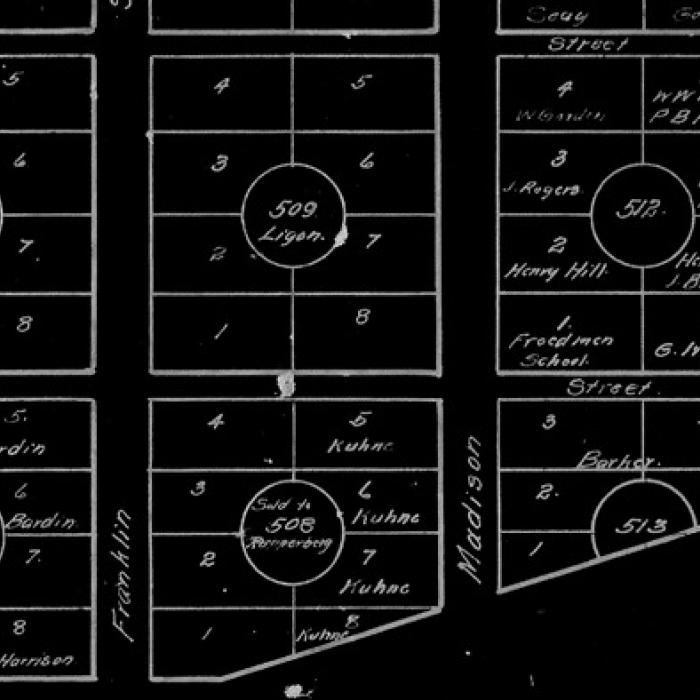
In Texas the educational activity of the Freedmen’s Bureau began in October 1865. Not only were day schools set up for African American children, but there were also night schools for adults and Sunday schools for both groups. Bureau funds paid teachers’ salaries and provided for their transportation, although salaries were partially subsidized by contributions from freedmen. Teachers were recruited from local white populations, from among freedmen themselves, and from the North by freedmen’s aid societies. A series of deeds in 1867 help us locate the site of the first Freedmen’s school in La Grange. On March 21, 1867 Nathaniel W. Faison and William W. Ligon, for the token sum of one dollar, transferred Lots 1 and 2 in Block 512 to the Trustees of the Methodist Episcopal Church South and the Missionary Baptist Church to be used for a school and place of worship. The Trustees named were George Phillips, George Ligon, Tilgham Eans, and Jesse Rogers. However, both lots were returned to Faison and Ligon the following May 29. The very next day Faison and Ligon sold Lot 1 in Block 512 for thirty dollars to the Trustees of the Freedmen’s School Association of La Grange, namely George Eans, Tilgham Eans, Jesse Rodgers, Fred Sutton, Moses Killon, William Ligon and Jackson Breeding. The final result was a school for black children maintained by the Freedmen’s Bureau that was built on the northeast corner of the intersection of Madison and Camp Streets.
The school built on Lot 1 of Block 512 measured 22 by 40 feet. We can get an idea of how the school was furnished from a Freedmen’s Bureau contract with F. Edwin Ingham of La Grange. He was hired to furnish material and build six 10-feet-long and 2 ½-feet-wide desks in “the usual style of common schools;” eight 10-feet-long plain benches with backs, one teacher’s desk, one seven-feet by ten-feet platform or dais raised eight inches above the floor, six 15-pane windows, and one fourfeet by six-feet blackboard. This contract does not specify that the furnishings are for the La Grange School, but we can assume that it was furnished in a similar manner.
Most of the early teachers in freedmen’s schools were white. The earliest hired here appears to have been Samuel Lea, who was in La Grange from March through June 1866. (We have no record of where his classes were held since they predate the school built in Block 512.) Other teachers of freedmen in La Grange were Cassie Westerfield, William T. Gooden, Julia and Mary O’Connor, M. C. Keith, and the last was J. Gottfried Schermack. Most spent only a few months in La Grange, the exception being Schermack.
Prof. J. G. Schermack was a young German immigrant who had arrived in New York in 1857 as a five-year-old boy with his parents. He enlisted in the U. S. Army on June 29, 1867 and served as a musician in post bands before being discharged at Austin on March 31, 1869. By January 1870, he had been hired by the Freedmen’s Bureau and was teaching day school, night school and Sunday school to La Grange children and adults. He was enumerated in La Grange in the 1870 census, living with the family of Rev. Murray Cole, a black minister who for a short while was hired by the Freedmen’s Bureau to teach school at Rabbs Prairie.
Surviving records show the regulations Schermack was to follow as set by the Texas Superintendent of Education with the Bureau of Refugees, Freedmen and Abandoned Lands. School hours were from 9 a.m. to 2:30 p.m. with a half hour recess at midday. As might be expected, the studies of primary importance were reading, writing and arithmetic. The holidays were to be the same as those customary in the white schools. Teachers were allowed to charge a tuition fee of one dollar per month up to two dollars per month for families with three of more attending school. Schermack’s records show that fewer than half of his students paid tuition.
Activities of the Freedmen’s Bureau in Texas were terminated on June 30, 1872. In a deed dated December 2, 1872, the Trustees of the Freedmen’s School Association of La Grange sold the school for $250, paid out of the Fayette County school fund by Jacob C. DeGress, Texas Superintendent of Public Instruction. The Trustees at that time were George McCauley, Jerry Hines, Down Penick, Jesse Rodgers, Tilman Eans, Fred Sutton, and Jackson Breeding. Ironically, all the trustees except George McCauley signed the deed with an X.
Although the era of the Freedmen’s Bureau had ended, black children in La Grange continued to attend school at the same site until 1903, with Schermack teaching in La Grange until at least 1887.
Sources: Fayette County Deeds National Archives Freedmen’s Bureau records at Ancestry.com