


Fayette County Ox-Team Caravans to Mexico During the Civil War, Part 1
-
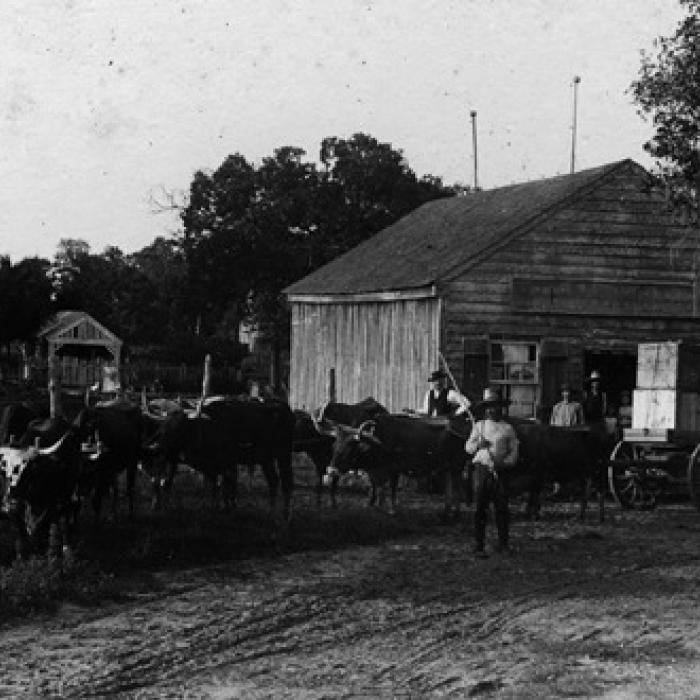 Louis Melcher captured this photo of George Huebner with his ox-team at O’Quinn in the 1890s; courtesy of the Fayette Heritage Museum and Archives.
Footprints Of Fayette
Fayette County is one of the most historic counties in Texas. In this weekly feature from the County Historical Commission, a rotating group of writers looks back at local history.
The following story, edited here for brevity, was written by Leonie Rummel Weyand and printed in the October 19, 1933 issue of the La Grange Journal. Within three years of their interviews, both of the profiled men had died.
Memories of the days when great cotton caravans meandered through miles of bandit-infested mesquite and cactus to bring fantastic profits to their owners still live vividly in the minds of George Huebner [1851 1936] and John Speckels [1847-1935] now living in La Grange. These two are the only living survivors of the Fayette County crew who so deftly handled ox-teams with the chant, “Haw,” “He,” and “Gee”. George Huebner, one of the two who did teamstering duties during the sixties, has a remarkable memory and a ready flow of picturesque words. He lives about twelve miles from La Grange on a rich black land farm, an inheritance from his pioneer father.
Until recently, Huebner’s physical vigor was a match for his alert mentality. A year ago, against the advice of his children, he attempted to break a wild horse which promptly threw him. An injured leg now hampers his movements but in no way diminishes his remarkable energy. Huebner has no patience with the mammypamby “finickyness” of the present generation. “I won-der,” he says, “How they would have survived just one trip to the Mexican border.” He made five.
“The dust”, he continues, “was awful — like a dense cloud. We looked like mounds of earth slowly moving along.” Huebner’s description of the dust menace is borne out by a story appearing in the Houston Tri-Weekly Telegraph of April 29,1863. “The drought extending from the mouth of the Rio Grande to within thirty miles of the Nueces, has proved to be the most thorough vegetation destroyer of any kind that has visited the country in years. The country begins to look as if seared with red hot irons.
Surface water sink holes give a feeble supply of water highly impregnated with offensive gases and saline properties. Oxen by droves are falling by the wayside, never again to bear the yoke or put their shoulders to the cotton loaded wheels. Rain we must soon have or the transportation jig will assuredly be up; the dust of the earth filling the eyes, nose, mouth and hair — making one feel gritty often and dusty always — dust of which a man eats his peck monthly and breathes daily — a terrible, inhuman, diabolical dust. A kingdom for a shower is the standing offer.”
In his smooth flowing style, Huebner tells the following story of his cotton hauling experiences: “Slave owners in Fayette County gave the Confederacy all the cotton they could spare. Those not owning slaves were forced to suffer confiscation of one-half of their cotton crop. Hauling cotton was a branch of military service that found favor among some Fayette County citizens; for, in spite of the long, hazardous journey, it was safer than serving in the army. Before being permitted to haul cotton, the teamster had to procure a detail, a contract with the government which pledged the teamster to haul at least five bales of cotton to Mexico, the round trip not to take longer than three months. The contract provided that certain contingencies such as a broken wheel, lost oxen and failure to secure food for the animals would be considered legitimate reasons for a tardy return. Some of the teamster members abandoned the ox-team, and proceeded on by steamer to New Orleans where they joined the Union forces. These men later drew fat pensions. Christian Lomaun, an expert ox-driver of the sixties, whose partner left his ox team in Brownsville, performed the unusual feat of driving back both ox-teams from the border.
“Since it was impossible to maintain a check on the drivers, killing time systematically was the order of the day among some of them in order to increase the time between the trips and to postpone compulsory military service. The teamsters received for services rendered, twelve cents per pound of cotton transported — but in Confederate money.”
Part 2 of Mrs. Weyand’s edited article will be published next week.