


Elevate Garden Production With Raised Beds
-
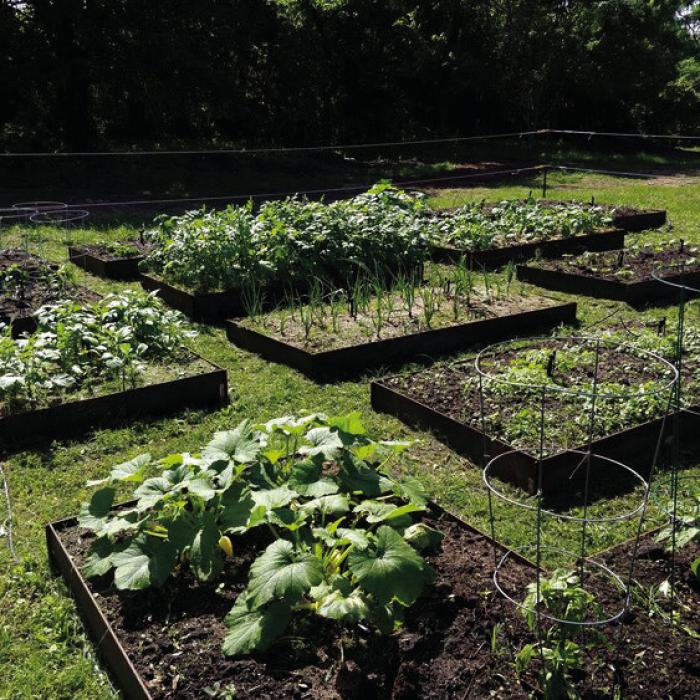 Martin Payne of Fayetteville designed and builds these metal raised bed garden kits. They are available for purchase from his company’s website, www.solitarioproducts.com.
 -
 Elevate Garden Production With Raised Beds
I wrote about my recent switch from raised beds to inground gardening last week. But I don’t want anyone to get the idea that raised beds are a bad way to garden. They’re not. For many people, raised beds are ideal.
Here’s what I liked about raised beds:
• You can sit on a bucket or a short stool while working the beds instead of kneeling or bending over. They can save your back from a lot of pain.
• Raised beds give you more control over what goes into your soil. With an inground bed, you’re dealing with the native soil. It might have lots of rocks and gravel in it that need to be removed (especially if growing root vegetables like carrots). With a raised bed, you can fill it with the soil of your choice.
• The soil in a raised bed stays less compact. You’re probably not going to walk across a raised bed. You can easily use a garden fork to break up any hard spots. Gardeners with an in-ground bed might be more likely to fire up a mechanical tiller when their soil gets compact. But tilling year after year can lead to even more soil compaction problems. Raised beds can help you avoid this.
• Raised beds provide gardeners with many architectural options for their landscapes. You can incorporate them into a landscape design.
Mel Bartholomew’s famous book “Square Foot Gardening” was the most successful gardening book ever published in North America. The book is probably one of the best guides for gardening in raised beds.
My friend and fellow gardener Martin Payne of Fayetteville designed and builds raised bed garden kits. These metal beds are easy for anyone assemble in minutes. I have one and I love it. It’s one of the only raised beds that I still use. Payne, an engineer by trade, is a big proponent of Bartholomew’s method.
“His background was engineering, and while us engineers can admittedly “overengineer” stuff - and wind up missing the important ‘art,’ Mr. Bartholomew did some really good work, in my opinion,” Payne said. “First he tried to learn about the then current, state-of-the-art. He asked a lot of questions like, ‘Why do you do this, and why do you do that?’ He often heard, ‘Because we’ve always done it that way.’ So, he set about to re-create vegetable gardening, with a ‘clean sheet of paper.’
Following Bartholomew’s advice, Payne designed beds that measure four feet by four feet or four feet by eight feet.
“Any longer than eight feet and the gardener would be tempted to step into, rather than go around, the garden, to get to the other side - thereby leading to compaction,” Payne said.
Bartholomew advised that gardens only need four inches of soil to grow most vegetables. Payne differs with him on this point.
“Texas is too hot and dry,” Payne said. “You need a few more inches of soil here.”
Bartholomew recommended a soil mixture of 1/3 sphagnum moss, 1/3 vermiculite and 1/3 compost.
“A number of years ago, some Texas Master Gardeners tweaked Mel’s Mix for Texas, suggesting ½ compost, ¼ peat or sphagnum moss and ¼ perlite or vermiculite,” Payne said.
I think that’s a good mix. However, I’m not a fan of peat or sphagnum moss. These products are not very renewable. It takes many decades for sphagnum to turn into peat. In many places around the world, these products are mined faster than they can regenerate. Plus, peat moss is acidic and antimicrobial. This is a benefit for greenhouse growers who need sterile soil to control disease problems. But as an outdoor grower, I want a diversity of microbial life in the soil.
Coconut coir, a fibrous byproduct from coconut processing, provides all of the structural benefits of peat moss, but it’s not acidic or antimicrobial. Accordingly, I recommend using coconut coir in place of peat moss.
Bartholomew realized that certain plants can grow quite close to together without harming each other. When planted in this way, they require less water and nutrients.
“He worked out a “recipe” for planting plants on a one foot grid within your four foot by four foot garden,” Payne said. “And he strongly recommended using a literal grid – say, a wood lath - for cordoning off these one foot by one foot spaces. In his books you can find recommendations for each plant, in terms of numbers per square, etc. Square Foot Gardening is not the only way to garden in raised beds, but there are some great lessons learned.”
Payne said Bartholomew’s method inspired him to create his Designer Raised Bed Garden Kits.
“After crafting some Square Foot Gardens from Western Red Cedar about a dozen years ago, and watching the termites eat them in a few years, I came up with the idea for the Designer Raised Bed Gardens,” Payne said. “I wanted something that would last for many, many years, and which was easy to assemble, and would be weed-eater proof.”
Payne recommends laying weed barier down under and around the beds to keep grass and other weeds from growing up through the bed. You can also lay a few inches of gravel on top of the weed barrier around the outside of the beds to keep weeds from growing up the sides.
Payne’s 4x4 kits are eight inches tall and hold about 11 cubic feet of mix. He recently installed several of them at the new Fayetteville Community Garden. Go there to check them out. And if you like what you see, you can buy one at www.solitarioproducts.com.