


Don’t Get the Soggy Garden Blues
-
 Don’t Get the Soggy Garden Blues
 -
 Don’t Get the Soggy Garden Blues
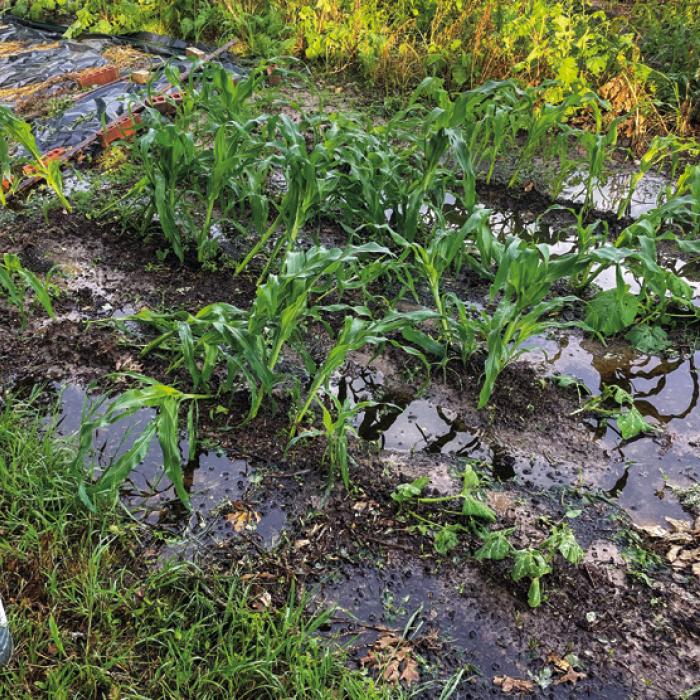
I haven’t watered my garden in weeks thanks to the abundant rainfall in Fayette County recently. I got three inches of rain at my place near Cozy Corner on Monday, and more is falling as I write this column.
But excess moisture comes with its own problems. Diseases like powdery mildew thrive in wet conditions. Cloudy skies block out the sun, which causes stunted growth. Drenching rains destroy soil structure, washing away nutrients and beneficial microorganisms. Weeds pop up everywhere. Standing water breeds storms of mosquitos that make us not even want to walk around in the garden.
Don’t let these soggy days discourage you, though. We’ll beg for rain in a few months when the heat of summer arrives. In the meantime, there are a few ways to deal with excess moisture in the garden.
Long time readers of this column know I’m a big proponent of mulch. Nature hates barren soil. You almost never see barren soil in a natural landscape. We usually apply mulch to conserve moisture. But mulch also helps to alleviate problems related to excess moisture.
Mulching the soil around plants helps to keep the soil structure intact. Nutrients and microorganisms stay in place instead of washing away. Mulch can absorb quite a bit of rain, so it helps to moderate soil moisture during a heavy downpour. It also acts as a barrier to the raindrops that disturb the soil particles as they fall, especially in heavy rains.
Mulch prevents the soil from turning into mud. A healthy soil structure breathes. Tiny gaps between the soil particles allows air to reach plant roots. Plant roots cannot breathe when soil turns into mud, .
In my opinion, wood chips from native trees make the best mulch for the vegetable garden. Fresh wood chips spread about two to three inches thick on top of the soil provides an ideal mulch. You should never incorporate mulch into the soil. If you do, the woody parts of the mulch will steal nitrogen from soil as they decompose, which takes away nutrients from your plants. Instead, lay mulch on top of the soil.
Fresh wood chips can be hard to find, unless you have a woodchipper. I often use mulch from the Fayette County Recycling Center because it’s so cheap. Some folks worry about the County mulch introducing weeds to their gardens. I have experienced this, too. But I don’t mind managing the few weeds that come with this cheap mulch.
On the other hand, if you don’t lay mulch in your garden, you can dry out wet soil with light cultivation. I recently expanded my vegetable garden and I haven’t gotten around to mulching the surface of this new spot yet. I planted some corn and squash in it. I’ve been using a stirrup hoe to lightly cultivate in between the rows and plants. If I hadn’t done so, I believe I would be facing some major water logging problems.
Organic gardeners often use a baking soda spray to control fungal diseases like powdery mildew. To make it, mix one tablespoon of baking soda and ½ teaspoon of Dawn dish soap with one gallon of water in a pump-up sprayer. Spray the affected plants, and make sure to apply some to the undersides of leaves and the stems. Neem oil is also commonly used to control powdery mildew. However, neem oil is more of a preventative than a treatment.
Powdery mildew is a fungal disease, and copper is a well-known organic anti-fungal agent. However, copper builds up in the soil and causes all sorts of nutrient problems, so I stay away from copperbased products.
I recently heard about a study conducted by some researchers in South America who used diluted milk to control powdery mildew, and I plan to give it a try. These scientists sprayed affected plants with a 10 percent solution of milk (one part milk and nine parts water). Wagner Bettiol, a scientist from Brazil who headed the study, found that weekly sprays of milk controlled powdery mildew in zucchini just as effectively as synthetic fungicides. He wasn’t sure why, but he believes it has something to do with milk proteins.
I read elsewhere of gardeners who use a ratio of 40 percent milk to 60 percent water. Some used skim milk; others used whole milk. Bettiol used raw milk, and that’s what I’m going to try. Those of us in Fayette County can buy raw milk from The Jersey Barnyard near La Grange or Stryk Dairy in Engle.
How do you deal with excess moisture in the garden? I’d love to hear from you. Email me at andy@fayettecountyrecord. com.