


Citizens Speak About Pollution Concerns
-
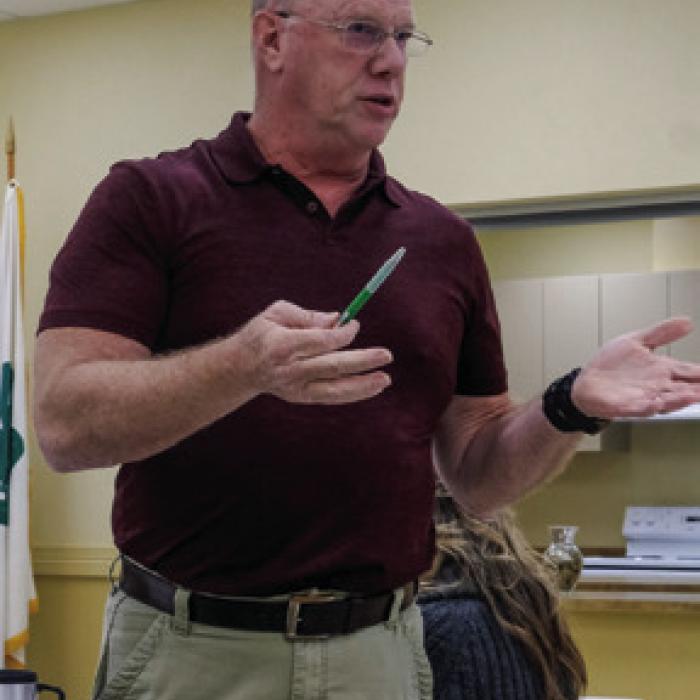
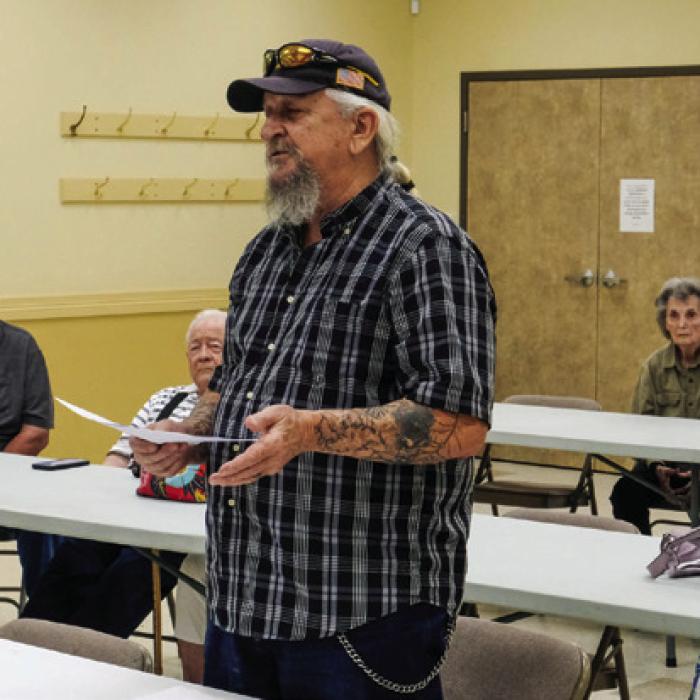 Jerry Moerbe of Nelsonville, pictured above, was part of a group of about 14 area citizens concerned about possible groundwater pollution from the Fayette Power Project who attended the Fayette County Groundwater Conservation District board meeting on Monday. Moerbe said he wants the District to step up groundwater monitoring. FCGCD General Manager David Van Dresar, pictured below, told the crowd that the District is prepared to launch a monitoring campaign. Photos by Andy Behlen
 -
 Citizens Speak About Pollution Concerns
A group of local citizens concerned about pollution runoff from the Fayette Power Project spoke at the Fayette County Groundwater Conservation District (FCGCD) meeting on Monday. They want the district to step up groundwater monitoring for pollution.
After hearing their comments, FCGCD General Manager said the district is prepared to launch a monitoring program. He invited property owners to add their water wells to the monitoring network. However, Van Dresar said the District has little authority to enforce environmental regulation.
All of the citizens who spoke did so during the public comment period at the meeting. By law, the board of directors could not deliberate on their comments or take any action since the topic was not on the meeting agenda. FCGCD limits public comment to three minutes each. Most of the citizens spoke very briefly, if at all, and yielded their time to local pollution activist Jerry Moerbe of Nelsonville.
Elizabeth Parry, who lives near Fayetteville, expressed her concern about groundwater pollution.
“Over the past several years, we have experienced groundwater quality concerns that have required extensive testing, water treatment, and significant personal expense,” Parry said. “As private well owners, we do not have the protections available to municipal water customers. And when questions arise about the water quality, the burden falls entirely on individual homeowners.
“Whether these concerns ultimately prove to be related to industrial activities is precisely why robust groundwater monitoring and transparency are so important,” she added. “I respectfully request that the district prioritize expanded groundwater monitoring and public reporting for private wells located near potential sources of contamination.”
Dennis Geesaman of Flatonia, who won the Republican nomination for State Representative, also spoke to the board.
“I appreciate the work the board has done in trying to protect our water,” he said. “But I also ask that you take any actions appropriate to deal with ongoing issues that are affecting our groundwater.”
Geesaman then yielded his time to Moerbe.
Moerbe said he wants the District to begin monitoring groundwater for pollution around the power plant. He believes runoff from the coal and ash piles has carried pollutants off the power plant property and into the groundwater of neighboring property owners.
“You’re our last hope to get the water situation straightened out, to try and make the power plant do something about poisoning everybody’s water that’s going down the streams and underground,” he said.
Moerbe said the Lower Colorado River Authority, which operates the plant, has little incentive to clean up on its own accord.
“The power plant doesn’t care,” he said. “They’re trying to burn up as much coal as they can and sell as much electricity. And their whole idea of remediating the problem is to throw a tarp over it when they get ready to shut it down and let it leach into the water until it quits leaching. And that may take 1,000 years.”
Moerbe said the District may need to increase its tax rate to pay for the monitoring program. Furthermore, he criticized the money the District spends on its hydrology expert and attorney. Van Dresar responded by saying the District is willing to launch a monitoring program. However, he said State law does not give groundwater districts authority to regulate environmental matters. He said groundwater pollution enforcement falls on the Texas Commission on Environmental Quality (TCEQ).
“(TCEQ) will not act against LCRA because they’re too married to the governor,” Moerbe said.
As Moerbe implied, LCRA board members are appointed by the Governor of Texas with confirmation by the State Senate. LCRA began as a state entity focused on managing the water resources of the lower Colorado River. Part of their mission involved hydroelectric generation, which brought electricity to the rural areas of Central Texas. But in the decades since its formation, LCRA has transformed into one of the region’s largest suppliers of electricity. Today LCRA is a multibillion dollar enterprise that is often described as a “quasigovernmental entity.”
“I don’t believe anybody in this room or anybody that’s sitting up at the state is in disagreement that there is pollution on the LCRA site,” Van Dresar said. “That’s why they have so many administrative orders against it. So we don’t have to prove that up. That’s already been proven. Now, what are they going to do to fix it? On that, I have zero authority.”
Van Dresar said State law limits groundwater districts to managing the use of groundwater resources. The District can set pumping limits and require permits for certain types of wells. But they have little authority to enforce anything related to water quality or pollution, he said. Nonetheless, Van Dresar said a new monitoring program could provide the District with pollution data that he could then present to the TCEQ. Right now, LCRA self-reports data related to pollution runoff.
“If we found something that would be out of the ordinary, we take all of the data and forward it to Region 11 of TCEQ, which is their enforcement region here,” Van Dresar said in an interview with the Record after the meeting.
“Wehavetoknowwhatthe background is, and we have that from a 2013-2017 study,” he added. “Then we can see if something’s changed. If we have a spike in this, or it’s not supposed to be here and, boom, it’s right there.”
Van Dresar said that if the District’s monitoring network detects movement or increase in pollutants, TCEQ may pay especially close attention to it.
“All of this stuff is factual information from an outside source, and it’s data that is coming from an authority,” Van Dresar said. “That does, I think, add weight to the argument.”
Anyone interested in volunteering their water well to become part of the monitoring network should contact the FCGCD. Their phone number is (979) 968-3135. Their office is in room 115 of the Fayette County Ag Building, located at 255 Svoboda Ln. in La Grange. You can also email the District at info@fayettecountygroundwater. com.