


Supak Reflects on 20 Years in Office
-
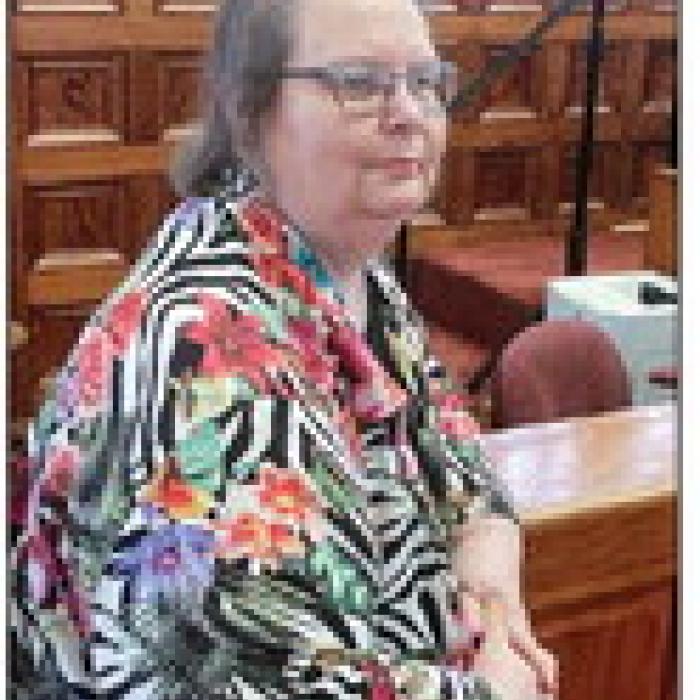 Peggy Supak
Peggy Supak stepped down as Fayette County Attorney on New Year’s Day after 20 years in office.
She’s not going far, though: just down the hall. She and her successor, James Herbrich, will trade places - he as the County Attorney and she as an assistant county attorney.
Supak sat down for an interview with the Record last Friday to reflect on her time as Fayette County’s lead prosecutor and top legal advisor.
“Fayette County is lucky to have, and I have been so fortunate to have worked alongside the good, competent and caring staff of the county attorney’s office and other county offices over these years,” she said. “We have laughed together and cried together while tending to the matters presented to us over the years. The position has been entertaining at times, frustrating at times, and gut-wrenching at times, but it has never been boring.”
Supak, who grew up in La Grange, said she hadn’t considered a career in law until college.
“I always wanted to be a coach,” Supak said. “My parents said, ‘You can coach on the side. But you’re not going to make any money being a coach.’ Softball was my love.”
She went on to play softball in college at Sam Houston State University. During her time there, she considered a career in journalism. She worked at the Montgomery Ward department store in Huntsville, which was owned by Charles Boyer.
“The Boyers were a won- derful family, and they kind of teetered me over to law school,” Supak said. “I graduated and stayed in Huntsville over the summer, and then I moved to Houston to go to law school.”
She enrolled in the South Texas College of Law in Downtown Houston in the fall of 1984.
“I moved to Houston and actually roomed with Renee Mueller, who is the County Attorney in Washington County,” Supak said. “She had one year of law school under her belt at that time. She graduated and moved back to Brenham. I stayed down there and clerked with a firm by the name of Donisi and Lang.”
After earning her law degree, the firm offered Supak a job. She stayed in private practice with Donisi and Lang until 1993, when she moved back to Fayette County.
“It was more of a civil practice,” she said. “I did some juvenile law. I tried a couple of DWI cases on the defense side. I did some divorces. Most of the work was in the construction industry. We represented a bunch of equipment companies. We did a lot of liens, that kind of stuff.”
Supak said she refused to take two cases during her time in private practice.
“One was a guy who charged up all his credit cards and wanted to come in and file bankruptcy,” she said. “I told the partners, ‘I can’t do this. This is legalized stealing.’ They didn’t make me do it.”
The other one was a child abuse case.
“The wife had come in and wanted us to represent her husband who had molested their child,” she said. “The guy was a long-time client of the partners. I asked the lady, ‘Do you think he did it?’ She goes, ‘Yeah, I believe my child.’ I was like, ‘Why are you here?’ And she said, ‘He needs representation.’ I get that, but I’m not the person to do it.
“I called the partners and said, ‘You can terminate me, but I’m not going to do this.’” Supak said.
In 1993, then-Fayette County Attorney John Wied offered her a job back in her hometown as an assistant county attorney.
“John was a great mentor, a great boss,” she said. “He and I still stay in touch on a regular basis. I loved working for him and Fayette County. I learned a whole lot. Things have changed a whole lot since ‘93.”
Supak left a lot of money on the table when she moved from private practice to government service.
“I was never a big city girl,” she said. “I mean, I’d never trade my time in Houston for anything. I learned so much. It’s just not where I wanted to be. I wanted to come back to a smaller community, my community, to make a difference. In Houston, it was a job. I didn’t feel like I was making a difference in anyone’s life. Coming back home was a win-win all the way around. But, yeah, I want to say I was making three times as much in Houston when I first came back home.”
Supak said the biggest change she’s seen involves mental health.
“We’ve needed to wake up for a long time regarding mental health,” she said. “We don’t do a real good job of that in the State of Texas. We’re making some in-roads. We’re finally realizing so many people have mental health issues. Right now, in our juvenile caseload, we have seven kids in placements. And those seven kids need to be in those placements. Most of it is because of their mental health issues, significant mental health issues.”
When John Wied decided to step down as County Attorney, Supak ran for the office and won. She took office in Jan. 1, 2005. At the time, Dan Beck was the district judge. Supak said she learned a lot from Judge Beck.
“I’ve had this philosophy, and it’s something Judge Beck talked to me about,” she said. “He said 90 percent of the people we deal with just made bad judgements and bad decisions. Ten percent would just as soon kill you. You learn how to see those signs. So for those 90 percent of the people, I want to get them treatment. I’m a big proponent of getting people help.”
Supak said she’s also been a big proponent of deferred adjudication. Under deferred adjudication, defendants facing prison time can instead be placed in a community supervision program. The court can order treatment followed by a period of probation with strict requirements for staying employed, drug and alcohol testing, and community service. The County Attorney’s office monitors their progress. If they fail at any step of the way, the court can order them to prison. But if they succeed, they can avoid prison time while getting their life back on track.
“They’re on my watch, as opposed to when we send someone to prison,” Supak said. “We had one of our biggest drug dealers who we sent to prison for 20 years. Two and a half years later he was back in our community selling drugs and laughing at me. I can’t tell you how upset that made me. At that time, I said, ‘I want him on my watch.’” Supak said the case of The Railroad Killer, Rafael Resendez- Ramirez, was probably the most interesting and impactful case that came across her desk. On June 4, 1999, Josephine Konvicka was found bludgeoned to death inside her home in Dubina. Her murder was later linked to more than a dozen others committed by Resendez-Ramirez. He was eventually tried, convicted and sentenced to death in Houston for the murder of Claudia Benton.
“Kenny Schmidt and I drove down every day to his trial in Houston,” she said. “That was very interesting. Remember, back at that point in time, every time the trains came through, everyone was on a heightened sense of alert. Everyone was really scared here. It was probably the biggest event to shake our community.”
Supak was the last Democrat to hold office in Fayette County before her term expired. Fayette County was still a Democratic county when she first joined the Fayette County Attorney’s Office. Her predecessor, John Wied, was a Democrat. So was the District Judge at the time, Dan Beck, and the County Judge, Ed Janecka (Janecka switched to the Republican Party in 2014).
The political winds here have since shifted to the right. Supak said she disagrees with many Democratic policies. She said she also disagrees with many Republican policies. Last year, when her seat came up for election, Supak drew a Republican challenger – Mark Elvig. Running as a Democrat would almost certainly lead to defeat, since nearly 80 percent of Fayette County voted Republican in the last election. Instead of switching parties, Supak decided to step down. She was also suffering some health problems at the time, while also taking care of her aging parents.
Herbrich ran as a Republican and defeated Elvig in the Republican Primary. He was unopposed in the General Election.
“I’ve never looked at the job as politics,” she said. “I grew up in the Democratic Party of that time. I’m Catholic, pro-life. I believe in the things the Catholic Church teaches. But I felt like, and I continue to feel like, there has got to be some loyalty to the Party and to John (Weid) and Judge Beck who basically helped put me here. I never felt like, for me personally, that it was the right thing to do – to change parties so I could keep my job.
“There is nothing political about what we do in this office,” she added.
Despite their different political parties, Supak said she believes Herbrich will do a fine job as County Attorney. She helped train him, after all. Supak offered him the following advice: “Always be fair. Look at both sides. There are always two sides to everything. And be sure to listen. As I’ve told him a lot of times, especially in sexual assault cases, I like to visit with the victims personally to find out what it is they need for their lives, whether that’s getting up on the witness stand to face their abuser, or whether its to make (the defendant) admit what they did is wrong. Those are two different things sometimes. Have them be a part of what we’re doing, because this is their life. This happened to them. I want them to always be a part of the process. I think we’ve done a fairly decent job of that over time. At least we tried.
“And I’ve tried to impart to James that same philosophy: that 90 percent of the people we deal with just made a mistake,” she added. “Here’s another philosophy I share with everybody here: ‘You be nice. Be nice. Be nice. Until it’s time not to be nice. And you’ll know when that is, or I’ll tell you.’ For people who it’s their first time in the criminal justice system, they don’t know how it works. We don’t need to be jerks to them. When you get to the point where you deal with somebody five times, and you know they’re jerking you around, you get to the point where you’re not so nice. Because they know the system.”
Supak will stay on as an assistant county attorney under Herbrich. She will handle juvenile cases and child protective services cases – areas that she is extremely passionate about.