


Lawrence Leslie McVey, World War I Hero
-
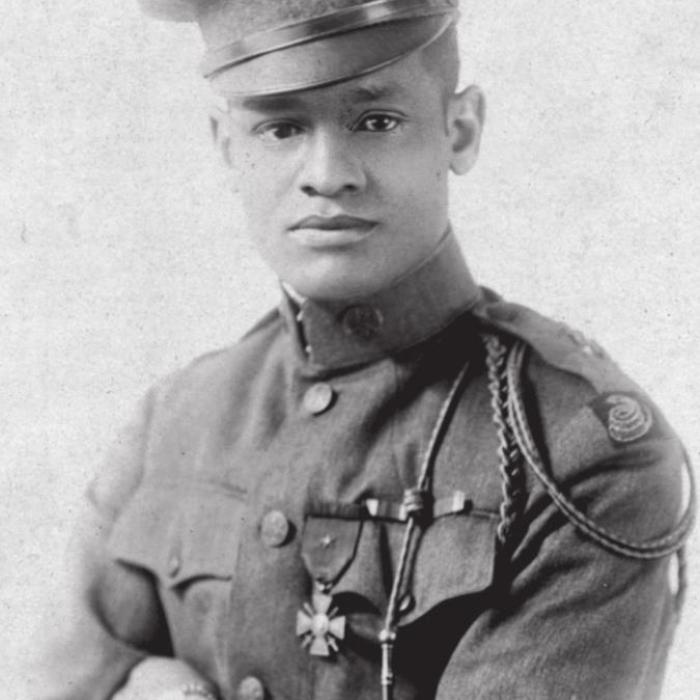 Cpl. Lawrence McVey, wearing his Croix de Guerre. Photo Original at the National Museum of African American History and Culture
In 1917, when the United States involvement in World War I was eminent and young African American men were required to register for the draft, they were expected to serve in segregated units led by white officers. At the time, those in command feared they would perform poorly in combat, while others feared that well-trained black soldiers would be a threat to society when they returned home. Of the 200,000 black troops who were sent overseas, most, like Bishop McVey of Flatonia, served in support roles. Bishop’s younger brother, Lawrence, had a very different experience.
Born May 11, 1897, the youngest of Milam and Elizabeth (Jackson) McVey’s five children, Lawrence Leslie McVey grew up on a farm on the northeast edge of Flatonia.He moved to the Harlem neighborhood in New York City when he was eighteen and that is where he enlisted in the Army on October 25, 1917.
By January 1, 1918, he had arrived at Brest, France with the allblack Company D of the 369th Infantry, commanded by Col. William Hayward. Their initial duties including cooking and digging latrines. However, after more than three years of fighting, the French were desperate for reinforcements. General Pershing did not want his white troops serving under French command. However, at Hayward’s urging, he sent the 369th to train with the French.
In April, after a mere three weeks of training, the 369th was sent into battle, some of the first American units to reach the front lines. Never surrendering a trench, they became known as the Harlem Hellfighters and would become the longest serving, at 191 days, and most decorated front-line American combat unit in the war. Their greatest contribution to the war effort came in the early morning hours of September 30th at the outpost of Sechault, a tiny village in Champagne. McVey was later cited for displaying “great courage by leading his squad to the attack of a nest of machine guns until he was wounded.” Taking out the German machine gunners set the stage for the American Expeditionary Force attacks that would eventually end the war. McVey was shot in the arm and awarded the French Croix de Guerre with a Bronze Star for bravery. He was also promoted to Corporal before his discharge. In 1932, when the modern Purple Heart award was created, he also received that medal.
The heroes’ welcome the 369th received on February 17, 1919 when they paraded up Fifth Avenue in New Yok was soon replaced by a return to bigotry that made finding good jobs difficult. Lawrence remained in New York, where his mother eventually joined him and other siblings. Known as Mac by his friends, he worked in his brother’s barber shop until he eventually found work as a waiter with the Pennsylvania Railroad. He married twice and had a son, Lawrence McVey, Jr., but was living with his sisters when he was beaten to death in a New York City park on September 13, 1968. He was seventy-one years old. Both he and Pvt. First Class Bishop McVey lie buried in the Long Island National Cemetery at East Farmingdale, New York. An obituary written by his family described his “wholesome good humor, cheerful disposition and frankness of expression.”
Corporal Lawrence Leslie McVey’s story might have remained untold in Fayette County if he had not been mentioned in the May 2021 issue of Smithsonian magazine. This article led to a treasure trove of beautiful photographs and other documents that were donated by McVey’s granddaughter to the National Museum of African American History and Culture, a Smithsonian Institute museum which opened on the national mall in Washington, D. C. in 2016. We are proud to finally share his story where he was born.
Sources:
The United States World War One Centennial Commission website, https://www.worldwar1centennial.org/
Williams, Joe. “Profiles in Courage: A Salute to the bravery of the Harlem Hellfighters,” Smithsonian Magazine, May 2021, pages 28-30.
Magagnini, Stephen. “Harlem Hellfighter recognized in new national museum of black history,” Sacramento Bee, October 8, 2016. https://www.sacbee.com/news/local/history/article106981867.html
McVey entries at The National Museum of African American History and Culture website, https://nmaahc.si.edu/
Census records, military records