


La Grange M-K-T Depot Celebrates 125 Years
Footprints Of Fayette
-
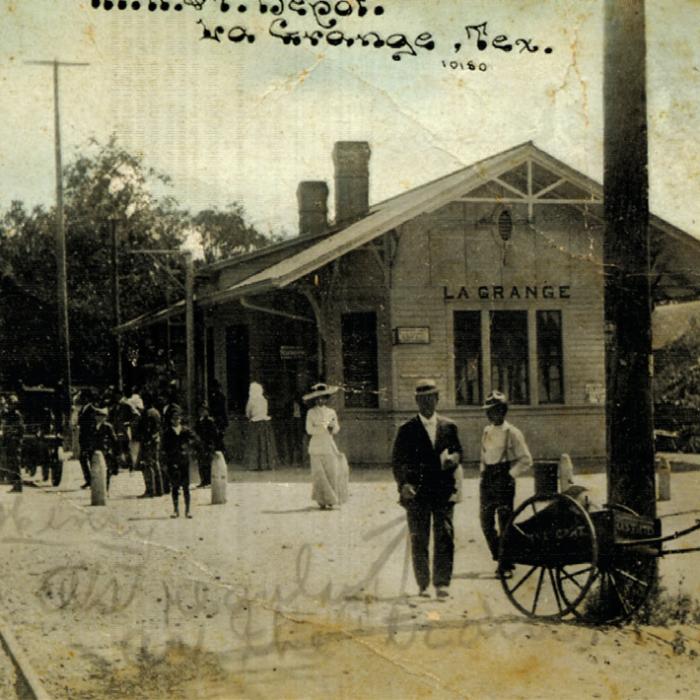 Depot Circa 1900.
 -
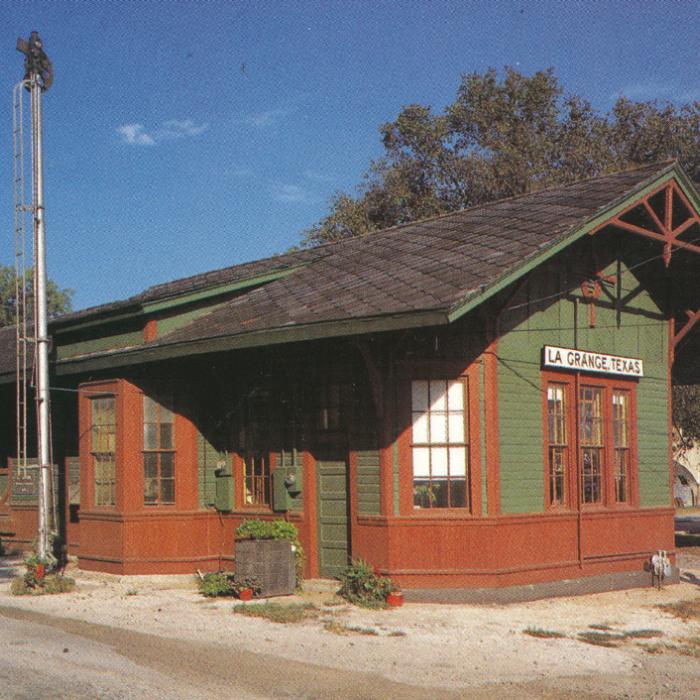 La Grange Depot 1994.
Fayette County is one of the most historic counties in Texas. In this weekly feature from the County Historical Commission, a rotating group of writers looks back at local history.
The Missouri-Kansas-Texas Railroad Company’s depot in La Grange, Texas, played an important role in the transformation of the county seat town from its moribund post-Civil War decline to a prosperous shipping point for the area’s lush agricultural produce. La Grange, founded when John Henry Moore built a twin blockhouse in 1826 within what are now the city limits, was the site where La Bahia Road crossed the Colorado River. Until the arrival of the railroad, however, its lush agricultural products could be transported to market only by wagon. The first railroad to get a charter in Texas and actually lay track was the Buffalo Bayou, Brazos & Colorado Railway Company, chartered on February 11, 1850. Legislation for the charter was introduced and sponsored by John W. Dancy, Senator for the La Grange District and “one of the earliest and ablest advocates of railroads.” The original charter did not call for crossing the Colorado River at Alleyton, across from Columbus, but instead to go up the east bank of the river through La Grange to Austin. With the onset of the Civil War, construction halted, with the rails stopping at Alleyton. After the war, work resumed on the railroad, by that time known as the Southern Pacific, but San Antonio had become a more desired goal than Austin. La Grange still remained 27 miles from rail. Not until 1880 was a “tap line” built to La Grange. On December 31, 1880, the first train reached La Grange on that line, giving the town its first rail connection.
Meanwhile a rival line, which would become known as The Katy (M-K-T), was crossing into Texas from the north. The Tayor, Bastrop & Houston Railway Company, chartered April 26, 1886 and controlled by the M-K-T, built a line that reached La Grange on August 17, 1887. This gave La Grange rail connections both to the north and the south, with two different railway systems providing service. “The advent of this road … will mark an epoch in the history of La Grange,” the newspaper wrote. “There are many reasons why our citizens should rejoice at its arrival.” It is within this context that the abiding significance of the Katy Depot is seen.
Overview
As the nineteenth century neared its close, La Grange had three depots. The Galveston, Harrisburg & San Antonio Railroad (Southern Pacific) had a passenger depot and freight platform at what today is the 500 block of East Travis Street. The TB&H (Katy) built a freight depot two blocks to the north, on Lafayette Street slightly farther east than the Southern Pacific. Both were in the town’s principal warehouse district, with lumber sheds, a cotton gin, cotton oil mill, feed mills, an ice factory and so on. The third depot was the Katy passenger station, which had been built downtown just to the north of the Lester Hotel and near the County Courthouse.
The Taylor, Bastrop & Houston Railway Company (TB&H) was building toward La Grange in 1887. Already it had a large facility in Smithville and local citizens of La Grange had agreed to provide a depot site. J.H. Hooper, TB&H construction superintendent, arrived in town Friday, March 17, 1887 to consult with “the executive committee” “in regard to the location of the depot and other matters.” The La Grange Journal reported that the committee voted 7 to 5 in favor of a 15-acre tract as the site for a “down town passenger depot.” A committee was appointed to “procure deeds for the depot grounds” and negotiate with Hooper for the depot.
With this incentive, the TB&H (later to be known as the Katy Railway) built its tracks from Smithville to Primm (whose name was later changed to Kirtley), then through West Point and Plum into La Grange, down Lafayette Street. The tracks then continued to Halsted and Fayetteville, then across the Colorado County line, ending at Boggy Creek. There an “Armstrong turntable” was installed to enable the engines to be turned for the return trip north. These devices got their name from the “strong arms” required to revolve it by brute force after an engine and tender had been driven onto it. This allowed the engine, once turned around, to go back in the direction from which it had come. The first train to arrive in La Grange on the Taylor, Bastrop and Houston Railway’s new tracks chugged into town about 4 o’clock on the afternoon of August 17, 1887. Its depot served passengers going to and from La Grange for nearly a decade. But on March 19, 1897, tragedy struck.
Tragedy Strikes
“About 4 o’clock last Friday morning [March 19, 1897] the citizens were aroused from their slumbers by the ringing of the courthouse bell and the firing of pistols, occasioned by a fire which started in the new city hall,” the La Grange Journal reported. “The building was soon a mass of flames, and was totally destroyed. The new twostory building of Mr. John Stoehr, boot and shoe maker, adjoining the city hall next caught, and it was soon a pile of ruins. The fire next spread to the M., K. & T. passenger depot, and it suffered a like fate. The firemen were helpless to prevent the spread of the fire, as all of their apparatus were in the city hall, and the building was far too destroyed when the fire was discovered to save any of it. Had they saved their hose cart they would have been able to confine the fire to the city hall, as they could then have thrown four streams on the fire and checked its ravages. The fact that there was a hard rain just before the fire, prevented it from spreading to the business portion of the town, as there was a strong northwest wind blowing, which carried burning shingles four and five blocks distant.”
Replacing the depot started quickly (“Work on the new ‘Katy’ depot has commenced, and La Grange can soon boast of another depot,” the Journal reported August 19, 1897). By October 7, however, attitudes had changed. “The new M.K.&T. depot is nearing completion very slowly,” the Journal stated. “For the past month no work has been done on the building, when it should have been completed by this time and ready for the convenience and comfort of the road’s patrons. They are now waiting for the window and door frames to arrive, and we suppose the travelling public will have to wait another six months before they will have the use of a decent depot. It is a shame for a town the size of La Grange to be without a depot for nine months or a year, and it should be completed at once. It seems as if the ‘Katy’ people are trying the patience and good nature of our citizens, just to see how long they will stand it.”
Perhaps the verbal prod was effective. “The old cars used so long by the Katy for depot purposes here and which had become an eye sore to our people, have been removed from the right of way and the passenger depot grounds are being put in first-class condition,” the Journal reported on November 11, 1897.
That building has now endured for 125 years. Built of wood, in standard Katy architectural design, it included an office with ticket windows, operator’s desk (in a bay window which allows the agent to look down the track in both directions), telegraph and semaphore controls; a “White Waiting Room” approximately 22 feet, 10 inches by 16 feet, 2 inches; and a “Colored Waiting Room” approximately 13 feet, 6 inches by 11 feet, 10 inches. This building, on a concrete slab, measures 47 feet, 5 inches by 24 feet, 3 inches.
Sanford insurance maps show that the original loading platform was extended and the building divided into rooms sometime between 1901 and 1906. Attached to the passenger depot was an elevated freight area on pier and beam, measuring 22 feet, 10 inches by 18 feet, 3 inches. A small staircase leads from the depot office up to the elevated freight room. Detailed drawings of the combined structure were made by the U.S. Department of the Interior, Office of National Parks, Buildings, and Reservations, April 7, 1969, and another by James A. Recek in the Summer of 1975. (Copies are attached.)
For fully six decades – from 1897 to 1957 – this wooden depot served passengers coming and going by the Katy Line. A train bearing Former President Theodore Roosevelt made a station stop at La Grange in 1911, where he spoke for five minutes to a large crowd of citizens who came to see him. Both regularly scheduled trains and specials, such as one that took school children to the Shrine Circus in Houston, called at the La Grange depot.
For many years, M-K-T passenger trains between Dallas and Galveston stopped at La Grange twice a day in each direction, along with a “mixed” train that ran between San Marcos and Houston daily except Sunday.
The Decline of Passenger Service
Eventually, however, rails could no longer compete with automobiles and airplanes for passenger transport. All across America, railroads petitioned government regulators for permission to abandon little-used tracks and to discontinue service (both passenger and freight) to various places. In 1942, the Southern Pacific abandoned its 24.76 miles of track between Glidden and La Grange, leaving freight service to only the Katy.
By 1957 passenger patronage on the Katy had declined to the point that the MKT decided to end passenger service in most ofTexas. Its last streamliner serving La Grange was The Texas Special (Trains 21 and 22) between Kansas City and Houston, including a stop at La Grange. The final Texas Special run came on November 23, 1957. A group of citizens calling themselves the “Last Ride Gang” waited at the station in Plum to board the last regularly scheduled passenger train that would arrive in La Grange. Although it was scheduled for a 3:04 p.m. arrival, the train was running late as usual. Braving rain, sleet and nearly freezing temperatures, the Last Ride Gang arrived in La Grange about 7:20 p.m. The train was manned by Conductor E.W. Hatch, Brakeman J.C. Simpson, Engineer J.C. Smith and Fireman Fred Scroggin. Eight years later, the M-K-T ended passenger service entirely. On June 30, 1965, the last of Katy’s famous trains ran from Dallas to Kansas City, making the Katy System a freightonly railroad.
Although passenger service had ended, freight trains continued to rumble past the old depot in La Grange, and the M-K-T maintained an office in it at least until March 1983. The front part of the building was leased by Bloomin’ Junction, a floral shop owned by Sharon Satterwhite, and Bahnhof Galerie, an art gallery. By March 1982, Bloomin’ Junction had moved to a new location at 111 South Vail Street, but the La Grange Chamber of Commerce obtained space in the depot for their offices. The Chamber moved its office to 129 North Main in 1991, but Bahnhof Galerie continued in the old depot building until 1994. Next came a beauty salon, the Cutting Edge, until 1996, then Trends Hair Design until 1998, and a video rental store.
Meanwhile, an effort was begun to preserve more permanently the historic property, by this time owned by the Missouri Pacific Railroad Company, a Delaware corporation. This resulted in the Missouri Pacific selling the depot and 0.211 acres on which it sits to the La Grange Area Chamber of Commerce. The deed transaction was officially recorded on August 28, 1996.
Group Saves, Preserves Depot
A few years later, the Chamber of Commerce offered the old depot for sale. Rail enthusiasts formed a nonprofit corporation, Friends of the La Grange Railroad Depot, that would be devoted specifically to preserving and utilizing the depot. From several bids for the property, the Chamber selected the offer of $45,000 made by Friends of the Depot. On October 22, 1999, the chamber deeded the property to this organization of railroad devotees. Friends of the La Grange Railroad Depot not only refurbished the old depot, but also gathered an impressive collection of railroad equipment, artifacts and memorabilia in order to create an enduring museum. They later offered ownership of the depot property to the City of La Grange, with the provision that the Friends would continue to staff and maintain its operations. On December 9, 2002, the deed was officially recorded to the City. With an $80,000 grant from the Texas Department of Transportation, the City of La Grange fully managed the restoration process. Some elements that had been removed over the years, such as the chimneys, were restored to assure historical accuracy. Restoration efforts carefully followed the detailed architectural drawings that had been made in 1969 and 1975. The City, with the help of the Friends and of a grant, put a new roof on the depot in 2015. The 125-year-old Katy Depot has been well preserved and well maintained.
A number of items that were original to the depot were found and either bought or acquired on loan. These include the depot’s original M-K-T safe, pot-bellied stove, roll-top desk and some original waiting room benches. A large stand-up stationmaster’s desk originally at the Fayetteville MKT Depot also was acquired.
After title to the property was acquired by the City of La Grange, Friends of the La Grange Railroad Depot have continued to operate and maintain the depot for educational and historical purposes on behalf of the public.
Enduring Landmark
Since then, the Friends organization has acquired two railroad cabooses, painted in authentic Katy colors, to place on the depot property. The cabooses and depot are open to the public regularly. Other events, including an annual arrival of Santa Claus by Union Pacific locomotive, attract hundreds of visitors each year. Working cooperatively with other area museums and tourism groups, the Friends of the La Grange Railroad Depot expect to preserve and enhance the historic structure long into the future.
Meanwhile the freight line next to the station, now owned by Union Pacific Railroad, continues to meet vital transportation needs of the state. Each day numerous trains operated by Union Pacific and by Burlington Northern Santa Fe pass the depot, including the frequent coal trains to and from the nearby Fayette Power Plant. Though carefully separated from the active tracks by an ornamental metal fence, the historic Katy Depot is a constant reminder of La Grange’s transportation heritage.
Many railroad depots have received marker recognition from the Texas Historical Commission, but the La Grange Katy Depot is unusual and perhaps unique due to its age. This depot is not only the original 1897 structure, but remains in its original location. Throughout its long life, the La Grange Katy Depot building has contributed immeasurably to the town’s vitality. When it first opened, it was the unrivaled center for passenger transportation. Later it was the town’s only rail freight office. Later still it was home to retail businesses and to the La Grange Area Chamber of Commerce. Today it continues to entertain and educate the public as a museum and tourist attraction. It is designated as a “Contributing Property” to the Fayette County Courthouse Historic District. From its nineteenth century origin to its twenty-first century educational endeavors, the Katy Depot has been an enduring landmark for La Grange and its citizens.
Sources: 1 John Leffler, “La Grange, TX,” Handbook of Texas Online, accessed April 03, 2022, https://www.tshaonline.org/handbook/entries/la-grange-tx. Published by the Texas State Historical Association.
2 George C. Werner, “Buffalo Bayou, Brazos and Colorado Railway,” Handbook of Texas Online, accessed April 03, 2022, https://www.tshaonline. org/handbook/entries/buffalo-bayou-brazos-andcolorado-railway. Published by the Texas State Historical Association.
3 S.G. Reed, A History of Texas Railroads (St. Clair Publishing Co., Houston, Texas, 1941), p. 55.
4“Hurah!! Hurah!!! LaGrange a RailroadTown,” LaGrange Journal,Vol. 1, No. 46, January 6, 1881, p. 3. (Note: The name of La Grange was officially changed from LaGrange (capital G, one word) as used by the citizens and Lagrange (small g, one word) as used by the federal government, to La Grange (capital G, two words) on July 1, 2936. This was discussed in an article in the LaGrange (sic) Journal on June 25, 1936.)
5 “The First Train,” LaGrange Journal, Vol. 8, No. 5, August 25, 1887, p. 3 6“The La Grange Railyard, 1895,” Photographic exhibit at Fayette Heritage Museum and Archives, 855 S. Jefferson St., La Grange, TX.
7 Reed, A History of Texas Railroads, p. 204. 8 “Rail Road Meeting,” La Grange Journal, March 23, 1887, p. 3 9 Anonymous, “Boggy Creek (Colorado County),” Handbook of Texas Online, accessed April 03, 2022, https://www.tshaonline.org/handbook/entries/ boggy-creek-colorado-county. Published by the Texas State Historical Association.
10 “The First Train,” LaGrange Journal,Vol. 8, No. 5, August 25, 1887, p. 3 11“A Big Blaze,” LaGrange Journal,Vol. 18, No. 13, March 25, 1897, p. 3 12 LaGrange Journal, Vol. 18, No. 40, August 19, 1897, p. 3 13 LaGrange Journal, Vol. 18, No. 45, Nov. 11, 1897, p. 3 14 Architectural drawings, Historic American Buildings Survey, U.S. Department of the Interior, Office of National Parks, Buildings, and Reservations; Branch of Plans and Designs. (5 sheets). April 7, 1969.
15 Photograph of event dated March 12, 1911. Original in the Heintze Museum Collection, Fayette Heritage Museum and Archives, 855 S. Jefferson St., La Grange, TX.
16 Fayette County Record, November 2, 1950. 17 MKT Timetable, September 1, 1938, pp 6, 7, 16, for example. 18 “T&NO Railway Has Created Stir,” La Grange Journal, Vol. 63, No. 23, June 4, 1942, p. 3 Citation needed. (SP abandonment) 19 La Grange Journal, Vol. 78, No. 48, November 28, 1957, p. 1 20 Hugh Hemphill, “The Railroads of San Antonio and South Central Texas,” accessed April 03, 2022, https://www.classic.txtransportationmuseum.org. Presented by Texas Transportation Museum, San Antonio, Texas.
21 Fayette County Record, March 4, 1986. 22 Deed records: Vol. 975, Page 191, Office of the Fayette County Clerk, La Grange, Texas.
23 “Town Wants Right Buyer for Historic Railroad Depot,” Austin American- Statesman, July 6, 1999, pp. 1, 4.
24 Deed records:Vol. 1078, Page 285, Office of the Fayette County Clerk, La Grange, Texas.
25 Deed records:Vol. 1196, Page 638, Office of the Fayette County Clerk, La Grange, Texas.
26 Membership application brochure, “The La Grange Railroad Depot Museum,” 2008.
27 Rails and Tales, newsletter of the Friends of the La Grange Railroad Depot, Vol. 7, No. 1, November 2017.