


A Holman Legacy: The Story of Handy Holman, Jr.
-
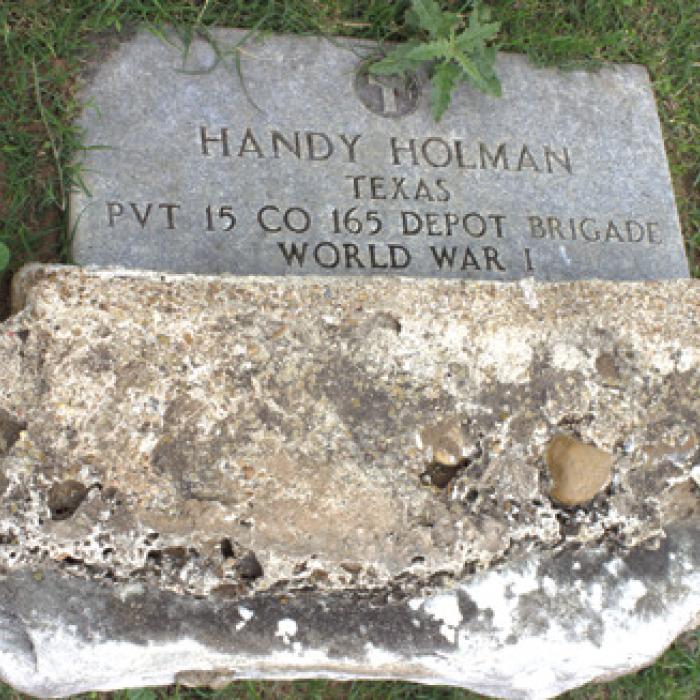 Handy Holman turned over headstone. Photo courtesy of the Hills.
The Holman name carries significant history in Fayette County, Texas—most notably through Holman Valley, located in the southeastern part of the county. The area is etched into the early story of Texas itself. In 1836, during the Texas Revolution, General Sam Houston and his army passed through the area, crossing the Colorado River at the nearby homestead of Jesse Burnam. In the years that followed, the land gave rise to a small but vibrant rural community named after one of its early settlers, John Holman, a plantation owner whose legacy—like so many of that era—was rooted in both opportunity and enslavement.
In the decades after the Texas Revolution, the Holman community became home to a variety of ethnic groups—including German, Czech, and African American families—who lived, worked, and worshipped in the same countryside. Among these families was a Black family who, whether by lineage, custom, or circumstance, carried the same surname as the man whose plantation once dominated the area: Holman.
It was into this complex legacy that Handy Holman, Jr. was born. Handy Holman, Jr. entered the world in Holman, Texas on October 15, 1893. He was the son of Handy Holman, Sr., and Queen Holman. Although an official birth certificate was not located, federal census records and military documents provide substantial evidence of his life and legacy.
By 1900, the Holman family was enumerated in the unincorporated Fayette County community of Holman. Handy’s father was working in agriculture as a farmer. His parents, though unable to read or write, supported a household where education was clearly valued. Handy’s older sisters—Saddie, Carrie, and Bessie—could read and write, and they were attending school. His brother David was enrolled alongside them. Handy, at age six, was not yet in school, likely due to his age.
The 1910 census showed the Holmans still living in the Holman area. Sixteen-year-old Handy was working on the family farm as a wage earner for his father, who was listed as the employer. Their residence was described as near La Grange–Weimar Valley Road (present- day FM 155).
On November 25, 1914, Handy Holman married Martha Hill in Fayette County. The couple likely remained in the Holman area, continuing the family tradition of farming and rural community life.
When the United States entered World War I, Handy answered the call. He registered for the draft on June 5, 1917, listing himself as a self-employed farmer in Holman, Texas. His registration card described him as a man of medium height and stout build, with dark eyes, black hair, a stiff arm, and noted that he was married. Handy signed his registration card, which confirmed his literacy.
On July 19, 1918, Handy Holman formally enlisted in the U.S. Army. He was active and assigned to the 15th Company, 165th Depot Brigade—a unit responsible for processing, equipping, and training recruits before deployment. He most likely served with the brigade at Camp Travis in San Antonio, a common staging location during the war. Following Armistice on November 11, 1918, he was honorably discharged on November 29, 1918—a reflection of the rapid demobilization after the war’s end.
After returning home, Handy resumed life in Fayette County. He continued farming and stayed connected to his local community.
On June 27, 1950, Handy Holman passed away from liver and stomach cancer after a 40-day hospitalization at the Olin E. Teague Veterans’ Center in Temple, Texas. He was 56 years old.
In 1953, a government-issued headstone was ordered to mark Handy’s grave. His nephew, Napoleon Wilson, applied for the stone, and his sister, Bessie Holman Sanders, signed to ensure its placement in the Holman Cemetery. The application was processed on July 16, 1953, and the stone was shipped on October 1, 1953.
Today, that stone lies overturned but still visible in the Holman Cemetery—a quiet, enduring testament to a man whose life, labor, and service were rooted in the land of his birth. Though he lived humbly, Handy Holman, Jr.’s story is part of Fayette County’s legacy—a reminder that ordinary lives often carry extraordinary weight.
Sources: Holman Cemetery Tombstone, Holman, Fayette County, Texas.
United States, Census, 1900 and 1910 Holman Steakhouse History of restaurant County Clerk Marriage filed United States, World War I Draft Registration Cards, 1917-1918, Headstone Application for Military Veterans Texas, World War I Records, 1917-1920 Handy Holman Death Certificate
Footprints Of Fayette
Fayette County is one of the most historic counties in Texas. In this weekly feature from the County Historical Commission, a rotating group of writers looks back at local history.