


The Great Train Heist at Flatonia in 1887
Part I of II
-
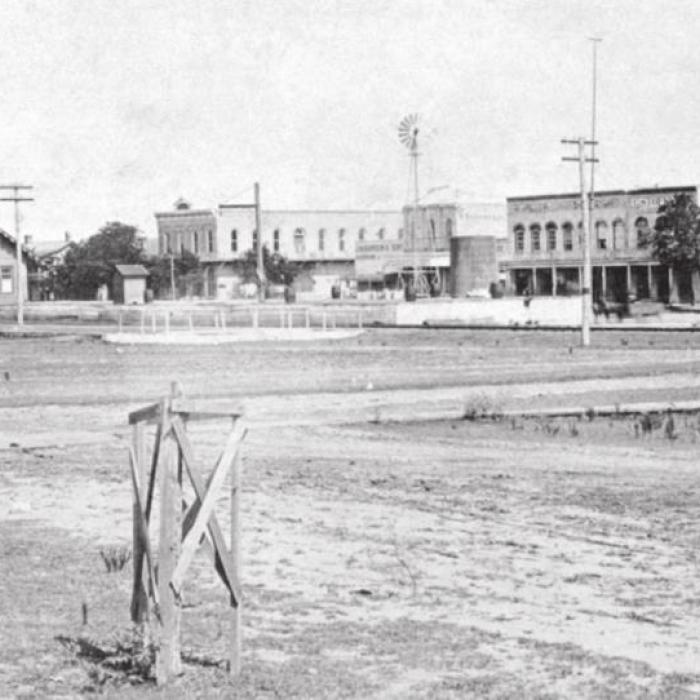 The Great Train Heist at Flatonia in 1887
The gang of train robbers met at night in the Flatonia graveyard on June 15, 1887. Around the campfire they plotted the details of their next move: robbing a train about a mile and a half east of Flatonia near Mulberry Creek. The robbery would make international headlines, would secure the notorious gang’s place in Texas history, and would make the town of Flatonia known as the site of “the most daring robbery ever in Texas,” as the New York Sun described it.
On the evening of June 18, the Cornett-Whitley gang, as they were known, waited until about midnight before they made their move. The leaders, Braxton “Brack” Cornett and George Whitley, boarded Southern Pacific train No. 19 at the Flatonia train station on the Sunset Line, and posed as passengers. About a mile and a half east of Flatonia, three or more other gang members were waiting at the designated spot on a bridge over the creek. They kept warm by the fire and watched out for the train as it made its way down the tracks. The passengers, conductor, and engineer did not anticipate what was about to happen.
Suddenly, Cornett and Whitley drew their pistols on the engineer Ben Pickren, and told him to stop the train immediately, which he did. The conductor, Jesse Lyons, asked Pickren why he had stopped the train, to which Pickren replied that outlaws were on board and had given the command to halt the train. The rest of the gang, likely three other men, jumped onto the train and assisted with the robbery in progress. As historian David Johnson, author of The Cornett-Whitley Gang: Violence Unleashed in Texas, describes the next scene on the train that night, “The gang demonstrated a vicious cruelty that had not been seen in train robberies. They moved through the train with promiscuous, pitiless violence, as uncalled-for as it was inhumane.” The gang forced the crew to the express car where they encountered Wells Fargo’s Frank Folger, who resisted the robbers and tried to prevent the theft of the train’s safe. In response, they severely beat him with their pistols and cut his ears with pocket knives, leaving him for dead. The gang took the money from the safe, rifled through the mail, and moved on to the passenger cars. There were about fifty passengers on the train that night, from all over the country. Reports indicate that nearly all of them received a beating of some kind, whether with fists or pistols. The passengers were brutalized, robbed, humiliated, and terrified. They murmured among themselves about what could be done, including hiding their valuables and thwarting the robbers. One passenger aboard train No. 19 was Colonel Quintos of the Mexican Army, along with his lieutenant, a man named Cruz. Quintos quietly ordered Cruz to retrieve his pistols so that he could meet the robbers’ violence with his own. But Barbara White, the Spanish-speaking wife of El Paso Sheriff James White, “frantically begged him” not to do so. So the Colonel acquiesced in her pleas and handed over his money. The gang made its way through the train, stealing money and valuables from almost all of the passengers.
Suddenly, John Barber, one of the robbers, announced to the gang that it was time to go, and so they did, leaving behind a path of torment and fear. The robbers made off with somewhere between $7,000- $10,000, and escaped to their designated meeting place to divide their loot, a place called Butler’s pasture in Karnes County. The train, with its distressed passengers in tow, then made its way on toward Schulenburg, where the passengers recounted their story and received medical care. Telegrams were drafted and sent in all directions from Schulenburg, and the word spread rapidly throughout Texas, the United States, and even the world. At about 3:20 a.m. on June 19, just a couple of hours after the robbery, the news had made it to Flatonia from a westbound train, where Constable Sloan was on duty. He formed a posse with Constable Hall of Waelder and the manhunt began.
The lawmen rode toward the scene of the crime, but the gang had disappeared immediately after the robbery. The constables did find remnants of the campfire that marked the spot where the train was stopped, as well as horse tracks that indicated that the gang had scattered in different directions. They returned to Flatonia around eight o’clock in the morning and reported their findings. Lawmen from all over Texas were being activated, including Fayette County Sheriff Brutus Lytt Zapp, from La Grange. Zapp had been city marshal of Round Top, and a deputy to former Fayette County Sheriff John Rankin, who was then serving as U.S. Marshal in San Antonio. Zapp began his investigation, speaking to witnesses and arresting suspects, whom he interrogated. Newspapers covered the investigation and arrests, but the real culprits would evade capture for some time.
The state of Texas, Wells Fargo, and other entities announced cash rewards for information leading to the capture of the robbers. Criminal intelligence began flowing into local sheriff’s offices, the Texas Rangers, and to the U.S. Marshal in San Antonio, John Rankin. There were a number of close calls, including a shootout in Cuero between one of the robbers, John Barber, and the local Sheriff. Barber survived the fight, stole a horse, and escaped. Two of the other gang members, Ike Cloud and Sion Secrest, fled the state. Whitley and Cornett split up and continued their life of crime, even attempting to rob more trains. In Galveston, months later, Whitley and Barber got into a gunfight with local lawmen, were arrested, and then released. But one by one the criminals would be tracked down, apprehended, or killed.
Sheriff Zapp and his deputy got wind that Secrest was being held on a murder charge in New Mexico, and so they traveled to the town of Magdalena to bring him back to stand trial for the Flatonia train robbery. Zapp had received some intelligence from an old detective in El Paso County who had been working the Flatonia robbery case, and he indicated to Zapp that Secrest was one of the Flatonia train robbers. So Zapp, wanting justice for the railroad, the passengers, and Fayette County, retrieved Secrest and brought him back to La Grange to stand trial.
Justice finally caught up with Brack Cornett in February, 1888 when he showed up at the residence of Frio County deputy Sheriff Alfred Allee. The stories differ, but it is believed that Cornett camped out at Allee’s place one night, and the next morning joined him for breakfast. At some point that morning Allee told Cornett that he intended to arrest the outlaw. Guns were drawn, and Cornett shot Allee through his hat, while Allee delivered the fatal bullets into Cornett’s chest and neck. When the smoke had cleared, Cornett was dead, and Allee was eligible for a big cash reward.
There are questions about whether Allee was merely doing his duty as a lawman, or whether he was initially in cahoots with the gang, and merely turned on them to collect his reward. Some people, including descendants of Cornett, allege that Allee was involved with Cornett in the criminal enterprise of horse theft. It is of course possible that Allee was a lawman doing his duty, acting as an agent of law enforcement who rode with the gang from time to time so that he could eventually help bring them to justice. But it is also possible that Allee was acting in his own self-interest, and was a compatriot of the gang until it suited his financial interests to betray them, kill their leader, and collect his $3,000 award. This may remain a classic case of competing claims and stories, lacking conclusive evidence one way or another, where the reader must decide for themselves what to believe.
Sources:
David Johnson, The Cornett-Whitley Gang: Violence Unleashed in Texas (Denton: UNT Press, 2019), 83.
Author Unknown, “All Hands Up: The Order of the Train Robbers Promptly Obeyed,” Houston Daily Post, June 19, 1887.
Johnson, The Cornett-Whitley Gang, 71.4 Johnson, The Cornett-Whitley Gang, 72.
Johnson, The Cornett-Whitley Gang, 73.
Johnson, The Cornett-Whitley Gang, 78.
Johnson, The Cornett-Whitley Gang, 87.
Johnson, The Cornett-Whitley Gang, 149-150.
Footprints Of Fayette
Fayette County is one of the most historic counties in Texas. In this weekly feature from the County Historical Commission, a rotating group of writers looks back at local history.