


Fayette County Ox-Team Caravans to Mexico During the Civil War, Part 2
-
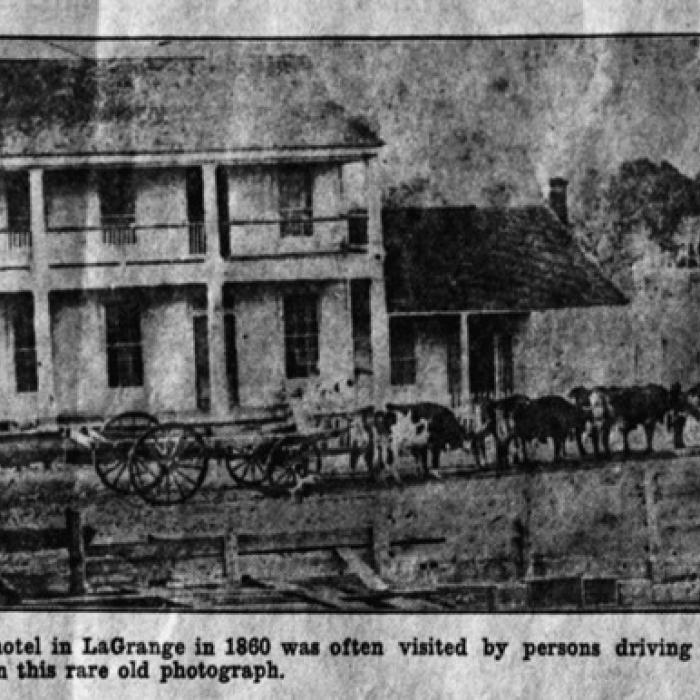 The hotel pictured behind this team of oxen in the 1860s was located where the Lester Hotel later stood, in the northeast corner of the intersection of Colorado and Washington Streets in La Grange; photo courtesy of the Fayette Heritage Museum and Archives.
Edited here only for brevity, this is the second part of an article written by Leonie Rummel Weyand and printed in the October 19, 1933 issue of the La Grange Journal.
George Huebner continued, from his story in Part 1: “Fayette County teamsters hauled to Mexico not only the cotton raised in Fayette County, but also cotton that was raised in East Texas and in Louisiana. Cotton raised in these two sections was not hauled directly to Mexico, but was dumped at certain convenient concentration points, from which, it was relayed to its destination. These points were Alleytown, Bernard, Columbus in Colorado County, and La Grange and Round Top in Fayette County. There were two cotton agents in Fayette County, Judge J. C. Stiehle [sic.], stationed in La Grange, and [Arthur] Meerscheidt, at Round Top. Cotton sent to Fayette County was hauled to one of the following places for re-shipment to Mexico: Brownsville, Mier, Rancho Davis, Laredo or Eagle Pass.
“A cotton convoy usually consisted of from three to fifteen wagons. From five to seven yoke of oxen were necessary to pull one wagon. It was necessary for teamsters to take along sufficient food for the entire trip, for often food was not available. Procuring enough food for men and oxen was often quite an undertaking.
“The difficulties of the Confederate, state and county governments were by no means ended when the cotton had been hauled to the border. Here the cotton was likely to be seized by the Mexicans, the Federals, or even by the Confederates. On one occasion a convoy of eighteen wagons from Fayetteville was captured by Mexican bandits. The Mexicans stripped the teamsters of everything — cotton, wagons, and ox-teams. The men had to thumb a ride home or walk. Bryan Lane, an unfortunate member of this party, was killed by the Mexicans and, as a warning to future teamsters, was buried with his hands and feet sticking out of the ground.
“The Fayette County Commissioners in 1863 conceived the idea of buying cotton and selling it to Mexico for relief of the county’s destitute war widows and orphans. In accordance with this plan, they bought thirty-two bales of cotton from William J. Russel to haul it to Mexico. At King’s Ranch, the party was seized by General Bee, who had been forced to evacuate Brownsville as a result of the Federal invasion. Negroes, teams and cotton, according to Russel, were impressed into service by General Bee, who compelled Russel to sell him the cotton at fifty cents per pound, Confederate money. When Russel made his report to the Commissioners’Court, they agreed to let him keep the money given him by Bee as a remuneration for freight charges.
“Still another large shipment of cotton that was a total loss to the owner, belonged to William Neese of Warrenton. He had sent thirty-eight bales of cotton to Mexico with the following teamsters in charge: J.C. Moss, F. Holman, Conrad Tieman and Mano Garbades. In Brownsville, Neese’s cotton was taken away from him by order of General Brown, the Federal Commander in charge of the Forty-third Indiana Infantry, the Sixty-second Ohio (a colored regiment), and the Second Texas Regiment. It was the colored Major of the Ohio contingent who actually took possession of the cotton.
“The fraud in the cotton business which aroused such indignation among the soldiers and patriotic citizens of Texas was not entirely absent in the Fayette County teamsters’ trade. A Confederate law prohibited teamsters from carrying more than ten bales a trip, and special agents were placed at Flatonia and at Gonzales to supervise the transportation. By splitting with them, it became an easy matter to arrange with the agents to carry an extra bale or two, and with cotton selling at forty cents per pound, such a rascally procedure was highly profitable.”
The second of the surviving teamsters, John Speckels, eightyfive, and as peppy as a sophomore, recalls that the Confederate government sponsored the first trip of cotton hauling that he made to Mexico. The unsatisfactory schedule, Speckels explained, was due to the fact that the necessary food for the men and oxen through the long desert stretches along the last part of the journey was not promptly furnished by the Confederate government. During the waiting period, perhaps the most satisfactory of all to the men, hunting parties were organized, which netted rich bags of wild turkey and plenty of deer. Deer and turkey meat with rye coffee and bread made a satisfying meal. The Speckels lad was unfortunate and contracted measles on the trip. A rain storm came up and the sick boy spent the night trying to hold a flappy wagon cover back in place. He suffered a relapse and as a result his hearing today is slightly impaired.
The exhausted men and oxen finally reached Eagle Pass, the place named as cotton depot by the Confederate government. Here the Confederate officiate ordered machinery to be placed on the wagons and delivered in San Antonio on the return trip. A sturdy band of German farmers, all neighbors of his father, were Speckels’ next companions on a cotton hauling trip to Mexico. By agreeing to turn over one-half the profits to the government, Speckels secured permission to take cotton to Mexico. The hazardous journey was safely negotiated. The cotton was sold in Rio Grande City for thirty-one cents per pound. The youth carried the money paid him for his father’s cotton (in Doubloons) safely in his belt. The same financial success that attended Speckels’ trip to Mexico has followed him throughout life. His business ability has made profitable all his ventures. Speckels, in addition to the part that he played in transporting cotton during the Civil War, has assisted materially in the industrial development of Fayette County. He represented his county in the State Legislature during the years 1895-97.
Footprints Of Fayette
Fayette County is one of the most historic counties in Texas. In this weekly feature from the County Historical Commission, a rotating group of writers looks back at local history.