


A Closer Look at the Fun of Oktoberfests
The Origins of Oktoberfest
-
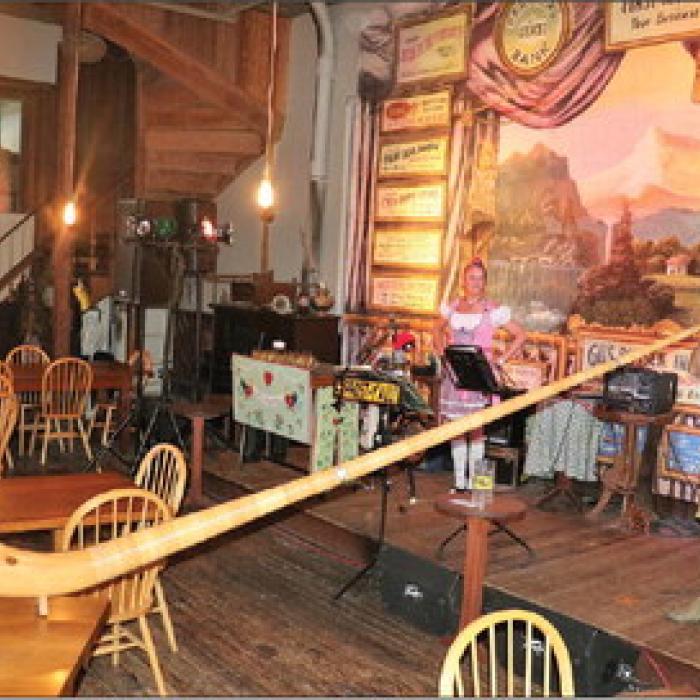 The giant alphorn is part of Das Ist Lustig’s show. That massive horn is shown here during one of their previous shows at Sengelmann Hall in Schulenburg. They return Sept. 28.
As the summer turns to fall, German communities across the world gather to celebrate Oktoberfest. This celebration of food, drink, culture and music goes back more than two centuries. Just about everywhere the Germans settled, they brought this tradition with them, especially in Texas.
A proper Oktoberfest requires the right ingredients: bier (preferably good German bier from Munich, the home of Oktoberfest), traditional foods like sausage and pretzels, pleasant company and music.
Music might be the most important ingredient. Just ask Das Ist Lustig, the popular German band from Houston, which will be performing at Sengelmann Hall in Schulenburg on Sept. 28.
The name of the band means “That’s Fun” in German, and they stay pretty busy this time of year.
“We’re pretty much on the stage or on the road six days out of the week this time of year through November,” said Valina Polka, who with her husband Ross forms the duo at the core of the band.
Ross plays the accordion, singing saw and alphorn. Valina plays the autoharp, Holzernes G’lachter (Bavarian xylophone), Teufelsgeige (drum set on schtick) and tuned Austrian cowbells. Both of them sing and yodel.
“We’re even doing an Oktoberfest at an H-E-B grocery store this year, and I’m trying to figure out how that’ll work,” Valina said. “Maybe I’ll put Ross in a grocery basket with his accordion and push him around the store.”
The Oktoberfest tradition started on October 17, 1810, with the wedding of Bavarian Crown Prince Ludwig and Therese Charlotte Luise Friederike Amalie von Sachsen- Hildburghausen. Ludwig and Therese invited everyone in Munich to a horse race on a meadow just outside the city.
“Of course, the breweries brought all the beer they had, and it went on for two weeks,” Valina said.
In 1811, the Bavarian Agricultural Association decided to continue holding a festival to showcase their farming achievements. A few years later organizers set up a merrygo- round and swings. Breweries began setting up huge tents to accommodate the visitors. The horse race was part of Munich’s Oktoberfest until it ended in the 1960s.
“They’d celebrate the anniversary year after year, and over time it became Oktoberfest, because it was in October” Valina said.
Weather in Bavaria can be quite cold and rainy in October. So organizers in Munich moved the festival to September.
“Now, Oktoberfest in Germany starts in September and ends the first weekend in October,” Valina said. “This year, Oktoberfest is really early because October 1 is Sunday. The weather is a lot better in Munich in mid-September and late-September than it is in mid-October, when the original wedding took place.”
Valina said the music of early Oktoberfest celebrations likely included a mix of classical and traditional folks music.
“At that time, the music there was probably classical,” Valina said. “Beethoven, Mozart and Bach were more recent music in the 1800s. There was probably some of that music and the folk music of that time. It probably sounded a little different from the folk music we think of today, because the instrumentation was different.”
The accordion as we know it today was not developed yet. Ross said the earliest accordions that we would recognize today were not invented until the 1820s.
“The very first accordions, the earliest designs, were like the accordions used in Cajun music today,” said Ross. “You can see the flappers and the reeds on the outside.”
“The music was played by a traditional Bavarian orchestra, with brass instruments and reed instruments,” Valina said. “Marches and polkas were popular.”
Anyone who has ever seen Das Ist Lustig perform will recognize one of the most iconic Oktoberfest instruments, the Alphorn – a wooden horn several yards long that comes from the Alpine regions of Europe.
“Different hollowed out wood instruments have been used in mountainous regions all over Europe, not just Switzerland and Bavaria. That particular design with the curved bell at the bottom comes from an entire tree that grows from rock outcroppings. The curve of the bell at the bottom of the horn is naturally-occuring in the wood. In the last 500 or so years is when Alpine horns became a musical instrument. For thousands of years they were used as communication devices – to call cattle in, to call goats in, to send messages from one village to another.”
“I recently became aware of an alpine horn-like instrument from Poland, but it can’t play music, just a few tones,” Ross said. “The alpine horn that the Swiss play actually plays music.”
“Even some of the serious composers composed music using the alphorn,” Ross said.
Valina said touring with the alphorn presents some challenges. It’s big and hard to transport.
“It’s a very delicate instrument,” Valina said. “It doesn’t like being in the full sun. It doesn’t like being in the rain.”
Das Ist Lustig has been to Oktoberfest celebrations all over the world, including the original one in Bavaria.
“People come from all over the world,” Valina said. “Each brewery in Munich has a beer tent, and every tent holds thousands of people.”
Valina even visited an Oktoberfest in Malaysia in 2006.
“There’s a nice German club there in Malaysia, and they put it on,” she said. “There were 20 percent Germans in the audience and the other 80 percent were Malaysians and Chinese. Boy, do they know how to party.”
Why do so many people around the globe connect with this German institution?
“Germans are very hard working, industrious and detail- oriented people,” Valina said. “They work very hard. They also play very hard. As serious as they take their work, and as much emphasis as they put on high-quality, they also take their time off very seriously. Getting together with people, even though they might not get along politically or may not agree with each other. When you have a beer in your hand and it tastes good, and you have a smile on your face, and there’s good music, you enjoy the fellowship of that person who otherwise you don’t really care for. In Germany, they respect that. It attracts other people. Everyone wants to be a part of that. You share a table with someone you never met, and at the end of the night you’ve made a new friend and learned something about them. That spreads in a positive way, and there are Oktoberfests all over the world now.”
The Germans have a special word for this kind of fun: Gemütlichkeit. It doesn’t easily translate into English.
“Cozy, happy, fun, relaxed, good fellowship – it’s all of those things wrapped up together,” Valina said. “For that moment, there’s not a care in sight. Everything else melts away and Gemütlichkeit is what you have.”
Folks in Fayette County can experience some Gemütlichkeit for themselves at several upcoming Oktoberfest celebrations: • Sengelmann Hall in Schulenburg will host an Oktoberfest on Sept. 28. Das Ist Lustig will perform from 7-9 p.m.
• The Rotary Club of La Grange will host the 2023 La Grange Oktoberfest on the square on Oct. 7 from 3-7 p.m. Visitors can enjoy live music and 60 varieties of craft beer. A meal of schnitzel, German noodles, sauerkraut, sausage and applesauce will be served. Tickets can be purchased at Casino Hall or online at https:// www.eventbrite.com.
• The Fayette County Chapter of the Texas German Society will hold an Oktoberfest celebration at JW’s resatuarant in Carmine on Thursday, Oct. 12, from 11 a.m.-2 p.m.
• The Round Top Rifle Hall presents the 11th annual Okto-BierFest on Oct. 28 from noon to 8 p.m. Enjoy quality German biers, delicious kassler, wurst, kraut and authentic German music.