


1880 La Grange City Ordinances, Part 1
-
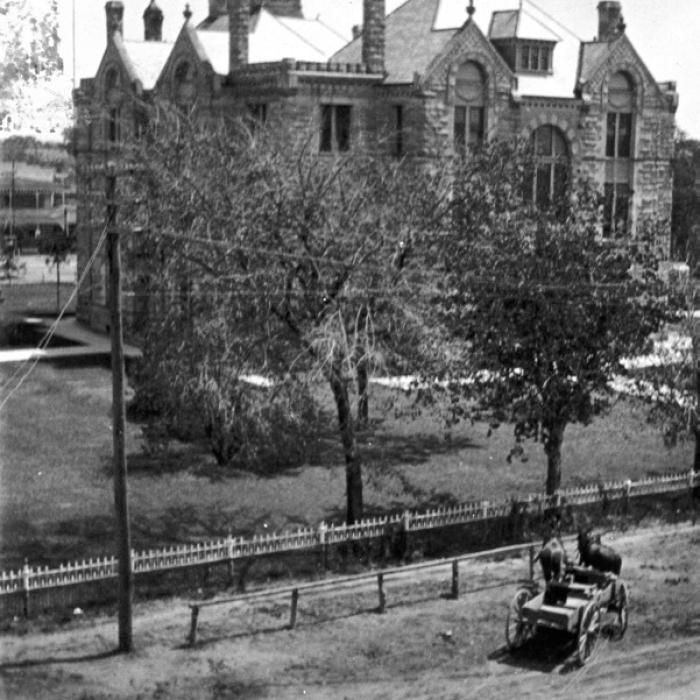 Circa 1900 photo of the west side of the courthouse taken from the second floor or roof of the Fink Building at 155 N. Main shows the iron fence that once surrounded the courthouse. A wagon drawn by a team of mules is tied to a hitching post, while a man is riding a bicycle down Main Street, which was still unpaved at the time. Photo courtesy of the Fayette Heritage Museum and Archives, La Grange.
A recent article in the Fayette County Record (May 19, 2026) brought to light an old La Grange City Ordinance (1898) concerning the removal of live oak trees within the city limits. Thus, a spark was created, and an idea developed to take a look back on a few of the old ordinances passed by the city council from a bygone era. In this particular case, the year we will look back at will be 1880. In the 140 years plus, a lot of changes have taken place in the city, the county, and the state. Throughout history, civilizations have set up a system of rules to live by, lest mankind destroy himself from the lack thereof. This article, Part 1 of a 2 Part series, will focus on some of the rules necessary to keep large animals within the city limits of La Grange. Keep in mind that in that era, horses and buggies, mules and wagons, milk cows, hogs for butcher, etc. were common in all towns and cities across the great state of Texas. Let us examine these ordinances, enacted the 9th of July, 1880, as they were printed in the La Grange Journal, August 18, 1880.
Horses, Mules, Cattle: Article 3--- “It shall be unlawful for anyone to kill … injure, … or ill treat any animal or dumb brute in this city.”
Article 4--- “It shall be unlawful for any person to exhibit for sale, or to stop a drove of horses, sheep, goats, hogs, cattle, mules, etc. or to drive the same across any part of the courthouse square.”
Article 5--- “It shall be unlawful… to attempt to break or tame any horse, mule, or other wild animal on the public square or in any street or alley of this city…” Article 6--- “It shall be unlawful for any person to ride or drive any animal under saddle or attached to any vehicle in a gait faster than ordinary.” (Apparently, the need for speed limit signs was already becoming a necessity.)
Article 7--- “Every owner… of any animal which may die within the city limits of the city of La Grange shall remove the carcass from the limits of the city, or bury or cover up with earth at least three feet deep.”
Article 9--- “It shall be unlawful for any person to turn in, or knowingly permit any animal … to remain within the enclosure known as the Court House Park.” (The iron fence encircling the Court House was later removed in July, 1925.)
Article 10--- “…it shall be unlawful for any person to leave their vehicle at any public place in the streets, without having some person over the age of ten years in charge of the animals, or without the animals securely attached to a stationary object…” All of the offenses aforementioned were considered to be a misdemeanor and punishable as such.
Goats, Sheep, and Hogs: --- it shall be unlawful for hogs, pigs, sheep and goats to roam freely within the city limits --- if the owner of such allows these animals to roam freely, the animals may be destroyed by the City Marshall. The owners of such animals will be fined $5 for each animal.
--- the ordinance shall not prevent anyone from bringing these animals into the city when they are planned to be auctioned off.
Auctioneers: ---Every auctioneer doing business in the city shall keep a record, and a description of every animal sold by him, and include the names of the buyers and sellers. The records are required to be open at all times.
Note: In an article in the La Grange Journal, dated October 1915, it was stated that “the Merchants Association and the city council met to establish a wagon yard one block west of the square on Brown Street. Later, in an article dated September 1920, this had apparently evolved into, and was thus referred to as the “stock yards one block west of the square.” Several years later, this site would become a place where horses and mules, etc. were bought and traded.
Such were the rules set up by city leaders in the late 1800s. Obviously, these rules were subject to change as society and technology would change. The ordinances set aside for horses and mules would have to change as the automobile would soon take their place. Stay tuned for next week’s edition, as the subject will change to dogs and cemeteries.
Sources: La Grange Journal
Footprints Of Fayette
Fayette County is one of the most historic counties in Texas. In this weekly feature from the County Historical Commission, a rotating group of writers looks back at local history.