


New Book Keeping Alive the Legend of Hugo Hollas
-
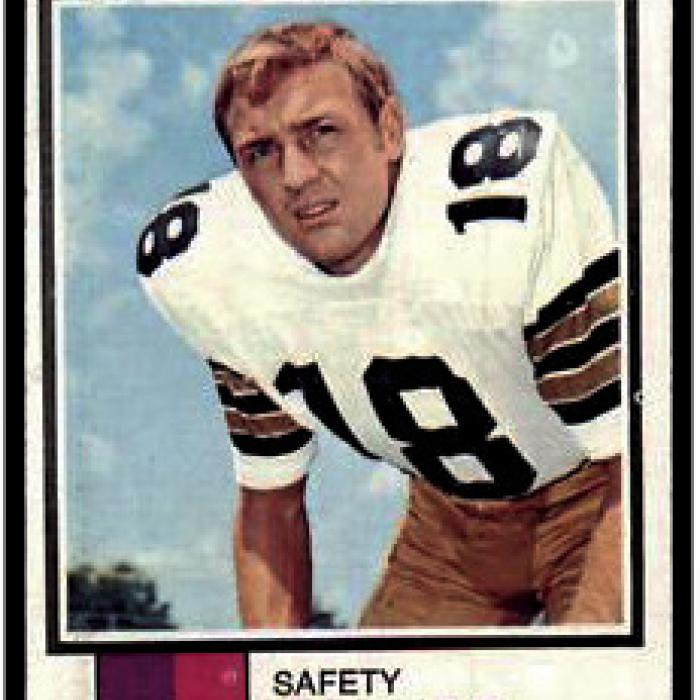 A trading card from Hugo Hollas’ days in the NFL.
 -
 Carl Duncan (left) and Richard “Rico” Hollas (right) recently published a book titled “From High Hill to the NFL: The Story of Hugo Hollas.” They’re pictured here with their book and some memorabilia from Hugo’s playing days. Photo by Andy Behlen
Hugo Hollas grew up on a farm in High Hill where he spoke German at home. He went on to play five seasons in the NFL during the 1970s before returning to Schulenburg, where he was a wellknown businessman and friend to many. Hugo died unexpectedly in 1995 at the age of 49.
His brother, Richard “Rico” Hollas and brotherin- law Carl Duncan recently published a book about his life: “From High Hill to the NFL: The Story of Hugo Hollas.”
We’re proud to honor Hugo as our first-ever posthumous Fayette County Record Athlete of the Week. The two authors gave a talk this week about the book to the Schulenburg Lions Club. They started the talk with a tragic story from Hugo’s high school days.
President John F. Kennedy died from an assassin’s bullet on Nov. 22, 1963. Hugo was a sophomore on the football team at Bishop Forest High School in Schulenburg. That evening, the Bishop Forest Rangers were scheduled to play St. Gerard of San Antonio for the regional title of the Texas Interscholastic Catholic League.
“He was the first Catholic president. And Bishop Forest being a Catholic school, a lot of people said, ‘Hey, y’all shouldn’t play this game tonight,” Duncan said.
On the opening kickoff, one of Hugo’s teammates, 16-year-old Tommy Schobel collided with a St. Gerard player. Schobel suffered a horrific spinal injury. He was carted off the field and spent a month in the hospital before he died.
“Everybody said they shouldn’t have played that game,” Duncan recalled.
Hugo and the Rangers would go on to win the state title. They won another state title his senior year. Hugo got a scholarship to play safety for Rice University and went on to play professional football, most notably for the New Orleans Saints.
He tried out as an undrafted free agent for the Dallas Cowboys in 1968 before playing three seasons with the Saints from 1970-1973.
He played part of the 1974 season with San Francisco and then a brief stint in the now-defunct World Football League.
“What a lot of people don’t know, Hugo was a twosport star,” Duncan said. “He was a baseball player also.”
After graduating from Rice, Hollas was not picked in the NFL draft. He tried walking on to the Dallas Cowboys in 1968 during training camp at Thousand Oaks, California. But he had a lingering thumb injury from his last baseball season at Rice. The coaches sent him back to Dallas for medical staff to look at his thumb. That’s when the Cowboys’ legendary head coach Tom Landry called Hugo into his office.
“He said, ‘You know son, you’re not at an NFL caliber. You need to find yourself something else to do,” Rico recalled. “At that point supposedly Hugo said, ‘You’re wrong, coach. I’m going to make it in the NFL.’” Hugo spent that year working as a school teacher in San Antonio. The next year he played for the Richmond Roadrunners, a sort of minor league farm team for the New Orleans Saints.
By 1970, he was starting for the Saints. The team as a whole performed poorly that year, and the Saints ended up with the No. 2 draft pick in 1971.
“The two best quarterbacks in college football that year were Jim Pluckett and Archie Manning,” Duncan said. “Archie Manning was a legend at Ole Miss. He was number 18, and they retired his number. They say if you go on the campus of Ole Miss to this day, the speed limit is 18 miles an hour because he’s number 18. But if you look on the roster of the 1971 Saints, Manning is number eight. That’s because Hugo was number 18, and he wouldn’t give him his jersey.”
Hugo became a fan-favorite in New Orleans due to his explosive blitz plays. In 1973, he suffered a seasonending knee injury in preseason against his old nemesis, the Cowboys. He had served as an assistant players representative for the team that year in contentious negotiations with NFL owners. In 1974, the players called a strike.
“There was a lot of hard feelings with ownership,” Duncan said. “They cut him.”
Rico said his brother’s annual salary during his first year in the league was about $14,000.
“In comparison, I joined the fire department as a rookie cadet going to school in 1974,” Rico recalled. “I was making almost $10,000 a year.”
Rico said the most Hugo made in the NFL was about $24,000 annually.
Hugo, like many NFL players during that, worked other jobs to support their families.
“Hugo worked for Illinois Central Railroad,” Rico said. “He was in sales. He worked during the season on Mondays. And then after the season, he worked full-time.”
Read more about these stories and a lot more in the new book. It’ll hopefully be available for sale soon at the Record office in La Grange. Until then, you can order a copy by emailing richardhollas@ hotmail.com.