


Second Lives of Surviving Rural Schools in Fayette County
-
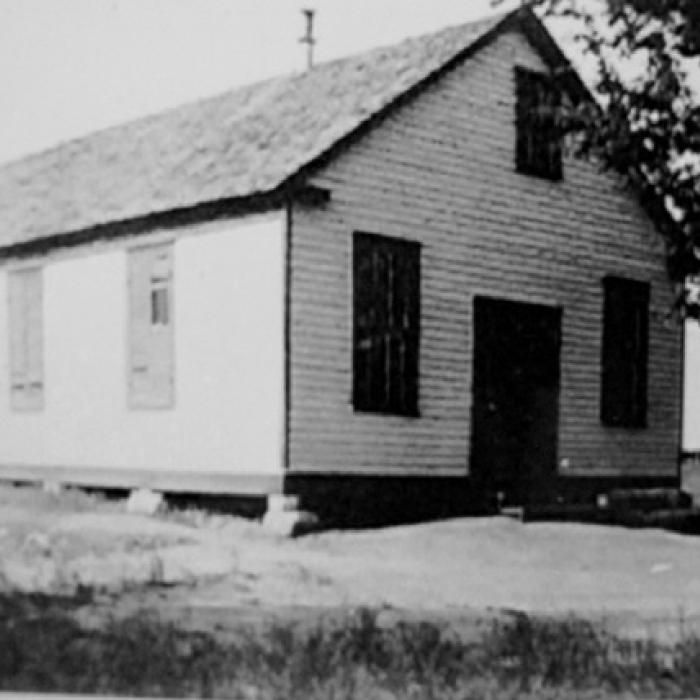 The Washington School at Swiss Alp.
Footprints Of Fayette
Fayette County is one of the most historic counties in Texas. In this weekly feature from the County Historical Commission, a rotating group of writers looks back at local history.
Early Anglo settlers in Fayette County were aware that education was important for their children, but at the time, there were no means to provide them with anything more than a very basic form of home schooling. David Breeding, who lived north of present-day Fayetteville, established the first log school in Fayette County in 1834. In a few short years, an increasing number of schools were being established in the county. There were several private academies in La Grange and Fayetteville, as well as Rutersville College, the first Protestant college in Texas, that was chartered in 1840. After the Civil War when the demographics of the county changed with most of the Anglos moving elsewhere, and Germans and Czechs moving in, more rural schools were being built, mostly within four to five miles of each other to accommodate students walking or riding horses or mules. There were public schools for whites and blacks, as well as parochial schools. At the time, even though not considered appropriate today, schools for black students were called Colored or Negro Schools. At one time, there were more than 200 rural schools in Fayette County.
Approximately 30 years ago, former Judge Ed Janecka decided to mark the locations of as many rural schools as possible with repurposed county road signs. Since then, many signs have disappeared or been damaged, and some had incorrect dates or were in the wrong locations, based on available information at the time.
Recently, a committee of volunteer members of the Fayette County Historical Commission completed an inventory of school signs and identified 51 schools that have priority status for replacement signs. This will be an ongoing project as further research and funds become available.
In researching the history of rural schools in the county, it was discovered that many were dismantled and recycled into barns or other farm buildings after school consolidations in the late 1940s. Some collapsed or were swallowed up by vegetation. However, some survived to have a second life. The following is a list of those rural schools.
The Ammannsville Public School, that closed in 1935, was sold to the KJT organization in 1948 and was moved near their hall to be used for dining for community and church events. It no longer exists at that site.
Big Bend School on Kitchen Lane was moved to Ellinger in 1951 to become the Zbranek Café located across from the Prihoda Garage.
The first Bluff School was moved to the Eck farm on Creamer Creek Road to be used as an outbuilding. The second Bluff School was built at the same location on Hwy. 77 South.
The Carmine Colored School, located on the old St. Matthews Missionary Baptist Church site, is currently being restored by volunteers, including David Collins and Ruby McCullough, a descendant of the McCoy family of Round Top.
The Cistern Public School is presently a privately-owned bar. The second Ellinger Public School became the Ellinger Chamber of Commerce Community Hall.
The Freyburg Salem Lutheran School is currently being restored.
The one-room Krupala School, that was located at the intersection of Jerome and Baumgarten Roads, closed in 1933. It was moved to St. John, where it became part of that community’s public school.
In the late 1940s, the Lane Pool Colored School was moved from Lane Pool Road to Cozy Corner next to Little Bethel Cemetery. Another room was added to accommodate the Lane Pool students and those from Radhost Colored School, also known as Tin Top, located on Munke Road. The new school became the Hostyn District Colored School, which is now a private residence. Old Tin Top was purchased by Arthur Dobbins, who moved it to a location behind his store to become a gambling venue.
In 1956, the second Middle Creek School was moved to become the Swiss Alp Farm Bureau building.
The Muldoon and Rocky Ridge schools were both moved to the Flatonia ISD campus.
The Nassau School was moved to the Round Top-Carmine Elementary School campus where it was boarded up, covered with metal siding, and used for transportation storage.
Both the Praha and Plum Public Schools were restored to become private residences.
The Prairie Valley School became a Sons of Hermann Lodge Hall and is now privately owned.
Alwin Baumbach purchased the Rabbs Prairie School and had it moved to a location on Hwy 71S at the intersection with Joiner Road. He operated a store in the building that later burned.
The Rocky Ridge Colored School was moved to a nearby ranch owned by Dr. A.J. Darilek, DDS, and later by Alois Keilers.
In 1953, the Round Top Negro High School was initially designed as a new elementary school, but plans changed for it to become a high school instead. The building still stands at its original site and is used as the Festival Hill Marketing Office.
The Round Top Public School, that was located near the Bethlehem Lutheran Church, was moved to Brenham to become a private residence.
The Rutersville Public School is now a Sons of Hermann Lodge Hall that is a rental venue.
St. Mary’s Catholic School at Live Oak Hill, later Hostyn Hill near Ellinger, was used as a parish hall until it was replaced by a new building. The old school was sold and moved to the Hoelscher-Fehmer Farm a few miles away to be used as a family gathering place.
Trinity Lutheran Church’s Christian Day School that closed in 1943 was sold to Mr. and Mrs. Herbert Diers, who moved the building to their farm on Old Plum Road to be used for Mrs. Diers’ noodle factory.
Washington School at Swiss Alp was moved and is now utilized as the Sunday School building for the United Evangelical Methodist Church at Swiss Alp.
The third Willow Springs School was moved in 1947 to Columbus Lane in Fayetteville to become the Fayetteville Colored School. After integration, it became the Knights of Columbus Hall. More recently, it was sold and moved again to the Star Hill Ranch, a wedding venue in Dripping Springs.
The Zion Lutheran Church, that was located near Swiss Alp, conducted a school in their church that was moved to Schulenburg in 1946 when the congregation disbanded. A new church was erected at a different location in 1975. The old church was sold, became a day care center and eventually was sold again to become an addition to a residence in Cat Spring. A Sunday School classroom addition remained and is now a residence.
The Winchester Public School is now Zilss Hall, a rental venue that is owned by the Winchester Civic Association.
If anyone has additional information about Fayette County rural schools, please contact Rox Ann Johnson, Fayette Heritage Library and Archives, (979) 968-3765.
Source: Fayette Heritage Library and Archives, La Grange, Texas