


A Brief History of La Grange’s Beef Head Ditch
-
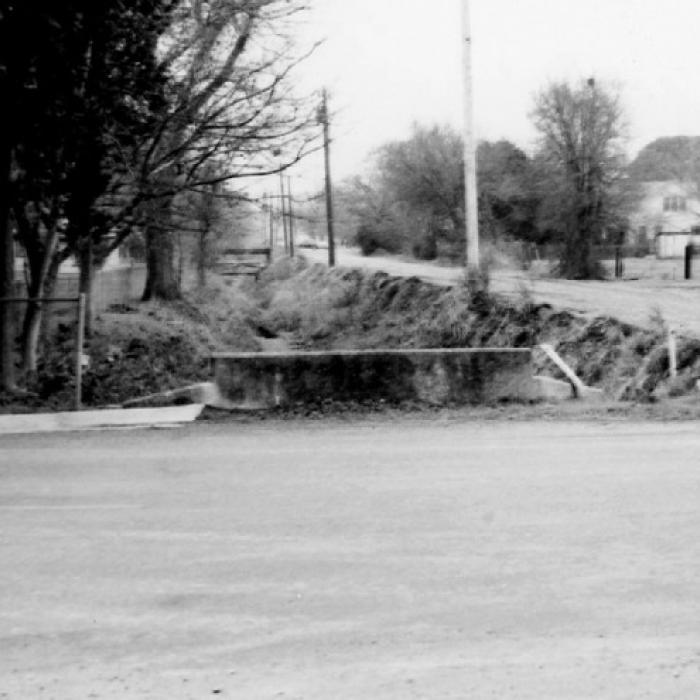 Dr. Leland F. Zatopek took this photograph at the intersection of Jackson Street with Live Oak and Eblin Streets in 1978 before Beef Head Ditch was covered. Photo courtesy of the Fayette Heritage Museum & Archives
Footprints Of Fayette
Fayette County is one of the most historic counties in Texas. In this weekly feature from the County Historical Commission, a rotating group of writers looks back at local history.
“Go out and play … but just stay away from that ditch.” These were the orders from Charlene’s mother. Good advice, but what red blooded explorer could resist the wilds of the upper Beef Head Ditch. It was 1955. I was eight. Sometimes I would walk to my cousin Charlene’s house on Pearl St. after school. In the area near the Randolph School, many sections of our uniquely named tributary of the Colorado River were still uncovered and offered natural sanctuary to countless species of native plants and wildlife. By its nature, “the ditch” attracted the neighborhood kids. One day a dare was given, and a dare was taken. The challenge was to ride Charlene’s almost-new red and white tricycle down the embankment of a particularly treacherous section of the waterway. No backing out now … mission accomplished. Bruised, scratched and muddied, I fared somewhat better than the tricycle, which had a bent handlebar, and a broken wheel spoke.
Before the existence of our fair city, this pristine little stream wound its way peacefully between the upland hills and the river valley. By the undefined “estimate of meander,” it may have wound its way as much as three miles from its source to its confluence with the Colorado. In 1824 John Henry Moore built a twin blockhouse, or fort, on the east side of the Colorado River. He soon built a public ferry and laid out the city of La Grange at that location. And the people came. The original plat map shows our “little tributary” as the eastern boundary of the new town.
And we grew; in the mid-1800s residents living along this little stream were using its water domestically. Somewhere in her headwaters there may have been a natural spring to keep the water clear and flowing. As early as 1871, the city and landowners were starting to modify the little creek to meet their needs. As our community grew, so did the need for roads. The first bridge over the then named Beef Head Gulch was completed in 1875. Prior to that a horse and rider could cross easily, but a wagon and its team had to travel some distance to the north to cross over to the other side.
By as early as 1880, our city fathers had deemed it prudent to “channel” (in a straight line) a large section of the little creek along the southwest side of Jackson Street. From the December 9, 1909, La Grange Journal: “the La Grange City Council voted to widen the two bridges across the Ditch, on Colorado and Travis Streets.” In the early 1900s there was a series of “overflows” (flooding) along the Ditch that impacted both the upper and lower parts of town. In 1929 bonds were approved to improve drainage along the Beef Head Ditch in the south part of town, at this same time the city acquired additional R.O.W. for many sections of the Ditch.
Around this same time efforts were made to line the Ditch with concrete and rock. From the December 30, 1933, Journal: “good and permanent improvements are being made by lining sections of the Beef Head Ditch along Jackson St. with the same stone that was used in the construction on Monument Hill.” In conjunction with this effort, there have been several major construction projects over the years to “cover” sections of the Ditch, or to re-pipe, or divert the flow below the surface. This effort continues today. Today, only a small section along Jackson Street, its headwaters, and its confluence with the river remain above ground. By covering sections of the Ditch we meet the needs for stormwater and aesthetics. By definition, it is now a storm drain.
All of which begs the questions …in hindsight …what if our predecessors had not channeled the ditch, lined it with stone, and covered it over? What if they had built gently winding roadways to follow the stream and its meanders, with bridges on every second or third street? No, not quite like the River Walk of San Antonio, but it could have been more than the celebrated Ditch Walk of Menard. What if the little stream had a name … would it have been more difficult to cover it up? Yes, drainage, sanitation, public safety and transportation are important issues that face our little city. However, so are preserving some natural open spaces, trails, trees, and habitats for small wildlife … and mosquitoes ... and snakes.
As a ditch, her watershed is quite extensive, she does her job well in a natural environment; however, with so much paved over … not so much. Her headwaters drain most of the upper half of our city, with lesser amounts being collected from the lower half, typical of many streams. But as everyone knows, water runs downstream. You can still see her in places today, the little duck pond at the intersection of Von Minden and Madison, or as the gentle slope of many backyards. If you look closely, you can still see her graceful banks in the contours of the land on most of our east-west streets.
Continuing downstream today as the lifeblood of a small tree-lined lake, she crosses Roitsch Lane to go underground, heading south through quiet little neighborhoods near the Rec Center on Pearl. Here she makes a gentle turn to the southwest through more tree-lined neighborhoods. At Jackson and La Fayette Streets she makes a hard left onto Jackson, above ground for two blooks, where you can admire the craftsmanship of the stone masons work. Below ground again, crossing Travis Street near the elementary school gym, now in a straight-line following Jackson to Eblin and Live Oak Streets. Continuing south, she emerges again as a tree-lined arroyo near the middle school and on to her destination, the Colorado River.
And what of the name? What’s a beef head? Every kid growing up in La Grange hears the stories: the dangers, the mystery, the campfire lore, the missing people and things that wound up in the Ditch. Was it an old term used to describe a section of the drainage? Did someone see a cow’s head? Was it a stupid ditch? We were never a cattle drive town, and it was named long before the railroads came. Our memory of the Ditch means different things to different people, through ever changing times. And that little catwalk under Travis Street by the old high school … how many first kisses were stolen there over the years? If anyone knows the answer to how our Ditch was named, please let the fine folks at the Library/Archives know. For now, let’s just keep it as a mystery, with fond memories to share. Remember, we have been trying to change it or cover it up for almost 200 years.
Sources: Fayette Heritage Museum & Archives, La Grange Fayette County Record, archived La Grange Journal, archived Fayette County Record, Jeff Wick, Oct 29, 2020, “Closing the Ditch”