


Weimar, Texas: The Prairie City
-
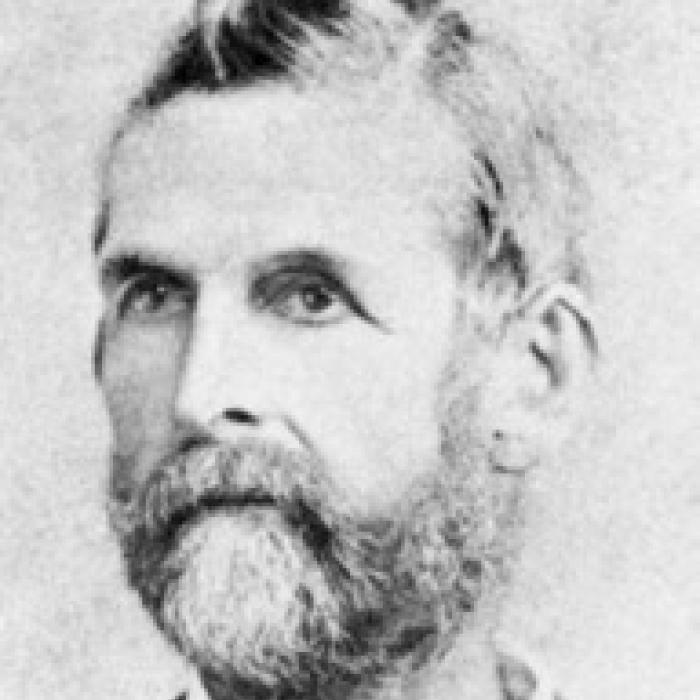 D. W. Jackson, founder of Weimar, from Weimar, Texas First 100 Years 1873-1973 by Mary Hinton.
The first map to show and describe the area that would one day become Weimar was drawn by Stephen F. Austin in 1829. Titled An Original Map of Texas, its title and notations were in Spanish. This large area was shown as Llanos (Plains) and Encino (Oak), a description that still holds true for Weimar today. It occupied the space between two rivers, the Colorado to the east and the Navidad to the west. It also sat between the major roads of the day. To the north ran the Gonzales Cutoff, crossing the Colorado at Burnhams Ferry. Further north was the La Bahia Road, crossing the same river near present-day La Grange. Nearby, but to the south, ran the Gonzales/San Antiono Road crossing the Colorado at Columbus. Further south was the Atascocita Road, crossing the Colorado at Montezuma below Columbus, and the Navidad at today’s Oakland. The early settlers in Austin’s Colony wanted prime real estate, land that was near rivers and roads. On May 31, 1831, the “Llanos and Encino” was granted to Henry Austin, Stephen’s cousin, as part of a five-league survey, a sizable tract of land. Henry Austin died in 1852 with a large estate. Per his Will and Testament two tracts of land, 976 acres, were partitioned to his son Edward T. Austin in 1857. That would be the future site of Weimar.
Little is known of the land use during this period. Large cotton plantations had developed on the blackland prairie, and cattle roamed the “open range” into the vast coastal plains to the south. Over the next decades several small but thriving farming communities sprang up in the area--Oakland and Content (now New Bielau) to the south, Borden to the east, and Osage to the north.
Daniel W. Jackson, the founder of Weimar, left Warren County, Georgia for the new State of Texas in 1854. For a time, he taught school in Holman and later was the manager of the large Adkins plantation a few miles northeast of present-day Weimar. In 1865 he purchased 640 acres in the heart of the “Llanos and Encino” from Edward Austin. For several years he operated a successful farm and ranching operation there, but his dream had always been to develop and build a new town on the open plain dotted with oak trees.
The Civil War and subsequent Reconstruction period had brought the Texas economy to its knees. Construction of the railroad to the west had stopped in Columbus, on the eastern bank of the Colorado River. By the summer of 1867, the tracks finally crossed the river into Columbus and headed west.
The Civil War had decided the issue of slavery, and the Union was again intact. Texas was once again the land of opportunity for new settlers heading west for a new start in life. Eastern Europe, especially Germany and the Czech regions were in severe economic turmoil. The people had reached their breaking point, immigration was the only answer for many.
Seizing upon the opportunity, on June 30, 1873, Jackson negotiated a deal with T. W. Peirce of the Galveston Harrisburg and San Antonio Railroad to lay track westward through his property. A complex deal giving the railroad a share of the new town was agreed upon, thereby ensuring its success in the future. The first town lot was sold later that year. By 1875 it had incorporated, and elected its first Mayor and City Marshal, with a population of two hundred souls. D. W. Jackson lived on his farm until 1876 when he moved to his town of Weimar and resided there until his death. T. W. Peirce, the president of the GH & SA Railroad, also the man with the money, had traveled to the city of Weimar, Germany. He was impressed with the city and wanted one of the new Texas towns on the rail line to be named after it. Otherwise, it may have been named Jackson Station.
Most roads of the day were just dusty trails. The importance of the railroad cannot be overstated; it provided reliable transportation and a way to get produce and cattle to markets. Weimar grew quickly. Many of the previously mentioned communities moved their businesses to be near the railroad. Many came to Weimar.
By 1885 it had grown to 32 commercial businesses and a population nearing 1,500. It was a typical Texas “cow town” of the time, facing the issues of “growing up” in the Southwest. The long-held tradition of keeping the coastal prairies “open range” only added fuel to the thirty-year feud between Stafford/ Townsend factions in Colorado County. Continuing to grow, Weimar became known as “The Prairie City.”
The following is a quote from Mary Hinton’s book describing Weimar in 1911: “It is a picturesque little town and is one of the most healthful sections of the Southwest. The surrounding country is a high rolling prairie whose fertility and productiveness cannot be surpassed, and whose thrifty and law-abiding inhabitants market immense quantities of cotton, corn, potatoes, onions, melons, poultry and dairy products.”
“Within the corporate limits are fifty or more business concerns, among which are two banks, two drug stores, numerous dry goods, grocery, general merchandise, hardware and implement stores, gins, oil mill, electric light and ice plants, creamery, etc. There are five churches, several fraternal organizations, and a modern two-story six-room brick school building.”
In the 1920s the Texas Highway Department completed its section of the Old Spanish Trail (OST), otherwise known as US 90. A major highway connecting California and Florida, the OST ran right through Weimar on Main Street connecting its front door to the rest of the country. Several new businesses catering to the automobile and travel opened, Weimar’s future looked bright.
I end my story here in 1927. If you find this column lacking in detail, it is by design. The story of Weimar is much larger. Go to your library or museum, the bookshelves are full. Find out why cotton, pickles and baseball were an important part of the community’s development.
Sources: Mapa Original de Texas, 1829, Estevan F. Austin, GLO #76201 Weimar, Texas First 100 Years 1873-1973 by Mary Hinton Consider the Lily: The Ungilded History of Colorado County, a paper by Bill Stein
Footprints Of Fayette
Fayette County is one of the most historic counties in Texas. In this weekly feature from the County Historical Commission, a rotating group of writers looks back at local history.