


A Closer Look at Fayetteville ISD's Tax Election
Fayetteville ISD’s Tax Vote
-
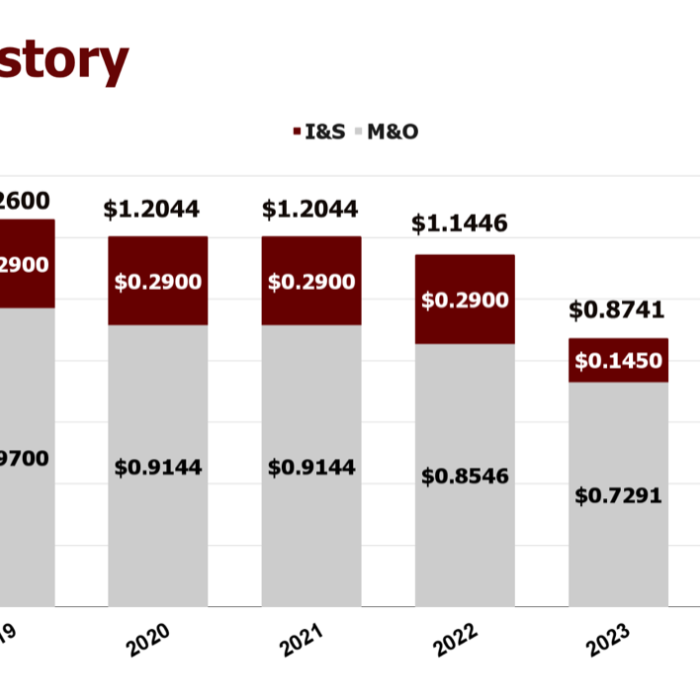 A graph from Fayetteville ISD showing the history of the property tax rate going back to 2018.
Fayetteville ISD will hold a special Voter Approval Tax Rate Election (VATRE) on Tuesday, Nov. 4.
If the proposition passes, the district says it will provide approximately $230,000 in additional state and local revenue each year. The district says the extra revenue will help it keep up with the rising cost of utilities and to keep offering competitive salaries.
The language on the ballot is quite confusing, however.
Here’s what it says: “THIS IS A PROPERTY TAX INCREASE. Ratifying the ad valorem tax rate for maintenance and operations of $0.655 per $100 taxable assessed valuation in Fayetteville Independent School District for the current year, a rate that will result in an increase of (-0.5%) percent in maintenance and operations tax revenue for the district for the current year as compared to the preceding year, which is an additional (-$14,949).”
State law requires the district to describe it as a tax increase. But due to a number of factors, taxpayers will see a savings regardless of whether or not it passes. The total tax rate for Fayetteville ISD will go down by 12 cents.
Fayetteville Superintendent Dr. Jeff Harvey spoke with the Record last week to explain what the district is asking of voters.
“Public school financing in Texas is complicated,” Harvey said.
That might be an understatement.
School finances are basically split into two pots: maintenance and operations (M&O) and interest and sinking (I&S). M&O funds are used for daily operations – teacher salaries, utility bills, supplies, etc. I&S funds are used to pay off debt such as bonds issued for the construction of new facilities. Voters must approve any bonds issued by the district. Fayetteville ISD last passed a bond in 2016.
Over the years the state has tried different ways to fairly fund public school districts while also protecting property owners from ever-increasing school taxes. On the one hand, the state uses “recapture” to redistribute what it considers “excess local revenue” from property-rich districts to property-poor districts. Fayetteville ISD is considered a property-rich district.
However, the Fayetteville ISD does not currently owe any recapture money to the state due to its large number of transfer students. State law allows districts to keep their “excess local revenue” to pay for educating transfer students who live outside the district.
On the other hand, if property values rise as they have in Fayetteville, state law requires the school district to “compress” their tax rate for maintenance and operations (M&O). Last year, Fayetteville ISD’s M&O tax rate was $0.7271 per $100. This year, due to compression, the highest tax rate the district could propose without voter approval is $0.6225.
However, a provision in state law allows districts to impose a higher M&O rate without voter approval during times of a declared disaster. Fayetteville ISD took advantage of this provision after Governor Greg Abbott included Fayette County in a disaster declaration related to Hurricane Beryl last year.
Accordingly, Harvey said the M&O tax rate will be $0.6555 per $100 this year whether or not voters approve Proposition A. If voters reject it, the three cents will come off the tax rate next year. If voters approve it, the three cents will remain as so-called “golden pennies” – yet another complicated component of Texas school financing.
State law allows school districts to designate up to eight cents of their property tax rate as golden pennies. These pennies are not subject to recapture or compression. Accordingly, school districts can count on the revenue from those pennies remaining in the district year after year.
Currently, Fayetteville ISD has designated five cents from their tax rate as golden pennies. Proposition A, if it passes, will provide the district with the maximum of eight.
“In order to get the extra three pennies, you have to have a voter approved tax rate election,” Harvey said.
Fayetteville ISD tried to do that in 2023. But at that time, it would have raised taxes for property owners. Voters ultimately rejected it.
“This year is really the anomaly because we have the constitutional amendments on the ballot, Proposition 11 and Proposition 13.”
Proposition 11 raises the exemption for people ages 65 and older from $10,000 to $40,000. Proposition 13 raises the homestead exemption from $100,000 to $140,000. Both amendments are expected to pass.
Coupled with that, Fayetteville ISD has lowered its I&S rate by paying off $1.4 million of the 2016 bond early. The I&S rate went from $0.1450 per $100 last year to $0.0967 per $100 in 2025.
That leaves a total proposed tax rate of $0.7517 per $100, which is 12 cents down from $0.8721 last year. The tax notices that Fayetteville ISD property owners recently received in the mail were calculated using the proposed exemptions, which are expected to pass.
And due to Fayetteville’s decision to include a threecent increase based on last year’s disaster declaration, the tax liability printed on the notice is the same it would be if Fayetteville voters pass the VATRE.
“And by doing it this way, everybody gets to see what their taxes will be with the three pennies,” Harvey said.
“I live in Fayetteville ISD boundaries,” Harvey added. “I can speak for myself. My personal taxes went down $341 for our school property tax from last year to this year.”
In a sense, Harvey said, Fayetteville ISD is asking voters to take three out of the nearly five cents in savings on the I&S side of the tax rate and transfer it to maintenance and operations.
“That is exactly what is going on,” Harvey said. “We’re saying, ‘Look, we’ve done a good job. We’ve paid down this debt. And we’re using some of our fund balance of the I&S to continue to pay it down. We’re saving five pennies on the I&S, and we’re just asking to move three pennies over to the M&O, and you’re still going to save money on your taxes.’” If the proposition passes, Harvey said he does not expect the district asking voters for any other tax increases in the foreseeable future. He said the district should not need any facility upgrades requiring a bond for many years. The last bond was passed in 2016 and it had been more than 30 years before that when the district last asked voters for a construction bond.
“We’ve been very fiscally responsible, and I don’t foresee that changing any time soon,” Harvey said. “We’re very proud of what we’ve got, and we want to make sure we take care of it.”
Election day voting takes place at the Fayetteville City Office, located at 202 West Main Street in Fayetteville.