


Bridge Stands The Test of Time – 100 Years
-
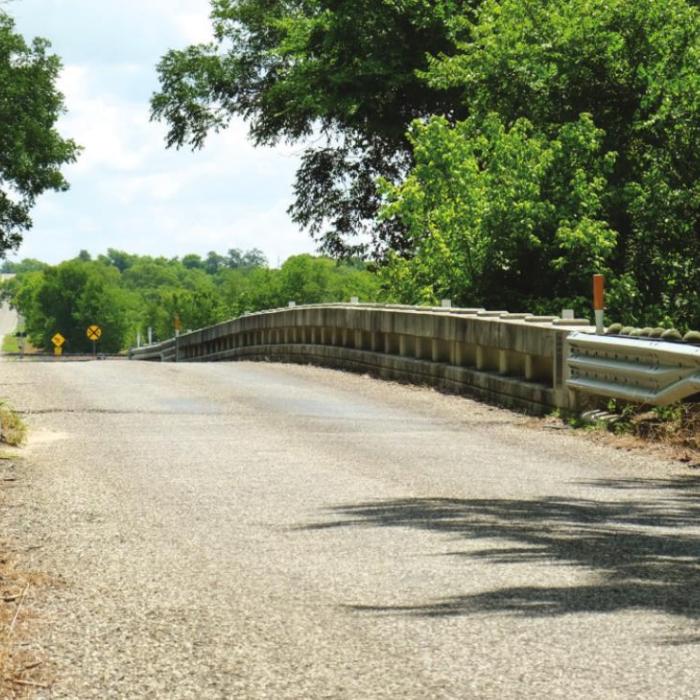 The bridge across the East Navidad River on FM 1579 was built 100 years ago as part of the Old Spanish Trail Highway, which later became US Hwy. 90. Photo by Andy Behlen
 -
 A plaque on the bridge crossing over the East Navidad River on FM 1579 still says “Built 1922 by The State of Texas and Fayette County.”
An oft-forgotten bridge in Fayette County turns 100 years old this year.
The crossing over the East Navidad River on FM 1579 doesn’t seem like much today. But when it was built in 1922, the bridge was part of one of the biggest trans-continental road projects in the nation at that point – The Old Spanish Trail (OST).
The OST was the highway that eventually became US Hwy. 90, stretching from St. Augustine, Florida to San Diego, California. The highway passed through Schulenburg and Flatonia in Fayette County. The section of FM 1579 between Schulenburg and Weimar was once part of this route. The Texas Department of Transportation rerouted Hwy. 90 north to its present location many years later.
Fayette County was in charge of building this bridge through a partnership with the State and business interests. The County advertised for bids in January 1922.
Also in January of that year, the County advertised bids to complete the 21 miles of road from the Gonzales County line to the Colorado County Line. Local contractor Lake Robertson won the bid to construct the East Navidad River Bridge at a cost of $27,000.
A railroad strike that year apparently delayed progress, but Robertson was able to complete the bridge by the end of the year. His laborers poured the main span around August and September. A Sept. 15 issue of the Schulenburg Sticker reported Robertson had 80 laborers employed and they worked in three-hour shifts.
The Sticker described a work camp that resembled a carnival. It said townspeople from Schulenburg would travel to the worksite to watch the large machines at work. Labor carried on until late in the evening and as late as midnight on at least one accession, according to the newspaper reports. The Sticker reported that Schulenburg butcher Otto Brauner barbecued seven calves to feed all the workmen on the day they completed the main span.
The December 1 issue of the Sticker reported that the bridge was complete and had opened that week.
TxDOT rehabilitated the bridge in 2015. Workers poured new concrete rails along the sides of the roadway. People traveling over the bridge never get to see the most beautiful part of the structure – the graceful concrete arches and sturdy pillars supporting the span that Lake Robertson designed a century ago. You can learn more about the OST by reading James Collett’s book, “The Old Spanish Trail Highway in Texas,” which will soon be available for purchase at the Fayette County Record Office.